

UCAS code: B19F
Start dates: September 2026
Full time: 4 Years, or 5 if a work placement is chosen
Part time: Up to 11 years
Location: Headington
School(s): School of Biological and Medical Sciences
Overview
The future of healthcare is driven by science and innovation, creating new opportunities to understand the human body and improve lives. Skilled medical scientists are in high demand to investigate disease, analyse data, and support advances in diagnosis and treatment.
Our Medical Sciences with a foundation year course starts with essential scientific knowledge and study skills to prepare you for degree-level learning. On successful completion, you’ll progress to the full degree, exploring areas such as human physiology, neuroscience, genetics, and disease processes.
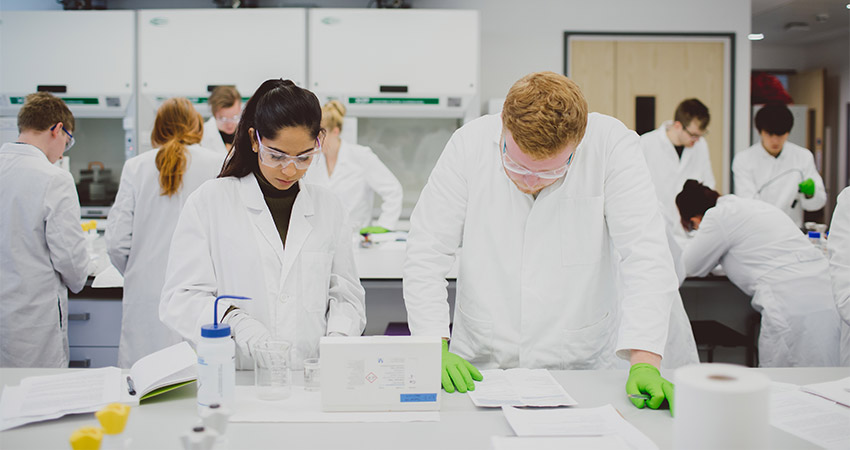
You’ll gain hands-on experience through laboratory work, developing key skills in lab techniques, data handling, computing, report writing, and presentations. With guest lectures from NHS professionals and opportunities for internships, you’ll build real-world experience.
Ready to turn curiosity into impact? Your journey in medical science starts here.
Why Oxford Brookes University?
-
Expert teaching
On your physiology and clinical modules, we use practising Clinical Scientists and Physician's to co-deliver your module learning, helping you build an understanding of how your growing knowledge and skills are used in professional settings.
-
Excellent grounding
Your degree provides you with a great foundation for careers in healthcare sciences and further professional study, including graduate-entry medicine and physician associate courses.
-
Perfect Preparation
Build essential study skills with an integrated foundation year. Gain academic confidence, improve critical thinking, and strengthen subject knowledge for your degree journey.
-
Strong industry links
Our links with industry mean many students go on to work for local hospitals and research institutions. We also regularly welcome guest lecturers from industry.
-
Research experience
You’ll work with our academics in research groups. You’ll explore subjects such as genetic damage induced by radiation and how the heart and lungs function.
-
Additional language modules
Our university-wide language programme is available to full-time undergraduate and postgraduate students on many of our courses, and can be taken as a credit on some courses.
-
Study abroad
You may be able to go on a European or international study exchange while you are at Brookes. Most exchanges take place in the second year. Although we will help as much as we can with your plans, ultimately you are responsible for organising and funding this study abroad.
Course details
Course structure
In your foundation year, you’ll study our Life Sciences Foundation to develop the academic skills and confidence needed for degree-level study.
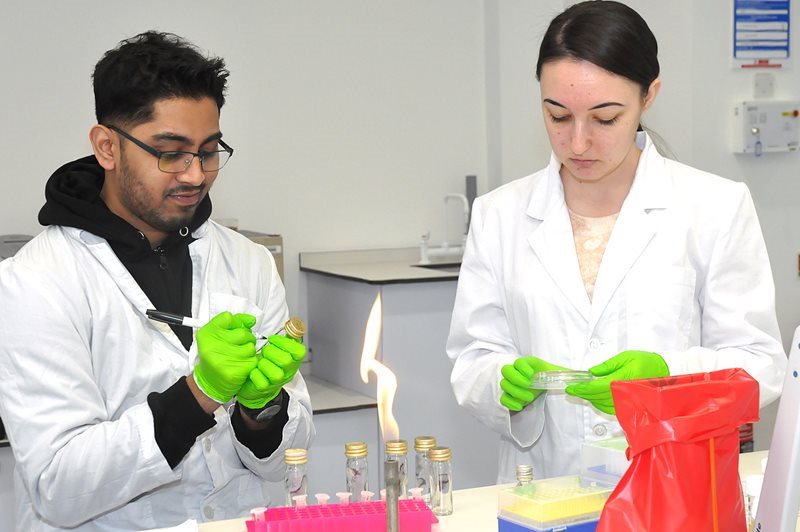
Throughout the course, you’ll gain hands-on experience using industry-standard lab equipment, with assessments including coursework, lab reports, presentations, and exams.
In the first year of your degree, you’ll explore the fundamentals of the human body in health and disease, studying cell biology and genetics, biochemistry, and human structure and function.
During your second year, you’ll deepen your knowledge with modules such as Integrated Physiology, Molecular Biology, and Biochemistry of Cell Function. You’ll also study genetics, research methods, and blood and transfusion science. Then you have the option to undertake a year-long work placement.
In your final year, you’ll study:
- neuroscience
- pathophysiology
- molecular biology of cancer
- human disease etc.
Also you'll complete an independent research project, collecting, analysing, and presenting data in a dissertation that showcases your skills.
Study modules
When you begin your degree programme, you can expect around nine hours of contact time per week. In addition to this, you should also anticipate a workload of 1,200 hours per year. Teaching usually takes place Monday to Friday, between 9.00am and 6.00pm.
Contact hours involve activities such as lectures, seminars, practicals, assessments, and academic advising sessions. These hours differ by year of study and typically increase significantly during placements or other types of work-based learning.
Please note: As our courses are reviewed regularly as part of our quality assurance framework, the modules you can choose from may vary from those shown here. The structure of the course may also mean some modules are not available to you.
Careers
You’ll be fully prepared for a career at the cutting edge of medical science. Alongside training you in theory and practice, we blend career development guidance and support into our modules, and these activities will help to prepare you for the world of professional work.
Many of our graduates have gone on to work in bioscience companies, diagnostic labs, diagnostic clinics, or to study further either through an MSc or a research-focused PhD studentship. While you’re with us, we’ll arm you with the skills you need to be successful in the workplace.
Oxford provides many excellent work opportunities. We have organisations like, Abbott Diabetes Care, Oxford Biomedica, Oxford Science Park, Milton Park and Abingdon Science Park right on our doorstep. Popular roles include:
- physician associate
- biochemist
- biotechnologist
- medical research scientist
- lab technician
- forensic scientist
- clinical research associate.
The BSc degree is well designed to provide a foundation for graduate-entry medical school or further academic training in the life and medical sciences.
Related courses
Entry requirements
Wherever possible we make our conditional offers using the UCAS Tariff. The combination of A-level grades listed here would be just one way of achieving the UCAS Tariff points for this course.
Standard offer
UCAS Tariff Points: 32
A Level: N/A
IB Points: N/A
BTEC: PP
Specific entry requirements
Please also see the University's general entry requirements.
English language requirements
Please see the University's standard English language requirements.
Pathways courses for international and EU students
If you do not meet the entry requirements for this degree, or if you would like more preparation before you start, you can take an international foundation course. Once you enrol, you will have a guaranteed pathway to this degree if you pass your foundation course with the required grades.
If you only need to meet the language requirements, you can take our pre-sessional English course. You will develop key language and study skills for academic success and you will not need to take an external language test to progress to your degree.
English requirements for visas
If you need a student visa to enter the UK you will need to meet the UK Visas and Immigration minimum language requirements as well as the University's requirements. Find out more about English language requirements.
Credit transfer
Many of our courses consider applications for entry part-way through the course for students who have credit from previous learning or relevant professional experience.
Find out more about transferring to Brookes. If you'd like to talk through your options, please contact our Admissions team.
Terms and conditions of enrolment
When you accept our offer, you agree to the Terms and Conditions of Enrolment. You should therefore read those conditions before accepting the offer.
International qualifications and equivalences
How to apply
Application process
Full time international applicants can also apply through UCAS
Tuition fees
Questions about fees?
Contact Student Finance on:
Tuition fees
Please note, tuition fees for Home students may increase in subsequent years both for new and continuing students in line with an inflationary amount determined by government. Oxford Brookes University intends to maintain its fees for new and returning Home students at the maximum permitted level.
For further information please see our tuition fees FAQs.
Tuition fees for International students may increase in subsequent years both for new and continuing students.
The following factors will be taken into account by the University when it is setting the annual fees: inflationary measures such as the retail price indices, projected increases in University costs, changes in the level of funding received from Government sources, admissions statistics and access considerations including the availability of student support.
How and when to pay
Tuition fee instalments for the semester are due by the Monday of week 1 of each semester. Students are not liable for full fees for that semester if they leave before week 4. If the leaving date is after week 4, full fees for the semester are payable.
- For information on payment methods please see our Make a Payment page.
- For information about refunds please visit our Refund policy page
Additional costs
Please be aware that some courses will involve some additional costs that are not covered by your fees. Specific additional costs for this course are detailed below.
You will need basic personal protection equipment for your laboratory practical classes. A lab coat costs around £25.
Optional costs
| Additional costs | Amount (£) |
|---|---|
It’s your responsibility to cover print / binding costs where coursework submission is required. Please note that a lot of the coursework is now submitted online. |
From £30 |
| You may choose to purchase books to support your studies. Many books on our reading lists are available via the Library, or can be purchased secondhand. | £20-60 per book |
Accommodation fees in Brookes Letting (most do not include bills) |
£107-301 per week |
Accommodation fees in university halls (bills included, excluding laundry costs) |
£139-248 per week |
Graduation costs include tickets, gowning and photography. Gowns are not compulsory but typically students do hire robes, starting at £41. |
Typically £0-200 |
Fines are payable on items returned late although we will give you 5 days to return an item before fines are payable. Find out more about how to borrow and return items. |
£1 per book |
|
Students are responsible for their own travel to and from university for classes with single bus fares in the UK currently capped at £3. Oxford Brookes has committed to offering heavily discounted bus travel for students for at least three years from July 2026 with further information on our Travel webpages. |
From £3 |
Funding your studies
Financial support and scholarships
Featured funding opportunities available for this course.
All financial support and scholarships
Information from Discover Uni
Full-time study
Part-time study
Programme changes:
On rare occasions we may need to make changes to our course programmes after they have been
published on the website. For more information, please visit our
changes to programmes page.