

Start dates: September 2026 / September 2027
Full time: MSc: 12 months, PGDip: 10 months, PGCert: 4 months
Part time: MSc: 24 months, PGDip: 20 months, PGCert: 8 months
Location: Headington
School(s): School of Sport, Nutrition and Allied Health Professions
Overview
Nutrition plays a vital role in health, wellbeing and disease prevention, making it one of the most important areas of science today. Whether you want to build on your existing knowledge, change career direction, or develop specialist expertise, our MSc Nutrition will help you develop the skills, confidence and scientific understanding to make an impact.
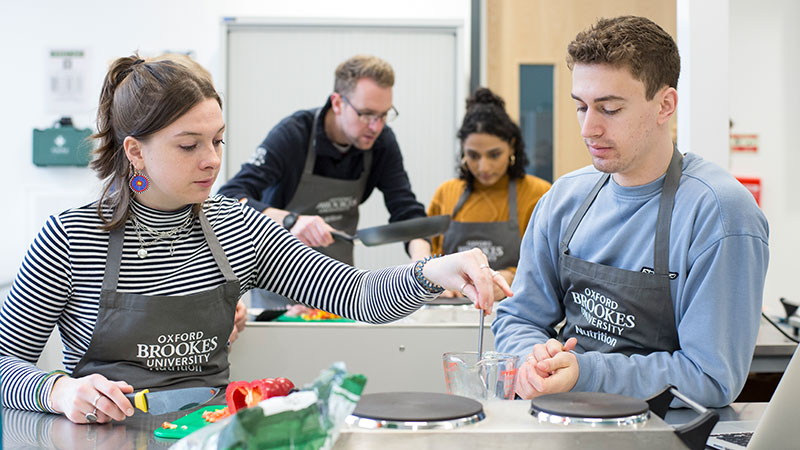
You'll explore nutrition from a range of perspectives, including public health, food science, physical activity and chronic disease. You'll develop practical skills through laboratory work, research projects and opportunities to engage with the Oxford Brookes Centre for Nutrition and Health.
We welcome students from a wide range of academic and professional backgrounds, including those who have not previously studied nutrition or a science subject (our Essentials of Human Nutrition short course will help you prepare). You'll learn from expert academics and active researchers in a supportive environment that encourages you to challenge yourself and achieve your best.
Why Oxford Brookes University?
-
Designed for diverse backgrounds
Whether you're a science graduate, career changer or returning to study, we'll help you build the knowledge and confidence to succeed.
-
Research-led learning
Learn from active researchers and engage with the Oxford Brookes Centre for Nutrition and Health and other professionals, gaining insight into the latest developments.
-
Beyond nutrition science
Develop expertise across nutrition, food science, public health and research methods, giving you a broad and versatile skill set.
-
Career-ready skills
Build practical, scientific and professional skills valued in nutrition, health, food industry, research and public health careers.
-
Develop professional confidence
Benefit from expert guidance in a supportive learning environment that encourages critical thinking, independence and professional growth.
-
Accreditation(s)
The course is accredited by the Association for Nutrition
Course details
Course structure
The MSc Nutrition can be studied full-time over one year or part-time over two years. To achieve the MSc you'll complete 180 credits, or you can complete fewer credits and exit with a PGDip or PGCert.
You'll develop knowledge and skills across nutrition, food science, public health, physical activity, health promotion and research methods. You'll also complete an independent research project, giving you the opportunity to explore an area of nutrition that aligns with your interests, career goals or future study plans.
You'll also have opportunities to build your experience, professional network and employability. You can get involved with research and community projects, make connections with organisations across the food, health and nutrition sectors, and attend our annual careers event to learn more about careers with many top nutrition employers.
Study modules
Our modules are designed for you to develop knowledge and skills across the key areas of nutrition practice, including nutritional science, food science, public health, behaviour change, health and wellbeing, and professional practice.
The MSc Nutrition is accredited by the Association for Nutrition (AfN) and has been mapped against the AfN core competencies required for professional practice. Students who successfully complete all compulsory modules and graduate with the MSc may be eligible to apply for direct entry onto the AfN Associate Nutritionist (ANutr) register.
Module content is reviewed regularly to ensure it reflects current research, industry developments and professional standards.
For the PGDip and PGCert awards, your module choices may be different. Please contact us for more details.
Please note: As our courses are reviewed regularly as part of our quality assurance framework, the modules you can choose from may vary from those shown here. The structure of the course may also mean some modules are not available to you.
Research
Our teaching is informed by research taking place within the Oxford Brookes Centre for Nutrition and Health, giving you insight into the most recent views about issues in nutrition and health today.
Our centre includes academics with a range of research interests and expertise, and this diversity allows for a multi-disciplinary research approach with significant clinical and public health impact. The role of nutrition in maintaining health and quality of life is of increasing public health importance. Our research actively engages with the most current and world-leading evidence base in nutrition science and policy.
You may also have opportunities to engage with this research through your independent research project. This allows you to investigate a topic that aligns with your interests, career ambitions or future study plans, while developing valuable research and analytical skills.

Careers
This course will prepare you for opportunities in the health, food and nutrition sectors. Career destinations could be:
- health promotion as food and health coordinators
- industry with food and drink manufacturers and retailers
- medical food companies
- food service providers
- government and policy to improve the health of the population
- research in universities, food companies or research institutes
- public health nutritionist
- global nutritionist.
Recent graduates have gone on to careers with organisations including the NHS, Médecins Sans Frontières, Coca-Cola, research laboratories and independent healthcare agencies.
The MSc can also provide a foundation for further professional training, including dietetics, or progression to doctoral study
Student profiles
Related courses
Entry requirements
Specific entry requirements
In order to successfully complete a postgraduate course, applicants are usually expected to have (or be about to attain) at least a second class honours degree in a related scientific subject from a recognised institution of higher education. If you do not have these academic qualifications, you could still be offered a place on this course if you can show evidence of the potential to succeed based on professional and/or related experiences.
If you do not have a first degree in a scientific subject, you may undertake the Essentials of Human Nutrition short course prior to applying for the full MSc Nutrition. This will give you the scientific basis you need to be able to succeed.
Please also see the University's general entry requirements.
English language requirements
For applicants whose first language is not English, an Academic IELTS score of 6.5 (with 6.5 in Reading and Writing, and 6.0 in Listening and Speaking) is required.
Please also see the University's standard English language requirements.
Pathways courses for international and EU students
We offer a range of courses to help you meet the entry requirements for your postgraduate course and also familiarise you with university life in the UK.
Take a Pre-Master's course to develop your subject knowledge, study skills and academic language level in preparation for your master's course.
If you need to improve your English language, we offer pre-sessional English language courses to help you meet the English language requirements of your chosen master’s course.
English requirements for visas
If you need a student visa to enter the UK you will need to meet the UK Visas and Immigration minimum language requirements as well as the University's requirements. Find out more about English language requirements.
Terms and conditions of enrolment
When you accept our offer, you agree to the Terms and Conditions of Enrolment. You should therefore read those conditions before accepting the offer.
International qualifications and equivalences
How to apply
Application process
Tuition fees
Questions about fees?
Contact Student Finance on:
Tuition fees
The following factors will be taken into account by the University when it is setting the annual fees: inflationary measures such as the retail price indices, projected increases in University costs, changes in the level of funding received from Government sources, admissions statistics and access considerations including the availability of student support.
How and when to pay
Tuition fee instalments for the semester are due by the Monday of week 1 of each semester. Students are not liable for full fees for that semester if they leave before week 4. If the leaving date is after week 4, full fees for the semester are payable.
- For information on payment methods please see our Make a Payment page.
- For information about refunds please visit our Refund policy page
Additional costs
Please be aware that some courses will involve some additional costs that are not covered by your fees. Specific additional costs for this course are detailed below.
Compulsory costs
| Additional costs | Amount (£) |
|---|---|
| All students are required to have a lab coat. | £25 |
Optional costs
| Additional costs | Amount (£) |
|---|---|
It’s your responsibility to cover print / binding costs where coursework submission is required. Please note that a lot of the coursework is now submitted online. |
From £30 |
| You may choose to purchase books to support your studies. Many books on our reading lists are available via the Library, or can be purchased secondhand. | £20-60 per book |
Accommodation fees in Brookes Letting (most do not include bills) |
£107-301 per week |
Accommodation fees in university halls (bills included, excluding laundry costs) |
£139-248 per week |
Graduation costs include tickets, gowning and photography. Gowns are not compulsory but typically students do hire robes, starting at £41. |
Typically £0-200 |
Fines are payable on items returned late although we will give you 5 days to return an item before fines are payable. Find out more about how to borrow and return items. |
£1 per book |
|
Students are responsible for their own travel to and from university for classes with single bus fares in the UK currently capped at £3. Oxford Brookes has committed to offering heavily discounted bus travel for students for at least three years from July 2026 with further information on our Travel webpages. |
From £3 |
Funding your studies
Financial support and scholarships
Featured funding opportunities available for this course.
All financial support and scholarships
Programme changes:
On rare occasions we may need to make changes to our course programmes after they have been
published on the website. For more information, please visit our
changes to programmes page.