

Occupational Therapy

BSc (Hons)

UCAS code: B920

Start dates: September 2026

Full time: 3 years, maximum 5 years

Location: Headington, Headington (Marston Road site)

School(s): School of Sport, Nutrition and Allied Health Professions

Find a course

Expand

Overview

On your Occupational Therapy course, you'll gain an understanding of how to help people overcome daily challenges. With your vision, you'll be able to help people achieve and progress in their everyday lives, and help them improve their quality of life.

You’ll meet people from around the world who share your values and can broaden your perspective on looking after others. You’ll also take part in a supervised practice placement each year. This gives you opportunities to apply everything you learn on the course in a professional context. Placements take place in or outside of the Oxford area, in professional settings, giving you the chance to learn and practice on location.

This degree is approved by the Health and Care Professions Council. It is accredited by the Royal College of Occupational Therapists. Successful completion allows you to register as an occupational therapist in the UK. So you can be confident you’ll be learning the right skills for a lifelong and rewarding career.

Order a Prospectus Ask a question Attend an open day or webinar

Why Oxford Brookes University?

  • Personalised support

    By joining a close-knit community, you’ll have easy access to help and guidance.

  • Diverse perspectives

    You’ll meet people from all over the world on this course, and learn from their perspectives and experiences.

  • Community spirit

    Engage and collaborate with the Oxford Brookes Occupational Therapy Society to enhance your learning.

  • Practical experience

    Hone your skills by practising occupational therapy in simulated learning environments.

  • Top 20 in the UK

    Occupational Therapy is ranked 15th in the Guardian Health Professions subject league ranking 2025.

  • Additional language modules

    Our university-wide language programme is available to full-time undergraduate and postgraduate students on many of our courses, and can be taken as a credit on some courses.

  • Accreditation(s)

    Approved by the Health and Care Professions Council (HCPC) and accredited by the Royal College of Occupational Therapists (RCOT)
    • Royal College of Occupational Therapists

Course details

Course structure

In your first year you’ll gain the understanding of humans as occupational beings and workplace values-based professional behaviours. Subjects include anatomy, physiology and pathology of medical conditions or impairments and key theoretical concepts for occupational therapy and its process.

In your second year, three modules continue with a part time placement. Theory is integrated into practice with alternative perspectives informing local and global occupational therapy practice. You’ll develop skills for creative and alternative problem solving for practice with diverse population groups, whilst collaborating with various professional colleagues.

In your final year you’ll develop advanced skills for delivering occupational therapy with and for complex populations. You’ll explore innovative occupational therapy that contributes to society and you’ll further develop your professional identity, delivering the roles and expectations of HCPC registered, future occupational therapists.
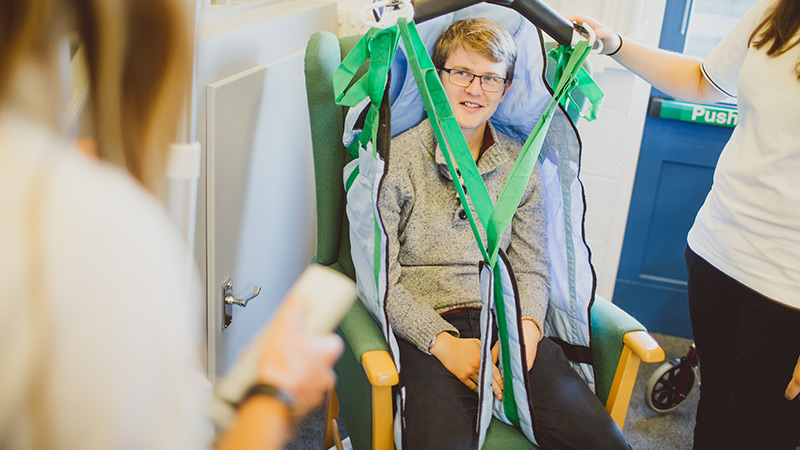
Occupational Therapy students in skills practice

Learning and teaching

Learning and teaching occur through problem-based learning opportunities, simulation, peer-supported learning and feedback, case-based methods, and open enquiry. You’ll take part in lectures, seminars, workshops, in-class discussions, individual and group tutorial opportunities, dissertation supervision and academic advisor capstone support. 

Active learning methods are embraced, and you must plan for dedicated time outside of the classroom for reading, preparation tasks and self-directed learning. 

Some of your learning is shared with other health and social care students, including: 

  • nursing (adult, children and mental health)
  • midwifery
  • paramedic science 
  • physiotherapy
  • social work.

The majority of the modules are taught on campus. The exception to this relates to modules that are delivered simultaneously with the first and third practice placement experiences. These modules are taught using a hybrid approach, in-person and online.

Assessment

Modules are assessed using a range of coursework styles enabling you to engage proactively with your own professional development and learning needs.

You’ll engage with a range of assessment tasks including: 

  • reflective journals
  • essays
  • case study reports
  • clinical workbooks
  • annotated bibliographies
  • critically appraised topic
  • academic posters
  • dissertations
  • multiple choice exams
  • presentations
  • professional service reports
  • Infographics
  • position papers
  • strategy/campaign proposals
  • portfolio and patchwork assessments.

This ensures the development of your academic and professional literacies that are essential in the workplace. Clear assessment criteria are used to grade your work, with opportunities in each module to discuss how the assessment criteria are used to grade your work and its relationship with the module learning outcomes.

Study modules

Teaching for this course takes place Face to Face and you can expect around 18 hours of contact time per week. In addition to this, you should also anticipate a workload of 1,200 hours per year. Teaching usually takes place Monday to Friday, between 9.00am and 6.00pm.

Contact hours involve activities such as lectures, seminars, practicals, assessments, and academic advising sessions. These hours differ by year of study and typically increase significantly during placements or other types of work-based learning.

Year 1

Compulsory modules

  • Navigating professional identity and communication

    This module helps you prepare to be ready for commencing your role as occupational therapist professional learners in real-life service contexts, helping individuals. Also you'll have the opportunity to explore the principles of, and develop skills in:

    • communication
    • behaviour
    • ethics and reflective practice. 

    You'll get to to understand the foundations of the occupational therapy process for practice, and its alignment with supporting people as occupational beings.

  • Applying Occupational Therapy Evidence

    This module will run at the same time as you're participating in a part time practice placement learning experience.

    You'll explore the research evidence that underpinns the centrality of the relationship between a person and their occupations and environments in support of meaningful occupation. Founded on pre-existing graduate research knowledge, you'll identify quality information, and be guided to demonstrate critical consideration of different forms of research, and you'll explore the ethical principles underlying evidence-based occupational therapy practice.

  • Meaningful occupation and the human body

    This module will run at the same time as you're participating in a part time practice placement learning experience.

    This format provides you with opportunities for practical application of your learning that you've gained from the start of your course. You'll explore relationships between body structures and their functions and how these impact on humans’ ability to do the things they want and need to do, with or without assistive technology. You'll be introduced to a range of theoretical perspectives to support your ability to engage with graduate level analysis of factors that impact on human function, and to develop your skills of clinical decision making.

  • Developing Values Based Professionalism

    You'll develop a critical understanding of your professional identity, helping you to progress a personalised way of being and relating in the health and social care environment. You'll learn about the delivery of effective health care, aligned with our governing bodies’ standards of practice, within a framework of client centeredness and teamwork. 

    Through evaluation and reflective opportunities, you'll take a deep exploration of the concepts of professional domains of concerns - more specifically:

    • codes of practice
    • standards of conduct
    • ethics
    • allyship
    • equality
    • diversity and inclusion.  

    You'll investigate the clinical reasoning process required to practice with sound judgement, honesty, openness and integrity, taking an academic critical approach.

  • Occupational Participation: Mind and Body

    You'll explore medical conditions and impairments impacting body structures and functions, and the importance of core occupational therapy skills in adapting activity in accordance with person/environment/occupation factors. You'll use a problem based learning approach, through teamwork and collaborative working you'll identify and share knowledge about health and social needs, and apply shared learning to case based scenarios and clinical triggers. 

  • Occupational therapy process in practice

    You'll gain in-depth understanding of occupational therapy-specific theories and models, and you'll develop skills in using them to guide the implementation of a theoretically founded, professionally-reasoned occupational therapy process. 

    On this module you'll all discuss the centrality of cultural humility, diversity and planetary health to the delivery of occupational therapy services.

Year 2

Compulsory modules

  • Occupational Therapists as Leaders

    You'll focus on leadership and change management in health, social care and non-traditional settings. Building your understanding of your personal role as a leader, and how you can facilitate quality improvement for efficient and sustainable service delivery. You'll proactively develop and deliver evidence-based services in an evolving world.

  • Occupational science: Foundations for therapy

    Through analysis of occupational science concepts, this module will help you develop an understanding of how people engage in daily activities and the impact of these activities on their health and well-being. TYou'll focus on the social and cultural influences on occupation, using intersectionality to understand the challenges faced by individuals, connecting therapeutic occupation to improving health at individual, community, and global levels, and questioning assumptions about health and environment. 

  • Occupational therapists as researchers

    Develop your ability to critically evaluate and apply peer-reviewed research in your delivery of occupational therapy practice. You'll gain a comprehensive understanding of research ethics and methodologies and you'll explore principles of evidence-based practice, assessing factors informing research quality, trustworthiness, and applicability. The module will help you to make clinical decisions that are rigorous, reliable and evidence-informed, and will underpin your ability to be research-active occupational therapists.

  • Collaborative Practices in Health Care

    This module will introduce you to the interdisciplinary approach taken in a wide variety of health care practices. You’ll examine the advantages and disadvantages of different approaches, and reflect on the learning outcomes of these.

    You’ll also participate in a series of enquiry-based learning activities focussed on practice-based scenarios designed to simulate working together as health care professionals in the real world. You’ll investigate the main challenges and factors influencing collaboration in health practices and use a person-centred approach to planning interventions in multi-disciplinary care.

  • Occupational therapy for the global world

    On this module you'll gain an understanding of how occupational therapy professional philosophies change over time, and the influences of such changes on professional models, frames of reference and approaches. 

    You'll explore meaningful activities from the perspectives of people from different backgrounds, considering intersectionality, cultural drivers and environmental sustainability, and you'll interrogate their personal responsibilities towards the delivery of appropriate occupational therapy practice for all service users.

  • Doing occupational therapy: Long term conditions

    Foster your skills for the development and delivery of theoretically-founded, client-centred occupational therapy for individuals with neurological or physical difficulties. 

    You'll demonstrate effective use of occupational therapy models, while critically evaluating appropriate frames of reference and therapeutic approaches when working with individuals with long term conditions.

  • Doing occupational therapy: Mental health

    On this module you'll progress your skills for delivery of theoretically-founded, client-centred occupational therapy for individuals experiencing mental health challenges. 

    In relation to various mental illnesses, you'll consider body structures and functions, sensory processes, stress and trauma responses and their impact upon occupational participation. You'll be involved in group work and therapeutic use of self in relation to a critical application of relevant frames of reference and therapeutic approaches, while demonstrating consideration of the social determinants of health and wellbeing.

Year 3

Compulsory modules

  • Occupational Therapy Dissertation

    The dissertation module will help you to gain experience in identifying appropriate practice-based research gaps, and implementing suitable strategies for addressing these. You'll have the opportunity to further progress your understanding of ethics and critical appraisal, and apply your learning related to a wide range of research methods and approaches. 

    You'll be able to demonstrate abilities of contextualisation of research findings in relation to the health and social care context in general, and occupational therapy practice in particular, with specific consideration of your personal obligations in this regard.

  • Doing occupational therapy: Older adults

    You'll gain enhanced knowledge related to supporting the occupational participation of older adult populations. 

    And you'll apply your knowledge and understanding of relevant anatomy, physiology and pathology in relation to lifespan development theory. You'll explore the cultural and societal influences on the occupational participation of older adults. alongwith with factors informing the delivery of appropriate, sustainable and ethical occupational therapy services for this population group. You'll focus on theory-based professional practice, and explore a range of therapeutic approaches for working with this population group.

  • Doing occupational therapy: Children, young people and families

    You'll gain enhanced knowledge related to supporting the occupational participation of paediatric populations, and interrogate the practical and ethical considerations related to balancing client-centredness with family-centredness. 

    Developing your knowledge and understanding of relevant anatomy, physiology and pathology in relation to early lifespan development theory. You'll explore the cultural and societal influences on the occupational participation of children and young people, along with with factors informing the delivery of appropriate, sustainable and ethical occupational therapy services for this population group.

  • Changing the status quo: Occupational therapists of the future

    Appraise the occupational therapist’s role for future practice in uncertain contexts, with consideration of the potential contribution of individual and group-based occupational therapy services. 

    The relationship between issues of occupational justice and human rights in relation to public policy will be analysed and you'll interrogate the contribution of occupational therapists as advocates within a global profession, in ever-changing, complex health, social care and non-traditional contexts.

  • Capstone project: Culmination, Integration and Reflection

    This module is submitted in the final semester of studies, however, it is launched to you during your first semester/first taught module. 

    This module bridges the gap between academic theory and professional practice, you'll take responsibility for developing a professional portfolio from the outset of your programme. During this semester, you'll have the opportunity to demonstrate high-level consolidation of all components of your learning in relation to your integrated professional identity, which will enable you to successfully deliver a role as future occupational therapist. 

    At this point you'll be aware of the ethical, professional and behavioural expectations of HCPC registered occupational therapists. Through consistent effort towards a long-term task with direct links to employability, you'll develop high level post-graduate skills related to integration and application of knowledge, portfolio building, project and time-management and communication techniques.

Work placements

Compulsory modules

  • Practice Placement 1: Commencing Practice

    This 7 week, part-time practice placement module takes place in the latter half of the semester, and is designed to run simultaneously with two taught modules and, where feasible, using a 2:1 supervision model. This format enables you to have opportunities for practical application of your learning from the start of your programme, and you'll develop the resilience necessary for commencing a professional role. 

    This practice placement module provides you with an opportunity to begin recognising key occupational therapy concepts, and to proactively develop and apply professional values, skills and knowledge in a professional practice context. 

    Developing your skills in observation, reflection, evidence-based practice and engagement in occupational therapy practice, and demonstrating professional behaviour through interaction and professional communication with team members and contribute to occupational therapy practice with service users.

  • Practice Placement 2: Expanding Practice

    This practice placement module provides you with an opportunity to further develop your occupational therapy professional identity, through increased autonomy within a professional practice setting that is likely to differ from your first professional practice experience. 

    By this stage, you've had extended opportunities to develop your learning related to all of the threshold concepts of the occupational therapy programme. This practice placement module is your opportunity to build on your previous placement experience, further applying your increasing skills and knowledge base, while continuing to integrate your learning across all modules you have completed so far.

  • Practice Placement 3: Contemporary Innovative Practice

    This placement will prepare and get you ready for practice across a wide range of contemporary, non-traditional settings. 

    During this 9 week, part-time practice placement module, you'll further develop your knowledge, skills, and confidence to effectively apply occupational therapy principles and practice within a non-traditional setting, fostering creativity, adaptability, and a broader understanding of the role of occupational therapy in diverse contexts. 

    You'll be supported through your transition from guided to self-directed practice, self-evaluation and identification of your own development goals with an emphasis on inter professional working.

  • Practice Placement 4: Consolidating Practice

    You'll be prepared for the transition into qualified occupational therapy roles, by providing opportunities for you to consolidate and apply all of your occupational therapy learning, experience, skills and understanding to date. 

    This 12 week, full-time practice placement module is designed to support your final university-based Capstone module, which requires you to reflect on your achievements and learning from each stage of your occupational therapy course, in the process of solidifying you professional identity. 

    You'll be supported to build on your previous practice placement experience and you'll take a greater autonomy over the implementation of occupational therapy practice appropriate to the clinical setting.

Please note: As our courses are reviewed regularly as part of our quality assurance framework, the modules you can choose from may vary from those shown here. The structure of the course may also mean some modules are not available to you.

Careers

You’ll have the opportunity to get involved with different groups and communities. This will help you develop skills useful in your occupational therapy career. This includes communication, research, and collaboration with sector professionals. You’ll graduate with the knowledge and skills to add real value to the role of occupational therapy.

You’ll find you can work in any field where an occupational therapist is needed. Our graduates have secured employment across various sectors, including social care, charities, and in policy development.

Entry requirements

Wherever possible we make our conditional offers using the UCAS Tariff. The combination of A-level grades listed here would be just one way of achieving the UCAS Tariff points for this course.

Standard offer

UCAS Tariff Points: 112

A Level: BBC

IB Points: 27

BTEC: DMM

Contextual offer

UCAS Tariff Points: 88

A Level: CCD

IB Points: 24

BTEC: MMM

Further offer details

The following are intended to give you a general guide to the attainment levels we expect for this course:

Access to Higher Education Diploma: to include 12 Level 3 credits in Biology/Human Biology. English and maths level 2 credits will no longer be accepted as GCSE equivalences.

Mature students are welcome to apply but will have to show evidence of recent academic study at A-level standard or above in the last three years. They will also have to have GCSE English grade 5 and Mathematics at Grade 4 qualification, or equivalent.

International qualifications and equivalences

Tuition fees

Please see the fees note
Home (UK) full time
£9,790

International full time
£19,700

Home (UK) full time
£10,050

International full time
£20,800

Questions about fees?

Contact Student Finance on:

Tuition fees

2026 / 27
Home (UK) full time
£9,790

International full time
£19,700

2027 / 28
Home (UK) full time
£10,050

International full time
£20,800

Questions about fees?

Contact Student Finance on:

+44 (0)1865 534400

financefees@brookes.ac.uk

Please note, tuition fees for Home students may increase in subsequent years both for new and continuing students in line with an inflationary amount determined by government. Oxford Brookes University intends to maintain its fees for new and returning Home students at the maximum permitted level.

For further information please see our tuition fees FAQs.

Tuition fees for International students may increase in subsequent years both for new and continuing students.

The following factors will be taken into account by the University when it is setting the annual fees: inflationary measures such as the retail price indices, projected increases in University costs, changes in the level of funding received from Government sources, admissions statistics and access considerations including the availability of student support. 

How and when to pay

Tuition fee instalments for the semester are due by the Monday of week 1 of each semester. Students are not liable for full fees for that semester if they leave before week 4. If the leaving date is after week 4, full fees for the semester are payable.

  • For information on payment methods please see our Make a Payment page.
  • For information about refunds please visit our Refund policy page

Financial support and scholarships

All eligible Occupational Therapy students on courses from September 2020 (new and continuing) will receive a payment of at least £5,000 a year which they will not need to pay back. For more information please visit NHS Learning Support Fund (LSF).

For general sources of financial support, see our Fees and funding pages.

Additional costs

Please be aware that some courses will involve some additional costs that are not covered by your fees. Specific additional costs for this course are detailed below.

Placement costs

There are costs that need to be paid for by students in travelling to and from practice placement and/or potential accommodation costs (a minority of students require additional accommodation for placement(s) during the course). Currently these can be as much as £1,500 per placement for accommodation and/or travel but will depend on location and type of placement. Eligible home students will be able to claim reimbursement of these additional placement costs but will need the money to pay upfront.  Currently, the average travel cost per placement is £300 and for placements that require accommodation the average cost per placement is £800. There are 3 placements during the course (but more may be required if students are obliged to re-take with potential resulting additional costs).

Student membership of the Royal College of Occupational Therapists (RCOT) is mandatory for this course. Student membership costs £61.51 per year (but is subject to annual increases as per the RCOT). The Membership Period runs from 1 October to 30 September in each year;  if you become a Member in the middle of the Membership Period, the Fee will be pro-rated accordingly (to include the month of joining). Membership includes professional indemnity insurance.


Information from Discover Uni

Full-time study

Programme changes:
On rare occasions we may need to make changes to our course programmes after they have been published on the website. For more information, please visit our changes to programmes page.