

We Walk in the Way of the Dragon
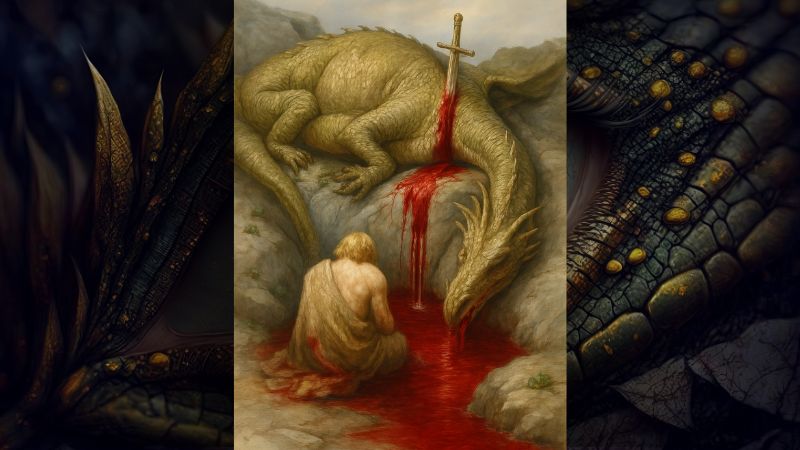
Rethinking humanity through myth and posthumanism
They hoard treasure, breathe fire, and are often destined to be slain. But what if dragons aren’t the monsters of legend, but mirrors held up to ourselves?
In the latest episode of Oxford Brookes Unscripted, PhD researcher Kam Zeb invites listeners to see dragons not as beasts to be conquered, but as philosophical companions in our search to understand what it truly means to be human. Their research - fusing literary analysis with posthumanist theory - challenges the centuries-old idea of human exceptionalism through the lens of mid-19th to early 20th century literature.
“Dragons have existed in almost every culture throughout time,” Kam explains. “They may not have biological reality, but their imaginative reality is undeniable - and incredibly powerful.”
Their work spans everything from Norse sagas to Japanese philosophy, Victorian children’s stories to modern ecological crises. At its core is a compelling argument: dragons are shape-shifting metaphors that help us question the human-centric worldview we’ve long inherited. In posthumanist terms, dragons become “prophets of the earth” - figures who collapse the boundaries between nature and culture, machine and body, myth and material.
Take Siegfried, for example, the dragon-slayer of Germanic legend who bathes in his victim’s blood and becomes nearly invincible - except for the one spot a leaf touches his back. Or the reluctant dragon of Kenneth Grahame’s tale, a poetry-loving creature who wants nothing to do with the violent role he’s been cast in. In both stories, Kam sees a deeper narrative: “These are tales about transformation, about refusing the roles tradition gives us - and about reconnecting with something ancient, elemental, and nonhuman.”
At a time when climate change, AI, and mass extinction are forcing urgent rethinks of our place in the world, Kam believes dragons may offer unexpected guidance. Drawing on theories from thinkers like Rosi Braidotti and Tim Winter, they propose that dragons can act as a gateway into new modes of being - ways of living that are less hierarchical, more connected, and rooted in mutual care with the earth.
And it’s not just metaphor. Kam references studies into animal communication, Indigenous cosmologies, and early religious philosophies that attribute intelligence, agency, and even spiritual capacity to non-human beings. In this world, dragons become a composite figure - part lizard, part bird, part machine, part divine - who symbolises the complexity of the planet itself.
“We’ve long used dragons to define the limits of human identity,” they say. “But what happens if we stop slaying them - and start listening to them instead?”
Their answer is as much about ethics as it is about literature. From Victorian anxieties about evolution and empire to today’s debates over artificial intelligence, Kam argues that the dragon endures precisely because it refuses to be pinned down. “Dragons are the ultimate shapeshifters. They exist in stories as flexible, fluid beings - just like our own identities could be, if we allowed them to be.”
In an age where the dominant narrative still places humanity at the centre of everything, Kam Zeb’s work is a timely reminder: the stories we tell about monsters often say more about ourselves than we realise.
And perhaps the first step to imagining a different kind of future is to stop being the hero - and start being the dragon.