

Embodied ancestor or harbinger of bad luck? Study reveals new insights into aye-ayes
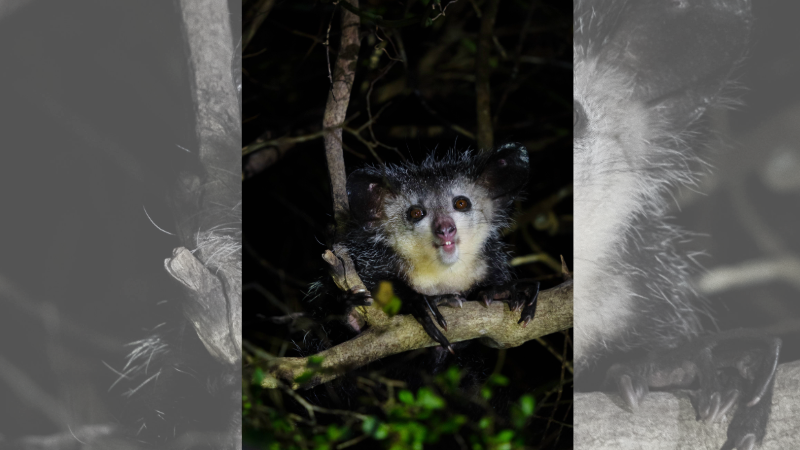
An international team of researchers led by Oxford Brookes University experts has challenged long-standing stereotypes about the traditions surrounding the aye-aye, an endangered lemur native to Madagascar.
The aye-aye is the world’s largest nocturnal primate, recognised by its continuously growing front teeth, large ears, and an elongated, flexible middle finger used for foraging. These unusual traits not only make it one of the most specialised primates, but also underpin its enduring prominence in Malagasy culture.
The study, published in the ‘International Journal of Primatology’, was conducted by a multinational team of primatologists and conservationists. Their research reveals that beliefs and practices linked to the aye-aye vary widely across eastern Madagascar, ranging from associations with misfortune and evil spirits to respectful mortuary traditions akin to human funerals.
Moving beyond the “demonic animal” stereotype
For decades, the aye-aye has been portrayed in conservation and popular narratives as a “demonic” animal feared and killed by rural communities. This study paints a far more complex picture.
Drawing on more than 200 interviews across three regions of eastern Madagascar, the researchers documented a spectrum of community practices: from rituals in which the animal is killed and displayed to appease its spirit, to funerals reflecting beliefs that the aye-aye embodies the spirit of an ancestor.
Lead author Alessio Anania, Research Fellow at Oxford Brookes University, explained: “Professor Giuseppe Donati and I realised with surprise that both our teams had independently recorded funeral practices dedicated to the aye-aye in two different areas of Madagascar. We understood it was time to take stock of the wider cultural imagination surrounding this species, moving beyond the popular narrative of the ‘demonic animal’ persecuted by local communities.”
The research highlights that these beliefs are deeply rooted in Madagascar’s animistic religious system, where animals such as aye-ayes, leaf-tail geckos, and chameleons may be perceived as vessels of spirits capable of vengeance.
Delaïd Rasamisoa, from conservation charity Wildlife Madagascar, added: “In Madagascar, wildlife can be seen as vessels of spirits, sometimes evil and vengeful, sometimes ancestral. Legends provide narrative justification for these beliefs, and practices, whether ritual killing or respectful funerals, directly reflect them. It is crucial to integrate this dimension into conservation and education programmes to maximise the chance they can be positively received by local communities. Without a deep consideration of the local spiritual system, conservation can be ineffective.”
Implications for conservation
The aye-aye is commonly feared as a harbinger of bad luck across eastern Madagascar. In some communities in the north, killing the animal is believed necessary to protect the village from spiritual harm. In others, the aye-aye is revered and respected as an ancestral king, and therefore taboo.
Dr Timothy Eppley, Chief Conservation Officer for Wildlife Madagascar, explained “We need to use caution against oversimplifying or manipulating cultural narratives for conservation purposes. Efforts such as imposing new taboos or promoting beliefs that killing the aye-aye brings misfortune can backfire, reinforcing fear or fuelling conflict between conservationists and local communities.”
A call for cultural sensitivity
Professor Donati, Professor in Biological Anthropology at Oxford Brookes University, concluded: “Successful conservation must adopt a context-sensitive approach, recognising the deep spiritual significance of animals in Malagasy traditions. Only by respecting and working within these cultural frameworks can initiatives hope to protect the Endangered aye-aye and other threatened species.”
Authors of the paper: Alessio Anania (Oxford Brookes University), Fiona Besnard (Oxford Brookes University), Delaïd C. Rasamisoa (Wildlife Madagascar), Erito Andriantsitoherina (L’Homme et l’Environnement), Jean Fidèle Mosa (ASITY Madagascar), Marco Campera (Oxford Brookes University), Megan Phelps (Oxford Brookes University), Dean Gibson (San Diego Zoo Wildlife Alliance), Timothy M. Eppley (Wildlife Madagascar), Giuseppe Donati (Oxford Brookes University).