

Basking sharks and soundscapes - conservation Students Shortlisted for Award
One million species currently face extinction, yet we are still uncovering secrets of giants like the basking shark and the complex 'soundscapes' of the tropics. The work of the upcoming generation of ecologists is crucial in protecting Earth’s diversity.
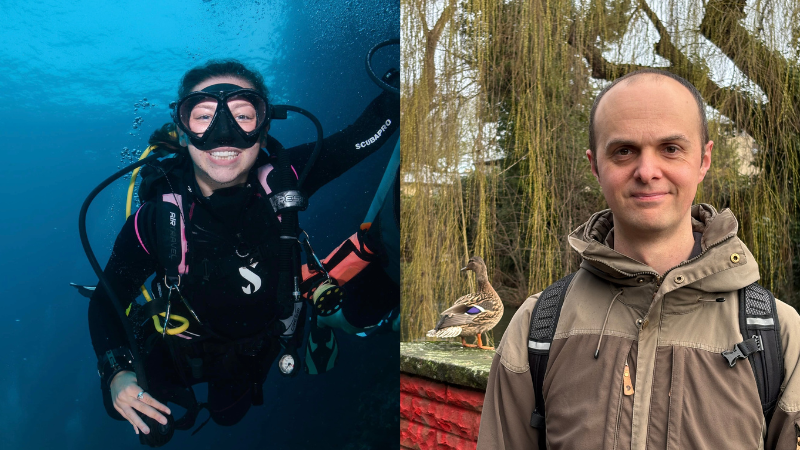
Two standout graduates from Oxford Brookes University are one of two to be shortlisted for a 2026 CIEEM Student Award, marking a significant achievement in conservation and environmental management. Oxford Brookes has achieved a rare double nomination, securing spots in both the postgraduate and the newly introduced undergraduate categories.
Novel analysis of over 79,000 Basking Shark Sightings
In the undergraduate category, Sasha King (BSc Biodiversity and Wildlife Conservation graduate) has addressed a major knowledge gap regarding migration of basking sharks - the world's second largest fish. Basking sharks are known to travel extensively through temperate waters during seasonal migrations, however scientists have long struggled to understand what actually drives their movements over long periods of time and across such vast areas.
Sasha pioneered a first-of-its-kind study by combining a staggering 79,338 citizen science sightings (1987–2024) with data of zooplankton numbers (their primary food source). By comparing these massive datasets, she identified that basking sharks are arriving earlier and staying longer in UK and Irish waters, proving that prey availability (access to zooplankton)—not just seasonal timing—is the primary driver of their movement.
Sasha’s results are important for informing conservation efforts, particularly in light of historical overfishing and the role of Marine Protected Areas in helping basking shark populations recover.
Sasha explains: “My research uncovered the regional and seasonal distribution patterns for a large and relatively elusive shark species through analysing datasets combined from multiple organisations to increase visibility. This has allowed for further understanding into important areas and timings for basking sharks, aiding in promoting conservation management strategies.”
Using the beat of the rainforest to assess diversity
To judge a forest’s health, scientists traditionally rely on physical checklists, such as measuring trees and soil or counting specific species like birds. Adam Ixer, MSc Conservation Ecology graduate and the postgraduate award finalist, investigated a more modern approach: using the "soundscape"—the total collection of sounds in an environment—to assess biodiversity in West African rainforests.
By analyzing habitat data, satellite imagery, and five specific audio measurements, Adam found that soundscapes reveal ecological details that physical surveys often miss.
While it is easy to assume more birds create a more varied soundscape, Adam’s research found the opposite, forests with fewer bird species have more complex soundscapes. His study also revealed distinct acoustic differences between community forests and national parks, with the latter producing soundscapes with more rapid changes in sound intensity.
Unlike a standard woodland found in the UK where the main vocalising animals are birds, the rainforest in Adam’s study is home to a range of vocalising animals, such as monkeys, frogs and insects. The more "crowded" or complex a soundscape becomes, the harder it is to isolate individual signals, such as birds.
Ultimately, Adam’s work suggests soundscapes provide a crucial "hidden" layer of data that may be used to assess levels of biodiversity in protected conservation areas. However Adam cautions that the technology has limits:““Changes in biodiversity may affect the soundscape in unexpected ways and therefore it is important that acoustic assessments are interpreted carefully. I have provided the RSPB (Royal Society for the Protection of Birds) with information on the limitations of using acoustic indices in this habitat as well as differences found between the National Park and surrounding community forests”.
Award Ceremony
The winners will be announced at the CIEEM Awards ceremony on 24th June 2026. Good luck Sasha and Adam!Collaborators
We would like to thank the collaborators that supported the research, those being The Shark Trust, Marine Conservation Society, Manx Whale and Dolphin Watch, Irish Basking Shark Group, Irish Whale and Dolphin Group, the Cetacean Research and Rescue Unit, Marine Biological Association Continuous Plankton Recorder, The Royal Society for the Protection of Birds (RSPB) and the Gola Rainforest Conservation - Limited by Guarantee.