

Oxford Brookes awards Honorary Doctorate to Lady Jan Chalmers
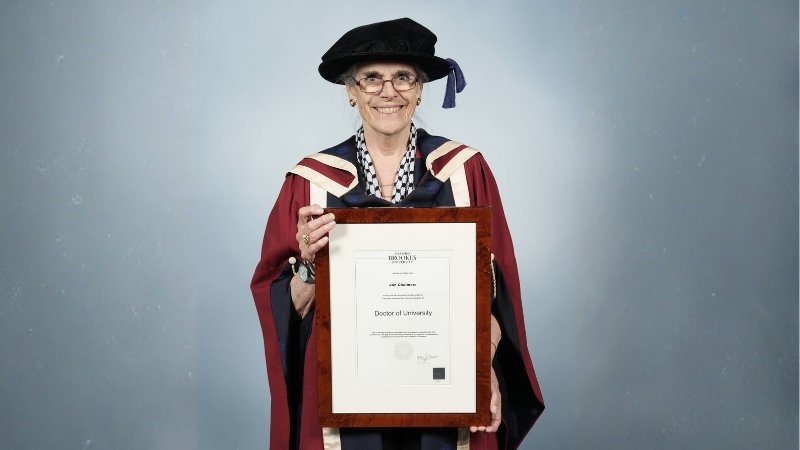
Oxford Brookes has proudly bestowed an Honorary Doctorate upon Lady Jan Chalmers, co-founder of the Oxford-based Palestine History Tapestry Project, at the September 2025 graduation ceremonies.
Lady Jan Chalmers began her career as a nurse and operating theatre practitioner, going on to become a senior nurse manager and teacher, working in the UK and Gaza. She works tirelessly to support education and creativity in communities affected by conflict.
Lady Chalmers co-founded the Oxford-based Palestine History Tapestry Project, through which she has helped to coordinate over 100 hand-embroidered panels telling the story of Palestinian life and land.
Since 2009, she has also supported Palestinian students from Gaza studying at Oxford Brookes and built friendships that continue to inspire her work. Lady Chalmers exemplifies how quiet determination and compassion can drive cultural understanding and international solidarity.
Below are excerpts from her acceptance speech:
Humble beginnings
My upbringing was working class on a housing estate in Norwich. I’m not an academic, I have no school certificates Os or As, but I like to think that common sense helped me qualify as a registered nurse in 1964.
A life-changing journey to Gaza
To me, one of the most important and privileged things I have done is to have worked for two years with the United Nations Relief and Works Agency in a Palestinian refugee camp.
Palestine: where Christmas and Easter originated. Shamefully, in my early 20s, that was the measure of my knowledge and interest in Palestine, and I had no plan whatsoever to go to the Middle East. While working in London, a young doctor suggested to me that I might like to go with him to what I understood to be a developing country.
In February 1969, we drove from the UK to the Gaza Strip; however, the nearer we got to our destination, the more nervous I became. Why in the world had I agreed to this? Would we be living in tents? What sort of people would I be working with, and how would life be? Would I like it, especially as Gaza was occupied by the Israeli army?
The reality of Gaza
On arriving in Gaza City, it was not what I had expected at all: substantial homes and buildings, busy markets, and shops, coffee places, sunbathing, sea and swimming, everything to like. Then, I met the refugees in the camps, where I discovered some important truths. The people I met there were Palestinians who had been expelled from their homes. They were living in appallingly overcrowded shelters built over 20 years previously as temporary accommodation by the United Nations. The fact that until recently some of these shelters were still standing proves they were anything but temporary.
I fell in love almost immediately with the Gaza Palestinians, who are a people with generous souls and a passion for life and their just freedom.
Working with the UK in Jabalia Camp
I worked for the United Nations Relief and Works Agency as a maternal and child health nurse in a clinic in Jabalia, a place where I came to feel safe and valued. At that time, Jabalia Camp was the home to over 43,000 refugees. I walked everywhere when making home visits. I was offered coffee at almost every turn. Children held my hand and followed me around. The positive impression the people left on me has never diminished.
A lifelong connection
I returned to the UK in 1970, and it was difficult to know how to continue supporting Palestinians. I married the doctor who took me to Gaza and we had two boys. Whilst the challenges of raising a young family became my priority, the people of Gaza always remained in my thoughts.
Founding the Palestinian History Tapestry Project
Over the years, I kept up with Palestine news, and in 2011, [my family now grown up], I was in a position to reestablish my relationship with the people of Palestine. Knowing that Palestinian women had a long history of cross-stitch embroidery [tatreez], along with two other colleagues, I founded the Palestinian History Tapestry Project.
We established embroidery groups in the Gaza Strip, Ramallah, the Naqab, Lebanon, and Jordan. Funding came through donations, sales of Palestinian embroidery, and talks. Now, years on, 105 embroidered panels illustrating the history of the land of Palestine in stitch, the Tapestry has found a home in the Palestine Museum in Connecticut and is being displayed widely. Many of the Project embroiderers remain active and are currently stitching a Gaza Genocide Tapestry.
Supporting Palestinian Scholars at Brookes
In 2008, my husband Iain Chalmers, and a colleague Paul Brankin, both of whom have strong connections with Oxford Brookes, initiated a fund to support an annual scholarship to enable one Gaza student a year to work towards a master’s degree.
By 2009, enough funding had been raised to support the first scholar. The then Vice-Chancellor, Janet Beer, took up the challenge, and offered a place for one Gaza student each year to study for an MSc at Brookes, and Vice-Chancellor Professor Alistair Fitt honoured this commitment. For the past 14 years, one Palestinian student each year has joined Oxford Brookes.
We look forward to Vice-Chancellor Helen Laville continuing this excellent tradition established by her predecessors. As an expression of Oxford Brookes’ commitment to Palestinian students, three olive trees were planted by the residents' lake in remembrance of a Gaza scholar’s wife and their small children, who were killed in Gaza in 2014 during Israeli air strikes.
Although a scholarship in Oxford was an excellent opportunity for a Palestinian student, it could perhaps have be an isolated and a stressful time, full of mixed feelings, leaving a family and home where sieges and bombing attacks were common and frequent. It was easy for me to befriend and support these young people of a community from which I had received such warm hospitality and friendship many years ago.
Where are the scholars now?
There have been 11 scholars, seven women and four men. All have had opportunities to use their Oxford Brookes degrees to help build careers.
At the beginning of the scholarship, it was envisaged that all students graduating would return to Gaza. In fact, it was possible for only four to do so. Amal and Haya are still in Gaza, but Ramy and Hassan returned to the UK for a PhD. Jamila works in Dubai, Shayma in France, Jehan, Omar, Hadil, Mosab and Soha are in the UK.
Parting words to the graduates
Congratulations to you, graduands. If we were in Palestine, I would say ‘mabrouk’. You are well-equipped with knowledge, strength, and enthusiasm. Use them well.
Be patient, be thoughtful - but mostly, be kind - and you will meet some wonderful people.
Hold on to the friendships you’ve made; they will serve you well. If my story is anything to go by, you may be surprised in ways you could never have imagined - even over half a century later.