

GetPublished! Conference 2026
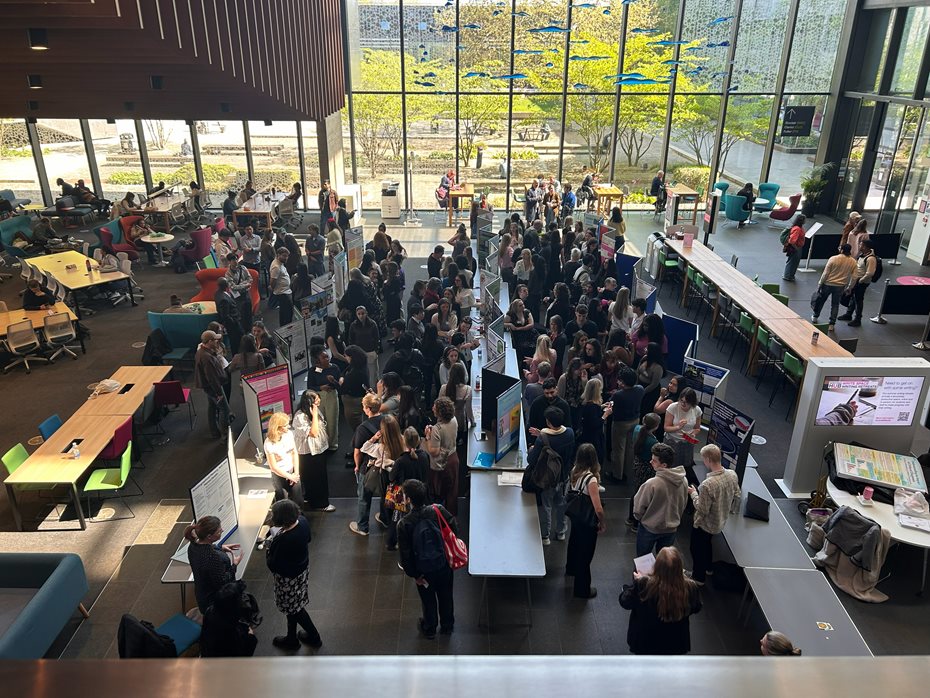
The Forum at Headington Campus was packed for the annual GetPublished! Conference on Wednesday 22 April, with students from across the University showcasing their research.
Oxford Brookes hosted its annual GetPublished! Conference on Wednesday 22 April, where Brookes undergraduate and taught Master’s students showcased their thought-provoking research through posters and spoken presentations. This year we had almost 100 students presenting their work!The GetPublished! Conference gives Brookes students the opportunity to present their research findings to a wider audience. This can be any research they have already undertaken or are in the process of undertaking. Students could attend workshops to help them write their abstract and design their poster.
The conference started with poster presentations in the Forum where students discussed their research with interested students, staff, members of the Student Research Launch Pad committee and other presenters. After the poster presentations, 9 students delivered spoken presentations, which were followed by the awards ceremony for highly commended and commended presentations.
The Student Communications team went along and managed to squeeze in amongst the busy crowd to speak to some of the students directly to find out more about their research. Here’s what we found out…
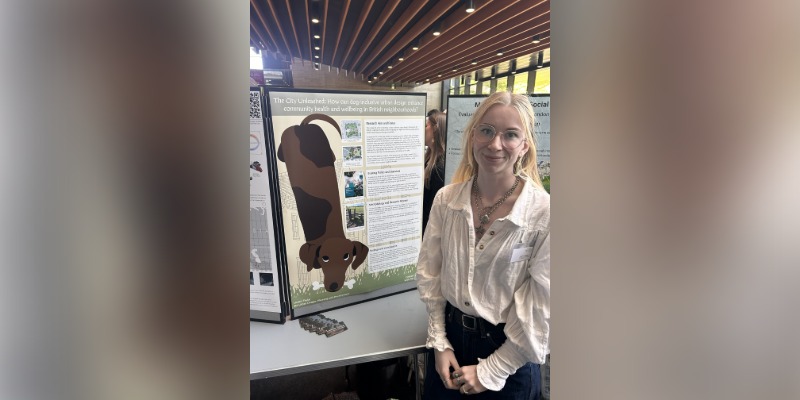
“About 30% of the British population owns a dog, which is a huge demographic that we aren't considering in design.”
Lauren Taylor, BA (Hons) Urban Design, Planning and Development
The city unleashed. How can dog-inclusive urban design enhance community health and wellbeing in British neighbourhoods?
The goal of my research is to develop dog-inclusive urban design principles, so that we can ensure that dogs are being seen as social spatial actors within the planning and design process. About 30% of the British population owns a dog, which is a huge demographic that we aren't considering in design. We [Britain] also sit about 5 to 15 years behind other countries, in terms of planning policy and design guidance, so that's what I'm trying to change.
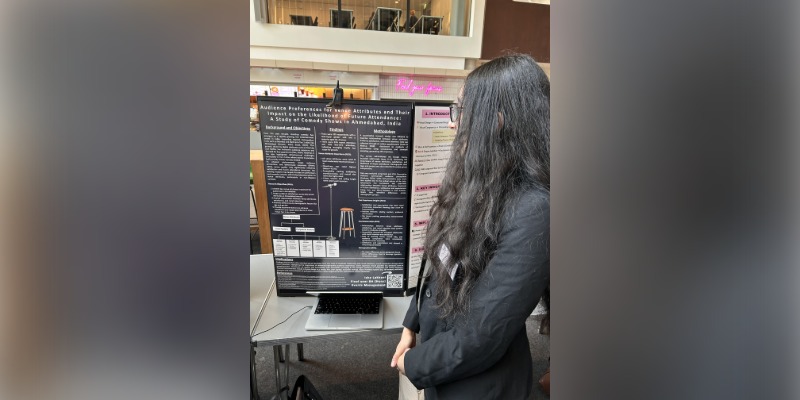
Isha Lakhani, BA (Hons) Events Management
Audience preferences for venue attributes and their impact on the likelihood of future attendance: a study of comedy shows in Ahmedabad, India
My research looked at how aspects of a venue impact the likelihood of future attendance.
I looked at comedy shows in Ahmedabad, India - comedy as a genre, as an events genre, is growing quite a lot - to understand whether there's an infrastructural challenge to this particular art form, which is stopping people from coming to the shows again. What I found out is that accessibility, cleanliness, parking availability, sound, and acoustics, these are all aspects of a venue that impact people coming back to a show. It's not just the comedian that brings people, it's also the physical space - so it's really important to know that this can be replicated in other places.
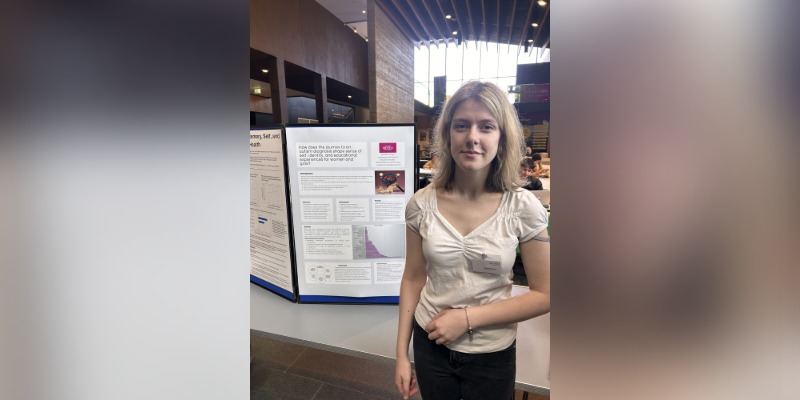
“Now a lot of women in their 30s, 40s are getting reanalysed.”
Matilda Holroyd, BA (Hons) Education Studies
SEN, disabilities and inclusion - How does the journey to an autism diagnosis shape sense of self, identity, and educational experiences for women and girls?
My research is looking at the journey to an autism diagnosis for women and girls…to explore how that journey is different. I did a thematic literature review, which looked at a huge body of literature…and through that process ended up finding recurring themes of why people weren't receiving diagnoses sooner.
[Women and girls] were presenting differently, and mental health was a barrier to actually receiving a diagnosis, and a lot of professionals were not recognising that there was a difference in the way that it was experienced, and were expecting there to be a very clear male-centric way of presenting. So a lot of women…when they were getting diagnosed against the criteria, all of those criteria points were very specific to the male-centred diagnosis.
So now a lot of women in their 30s and 40s are getting re-analysed. I'm looking at how education and schools could end up implementing a framework to actually recognise autism [in women and girls] sooner.
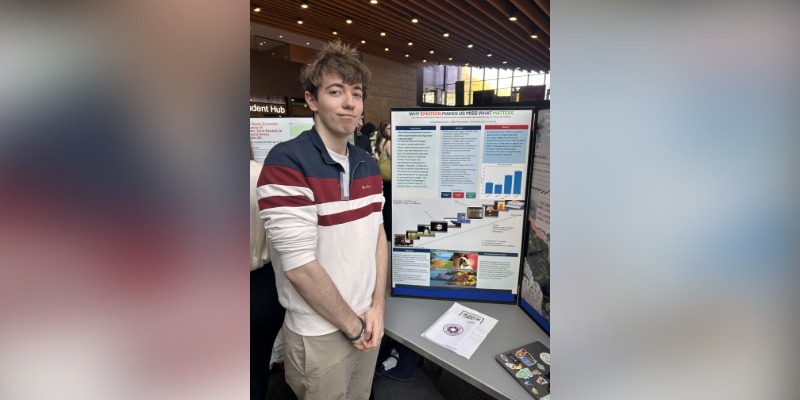
“Emotionally induced blindness, which is a phenomenon in which we fail to identify targets after a subsequent emotional distractor is present.”
Craig Shakespeare, BSc (Hons) Psychology
The effects of emotional valence and arousal on emotion induced blindness in visual perception
I did [my research] on emotionally induced blindness in visual perception, which is a phenomenon in which we fail to identify targets after an emotional distractor is present. Participants identified the orientation of a target image, either to the left or right, after viewing an emotional distractor image such as a happy animal or a threatening animal. This looked at valence, which refers to whether an image is emotionally positive or negative. Each image was there for 100 milliseconds, with a 50-millisecond break. There were four conditions: positive low arousal; positive high arousal; negative low arousal; negative high arousal. Arousal refers to how emotionally intense or activating the image is. The aim of the research was to examine whether valence [positivity] or arousal [intensity] had a greater effect on emotion-induced blindness.
The analysis found that there was a significant effect for valence, [but] not arousal or any interaction between valence and arousal. Accuracy was lower after negative distractors compared with positive distractors, which meant that emotionally induced blindness was affected more by negative content than any other.
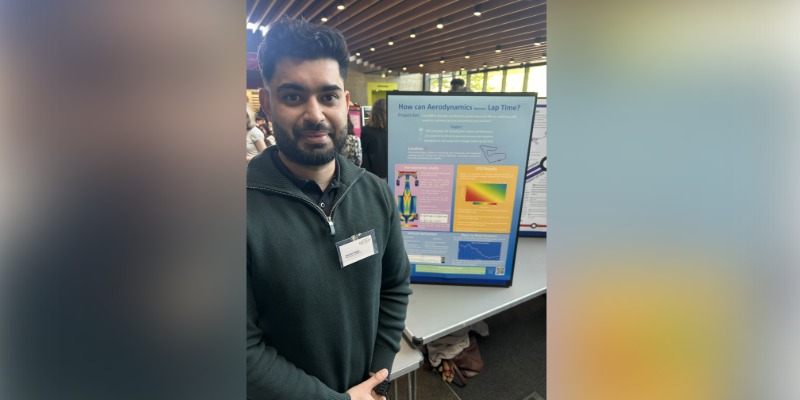
“My project aim was to use CFD to simulate the aerodynamic performance of a Formula 4 car.”
Eashan Sagar, MSc Motorsport Engineering
How can aerodynamics minimise lap time?
My project aim was to use CFD [Computational Fluid Dynamics] to simulate the aerodynamic performance of a Formula 4 car, and validate it using a lap-time simulation model. I inputted a CAD drawing into Star CCM…which is a virtual wind tunnel simulator. This was able to produce drag forces and downforce forces, which were then translated into an aerodynamic map, which describes aerodynamic performance. I was able to then input this data into another simulation software, to simulate the car going around the Red Bull Ring, and focus on aerodynamic and vehicle dynamic optimisations to reduce lap time.
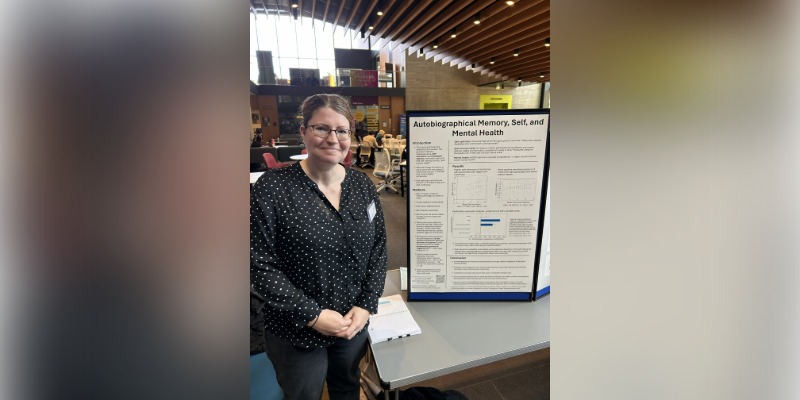
“As people get older, their sense of self tends to improve.”
Jennifer Eloff, MSc Psychology
Autobiographical memory, self and mental health
This was an online, preregistered questionnaire-based study in people aged 25 years or older. They were asked to recall one memory from each of four lifetime periods, between ages 10 and 30, when the storage of memories relevant to the self peaks. The study examined self-relevance (how personally relevant a memory is), self-continuity (the sense of being the same person over time), emotional valence (how emotionally positive or negative a memory is) and self-concept clarity (the extent to which self-beliefs are confidently and clearly defined, stable and internally consistent at a point in time).
The primary hypotheses were that self-relevance and self-continuity, that emotional valence of memories and current mental health, and that self-concept clarity, self-continuity, and mental health would positively and significantly correlate, and they did.
Exploratory research showed that emotional valence was a significant predictor of self-concept clarity, and age was a highly significant predictor of self-concept clarity. The more positive the memories were rated, the higher the self-concept clarity scores, and as people get older, their sense of self tends to improve.
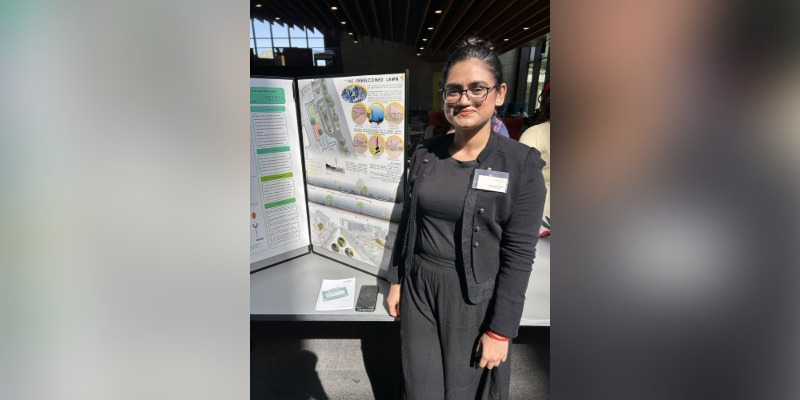
“Rather than having a very beautiful lawn area…people are not enjoying it properly”.
Anwesha Simlai, MArchD Applied Design
“The unwelcomed lawn”: a transitional landscape where spatial hierarchy and visibility undermine occupation
When I was walking through the Clerici Building at Oxford Brookes Business School...I found the lawn very underutilised and unused. …People are not using the lawn properly, not … enjoying the lawn. It is a transitional area, because there is no seating space and the eye level is not matching because [of] the visual exposure from [the] classroom. Nearby, there is lots of parking for different vehicles…so it's a disturbing area. Rather than having a very beautiful lawn area…people are not enjoying it properly, so it's unutilised. That's how I came up with the name, ’The unwelcome lawn’.
GetPublished! 2026 prize winners
Members of Brookes staff including the Get Published Committee judged the poster and spoken presentations and awarded prizes based on the quality of students’ presentations or posters, and potential research impact.
Highly Commended prizes:
Easy Chalmers, BSc Psychology: 'What if you are wrong?'
Emma Read, BSc Geography and International Relations: 'Representation of female refugees within discourses of displacement in British media outlets between 2022-2025'
Emilie Haines, BSc Psychology: 'The emotional and social effects of awe-inducing music: Exploring connectedness through Led Zeppelin songs'
Gabriela Szafran, BA Architecture: ‘Between creativity and regulation: How has the UK's pursuit of safety and compliance come at the expense of architectural beauty?’
Raquel Middleton, BSc Psychology: 'Stories of change: Identity reconstruction among South African veterans of the British Army'
Miles Coode, BA Urban Design, Planning and Development: 'We know, we still swim: Pollution does not stop coastal use. It distorts it'
Jennifer Eloff, MSc Psychology: 'Autobiographical memory, self and mental health'
Alexandra Howick Jones, BA Urban Design, Planning and Development: 'The socio-economic impacts of short-term rentals in coastal areas of the UK: Case studies of the Isle of Wight'
Alessandra Cavaliere, BA Economics, Politics and International Relations: 'To what extent is child trafficking related to poverty?'
Ioanna Kala Mlundira, BSc Nursing (Children’s): 'Bridging the gap: Evaluating the effectiveness of child exploitation education for undergraduate children nursing students - a mixed method study’
Isabelle Tolley, BSc Psychology: 'First love online: The effects of excessive swiping on intimacy and commitment in adults without prior relationship experience'
Rebecca Ansari, MA Global Development and Humanitarian Practice: 'Housing impacts, social connections for asylum seekers and refugees in Oxfordshire'
Elizabeth Brookes, BSc Criminology: 'Responding to mental health crises: Police experiences with NHS triage services'
Lauren Taylor, BA Urban Design, Planning and Development: 'The city unleashed: How can dog-inclusive urban design enhance community health and wellbeing in British neighbourhoods'
Isha Lakhani, BA Events Management: 'Audience preferences for venue attributes and their impact on the likelihood of future attendance: A study of comedy shows in Ahmedabad, India