

OxInAHR Symposium 2025: Where Research and Practice Meet
Transforming clinical curiosity into collective impact.
Every piece of research starts with a question, and very often, that question begins in a clinic, a corridor conversation, or a moment of quiet frustration that sounds like, “There must be a better way to do this,” or “I keep seeing this… and I don’t quite understand why.”
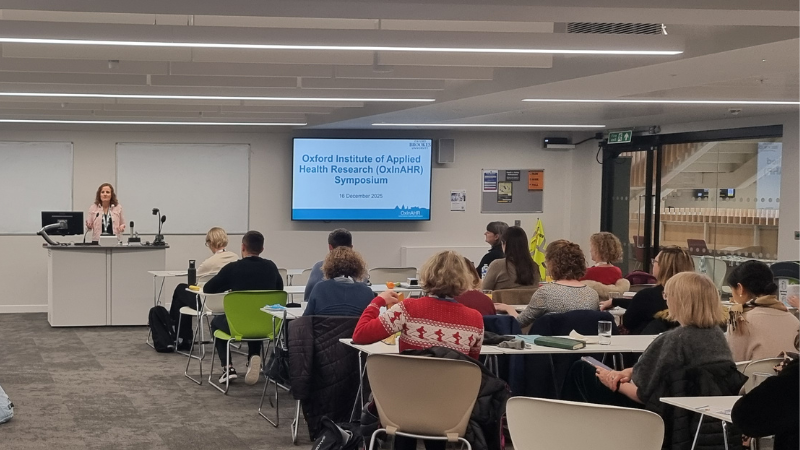
The Oxford Institute of Allied Health Research (OxInAHR) Symposium 2025 was about what happens next.The symposium was held at Oxford Brookes University’s Headington Hill Campus, bringing together clinicians, researchers, leaders and students for a shared conversation about how rigorous methods turn everyday questions into evidence, and how that evidence finds its way back into practice, improving patient care, strengthening services, and supporting clinical decision-making.
The symposium created a space where research and practice could meet in ways that made sense, where findings could be tested against reality, and where impact could grow through dialogue rather than slides alone.A Multidisciplinary Collective
Diversity is the strength of OxInAHR where our collective expertise is far greater than the sum of our parts.
We were joined by colleagues from across Oxford Brookes University, Oxford Health NHS Foundation Trust, Oxford University Hospitals NHS Foundation Trust, the University of Oxford, and partner organisations. The breadth of roles and expertise was genuinely inspiring.
One of the defining strengths of the day was who was in the room, including:
- Academic & Research Experts: Professors, Associate Professors, Senior Lecturers, and Researchers across nursing, midwifery, allied health, psychology, sport and exercise science, nutrition, cancer care, and rehabilitation.
- Clinical Leaders & Practitioners: Nurse Consultants, clinical specialists, advanced practitioners, and heads of service, alongside physiotherapists, dietitians, occupational therapists, paramedics, respiratory nurses, clinical research practitioners, suicide prevention leads, research facilitators and more.
- Operational & Strategic Partners: Research and training leads, Directors, Heads of Operations, and a Chief Medical Officer, all focused on the systems that support innovation.
- The Next Generation: PhD candidates, postdoctoral researchers, postgraduate research assistants, and Master’s students, working alongside suicide prevention leads and research facilitators.
A Wide Lens on Health: From Cancer Care to Paramedicine
The programme reflected the depth and breadth of applied health research across the institute, beginning with an overview from Professor Paul Carding, Director of OxInAHR, who set the strategic context and highlighted the Institute’s commitment to multidisciplinary, practice-relevant research.
Flagship projects from OxInAHR research centres showcased how research is addressing real-world challenges, from supporting people living with and beyond cancer to advancing rehabilitation sciences through diverse research lenses to co-designed interventions that empower healthier choices in mid-life women.
The afternoon whistle-stop tour offered a fast-paced but rich insight into the variety of work underway across the Institute. Presentations ranged from workplace exercise interventions for menopausal women to student paramedics’ learning experiences in emergency care; from physical activity after stroke to novel exercise modalities for blood pressure management; from safeguarding in paediatric diabetes care to musculoskeletal health following critical illness. Each study was grounded in practice, asking not just “what do we know?” but “how might this change what we do?”
Helping to shape future research
Throughout the day, participants were invited to contribute to two live “bridge-building” spaces: one capturing clinical challenges that need research, and the other highlighting research that could improve practice. With sticky notes appearing steadily during breaks and conversations, these walls became a visual snapshot of real needs, opportunities for collaboration, and ideas ready for translation.
Attendees were also encouraged to share clinical questions that could inform student projects, service evaluations or collaborative research studies. These questions will now be shared with students at Oxford Brookes University, helping to shape future research in direct response to practice-based priorities.
Were you unable to attend but have ideas for student projects? You can still submit clinical questions for student projects by filling out a google form.
Alongside this, everyone was invited to reflect on three small but powerful prompts: one thing that inspired them, one thing they might do next, and one person they could connect with. These quiet moments of reflection helped turn ideas into intentions.
The presence of senior leaders from across partner institutions reinforced the collective commitment to applied health research and knowledge exchange. Their engagement sent a clear message: research that makes a difference is everyone’s business, and it thrives when organisations work together.The symposium closed with reflections from Professor Koula Asimakopoulou, Dean for Research and Knowledge Exchange in the Faculty of Health Science & Technology, who spoke to the importance of nurturing research cultures that support people, collaboration and impact, not just outputs.
Thank you to everyone who contributed their energy, curiosity and expertise. The OxInAHR Symposium 2025 reminded us that when research and practice meet with openness and intent, impact follows, often in ways we don’t yet fully see, but are already beginning to build.
Contact us
Featured staff
Professor Paul Carding
Director of OxInAHR (Oxford Institute of Allied Health Research)