

Research Uncovers Brain Mechanism Behind ME/CFS Sensory Overload
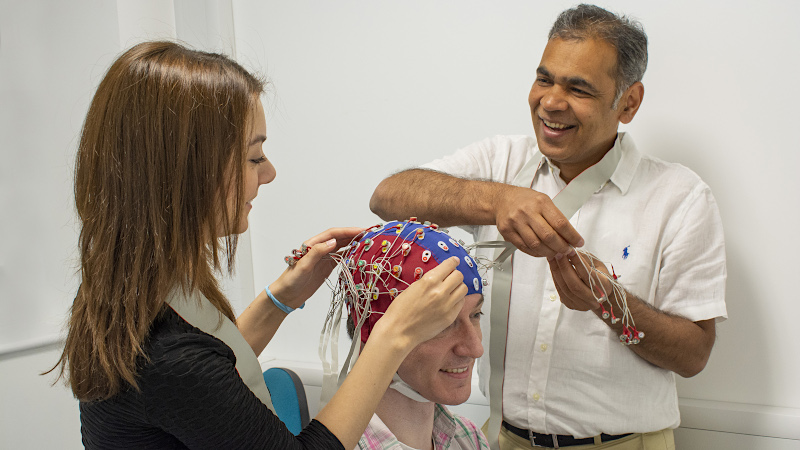
Breakthrough research reveals sensory overload stems from higher-level brain processing—opening new doors for targeted treatments.
With an estimated 404,000 people in the UK living with Myalgic Encephalomyelitis/Chronic Fatigue Syndrome (ME/CFS), understanding this complex condition is more urgent than ever. ME/CFS is a neurological disorder featuring a diverse range of symptoms.
While biomedical research has historically lagged behind, the tide is finally turning. Dr. Sanjay Kumar, Director of the Cognition and Cognitive Neuroscience research group, is leading the charge by investigating sensory processing—a common but often overlooked symptom that could be the key to new treatments.
The study explored sensory processing amongst individuals with ME/CFS using a method called EEG (Electroencephalography) that records your brain activity when responding to certain tasks. The EEG data can flag to scientists any differences in how individuals with ME/CFS process different types of sensory stimuli, be it auditory or visual.
61 participants took part, 31 individuals with ME/CFS and 30 matched healthy controls. Participants completed two auditory tasks during the EEG experiment. One of the tasks (a paired click task) was designed to test how well the participants' brains noticed a second stimulus when the brain had noticed the same stimulus a moment ago, in this case two click sounds separated by around 4.5-9 seconds.
The second task (‘oddball task’) tested how well the participant's brain filters out irrelevant background sounds, repeated clicking, similar to when your brain filters out the sound of a ticking clock.The first, ‘paired click’ task investigates the early stages of sensory processing, whereas the second ‘oddball’ task investigates the later stages of sensory processing.
The individuals with ME/CFS in our study reported significantly more severe sensory problems than the control group.
Interestingly, the first task showed no differences. This suggests that the brain’s "automatic" filter, the part that first notices stimuli such as consecutive sounds, works just fine in those with ME/CFS.
The real difference appeared in the second ‘oddball’ task. The ME/CFS group showed much lower activity in what scientists call the ‘P300 wave’. This wave represents how the brain consciously pays attention to, categorizes, and processes important or unexpected stimuli. The lower activity suggests that while the information is getting into the brain, the command center is struggling to manage and sort it all out, which may lead to sensory overload.
Dr Kumar explains: "This study helps us understand that the sensory issues people with ME/CFS experience come from higher-level brain processing rather than early sensory filters. Although more research is needed to confirm our findings, it's an encouraging step forward that gives us a clearer path for future research and helps us think differently about how we design supportive treatments."
The research article 'Higher-order brain processes, rather than early processing, underlie sensory problems in ME/CFS: evidence from ERPs' is published on the Frontiers in Medicine website.