

Applied Sport and Exercise Nutrition
MSc or PGDip or PGCert
Start dates: September 2026
Full time: MSc: 12 months, PGDip: 8 months
Part time: MSc: 24 months, PGDip: 20 months
Location: Headington
School(s): School of Sport, Nutrition and Allied Health Professions
Overview
As people are becoming increasingly aware of the importance of diet and exercise, the role of the sports and exercise nutritionist has grown in demand. Our MSc/PGDip is based on the latest scientific research and best practice. You’ll explore the role of nutrition in helping people improve their health and performance in competitive sports.
At Oxford Brookes, we place great emphasis on the word ‘applied’. You’ll be working with real people and real equipment in both simulated and live situations as you put theory into practice. Our team of experts, all experienced researchers and coaches, will encourage you to consider topics such as hydration, gut health or protein metabolism.
You may already be a practising sports and exercise nutritionist, so rather than make work experience compulsory, we’ve kept it optional. Apply your lessons to your own practice or use our links with professional sports teams, Oxfordshire hospitals and food organisations.
Whatever your starting point, our MSc will act as a great springboard for the next stage of your career.
Why Oxford Brookes University?
-
Hands-on training
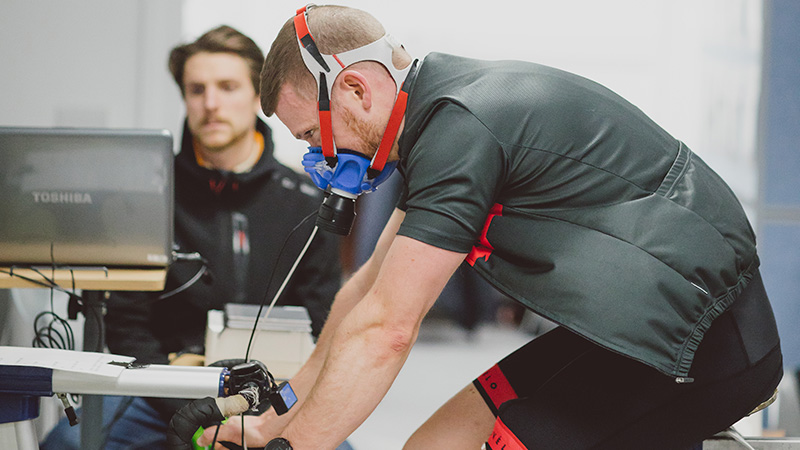
You’ll work to become an independent practitioner with the skills to interpret measurements like expired air analysis, lactate levels, or body composition.
-
Access to a variety of tech
You can access a wide range of the latest technology including GPS systems, ultrasound, activity monitoring sensors and more.
-
Professional accreditation
With our MSc/PGdip you can apply for Graduate Membership to the Sports and Exercise Nutrition Register (SENR), giving you professional credibility and legal protection.
-
Efficient timetabling
We structure our teaching so that you attend 2 days a week full time or once a week part time. Travel from further afield or combine the course with consultancy work.
-
Prestigious location
You can apply to access a range of academic opportunities in the city, such as Oxford University’s Bodleian library or union. Enjoy a direct bus route to London as well.
-
Accreditation(s)
Sport and Exercise Nutrition Register

Course details
Course structure
We expect you’ll have a strong understanding of either human nutrition or sport and exercise science.
So, in the first semester, depending on your background, you’ll take either the Fundamentals of Human Nutrition or the Sports and Exercise Physiology module. We don’t want you to repeat an entire module in a topic you have a bachelor’s award for already.
You’ll follow a series of taught modules, examining theoretical and research issues. You’ll also learn advanced information about the effects of diet and physical activity on metabolic health and disease.
In the second semester, you’ll test out some of the theories in the field using our specialist portable equipment or in our state-of-the-art lab settings.
If you’re on the MSc course, you’ll do a research project in the final semester. This could be investigating the calorie-burning estimates of sports equipment, or analysing the influence of fluid and energy intake on team or endurance sports.

Study modules
The modules listed below are for the master's award. For the PGDip award your module choices may be different. Please contact us for more details.
Please note: As our courses are reviewed regularly as part of our quality assurance framework, the modules you can choose from may vary from those shown here. The structure of the course may also mean some modules are not available to you.
Research
Our research areas and clusters include:
- immediate physiological and psychophysical exercise performed at different intensities
- effects of restricted fluid intake in people with MS on temperature control, energy levels, balance and cognitive and physical performance
- feasibility of supporting people with long-term neurological conditions to exercise in the community
- exploring exercise responses in children with physical disabilities with plans to explore delivery of community exercise and sports programmes
- exploring novel exercise delivery techniques for people who find it hard to move, including the use of mental imagery
- effect of fluid and carbohydrate intake on rowing skill and performance
- relationship between levels of physical activity and blood levels of neuroactive proteins induced by exercise
- effect of green tea on competitive cycling performance
- effective nutritional strategies for enhancing post-exercise rehydration.

Careers
With the MSc/PgDip in Applied Sport and Exercise Nutrition, you’ll have a wide range of options open to you. As well as your theoretical knowledge, you’ll have developed key skills in analysing results and presenting practical nutrition recommendations.
You may decide to work with a professional sports club as a nutritionist to help players improve their performance and find a competitive advantage.
Or you may choose to focus on nutrition in a health and exercise context as a lifestyle consultant. That could be in a hospital or in your own private practice.
Previous graduates have gone into industry, working for major companies like GlaxoSmithKline, or have taken up roles with the regional Institutes of Sport in the UK. Others have gone on to teach in further or higher education, or acquired funded PhD positions.
Related courses
Entry requirements
Specific entry requirements
To successfully complete this postgraduate course, you are usually expected to have a lower second class honours degree in a related scientific subject from a recognised institution of higher education.
Please also see the University's general entry requirements.
English language requirements
For applicants whose first language is not English, an Academic IELTS score of 6.5 (with 6.5 in Reading and Writing, and 6.0 in Listening and Speaking) is required.
Please also see the University's standard English language requirements.
Pathways courses for international and EU students
We offer a range of courses to help you meet the entry requirements for your postgraduate course and also familiarise you with university life in the UK.
Take a Pre-Master's course to develop your subject knowledge, study skills and academic language level in preparation for your master's course.
If you need to improve your English language, we offer pre-sessional English language courses to help you meet the English language requirements of your chosen master’s course.
English requirements for visas
If you need a student visa to enter the UK you will need to meet the UK Visas and Immigration minimum language requirements as well as the University's requirements. Find out more about English language requirements.
Terms and conditions of enrolment
When you accept our offer, you agree to the Terms and Conditions of Enrolment. You should therefore read those conditions before accepting the offer.
International qualifications and equivalences
How to apply
Application process
Tuition fees
Questions about fees?
Contact Student Finance on:
Tuition fees
The following factors will be taken into account by the University when it is setting the annual fees: inflationary measures such as the retail price indices, projected increases in University costs, changes in the level of funding received from Government sources, admissions statistics and access considerations including the availability of student support.
How and when to pay
Tuition fee instalments for the semester are due by the Monday of week 1 of each semester. Students are not liable for full fees for that semester if they leave before week 4. If the leaving date is after week 4, full fees for the semester are payable.
- For information on payment methods please see our Make a Payment page.
- For information about refunds please visit our Refund policy page
Financial support and scholarships
Additional costs
Please be aware that some courses will involve some additional costs that are not covered by your fees. Specific additional costs for this course are detailed below.
When possible, we provide financial support for you to attend conferences (subject to availability). Where financial support is unavailable, you will need to pay to attend the conferences.
Programme changes:
On rare occasions we may need to make changes to our course programmes after they have been
published on the website. For more information, please visit our
changes to programmes page.