

Occupational Therapy (Pre-registration)
MSc
UCAS code: P048452
Full time: 2 years, maximum 4 years
Location: Headington (Marston Road site)
School(s): School of Sport, Nutrition and Allied Health Professions
Overview
On our Occupational Therapy course, you’ll build the skills and knowledge to work with people of all ages from all walks of life. You will help individuals with a variety of physical, mental, and social needs improve their mobility in order to overcome the challenges they face on a daily basis.
You’ll take part in supervised practice placements during both years of study. These will present you with opportunities to take the skills you’ve learned on the course and apply them in professional settings. Placements in a professional setting, in or outside of the Oxford area, give you the chance to learn and practice on location.
This pre-registration Masters degree is approved by the Health and Care Professions Council and accredited by the Royal College of Occupational Therapists. Successful completion allows you to register as an occupational therapist in the UK. So you’ll be learning the skills, and gaining the knowledge for a rewarding career.
Why Oxford Brookes University?
-
Part of a team
Join a close-knit community of occupational therapists, with easy access to help and advice.
-
Global knowledge
You’ll meet people from all over the world on this course, and learn from their perspectives and experiences.
-
Enhance your learning
Make yourself more employable and gain new friends by joining the Oxford Brookes Occupational Therapy Society.
-
Be practical
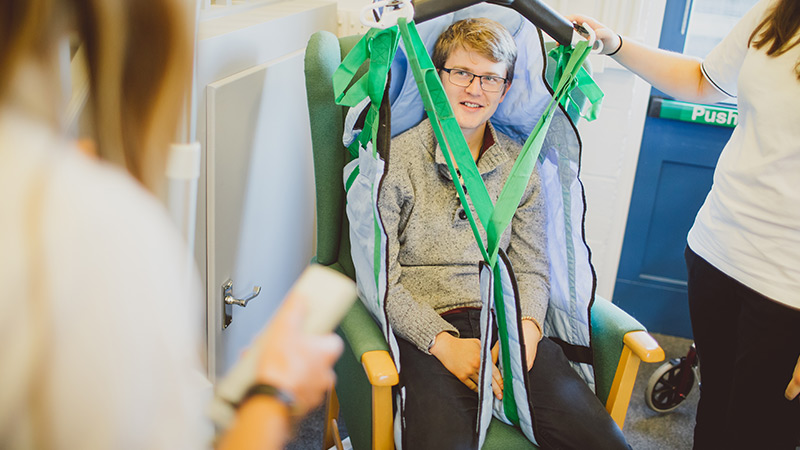
Improve your hands-on experience by taking part in simulations of real situations from the safety of the classroom.
-
Research opportunities
Discover and get involved with observational research projects, and sharpen your own research skills.
-
Accreditation(s)
Approved by the Health and Care Professions Council (HCPC) and accredited by the Royal College of Occupational Therapists (RCOT)

Course details
Course structure
In your first year you’ll study humans as occupational beings and workplace values-based professional behaviours. Two academic modules continue with a part time placement. Subjects include anatomy, physiology and pathology of medical conditions or impairments of various client groups. Key theories for occupational therapy and its process are also studied. Semester three finishes with a full time six week placement.
In your second year you have a part time placement where three academic modules are also studied. Theory integrates with practice and various perspectives informing local and global occupational therapy. You’ll develop advanced, creative, alternative problem solving skills for practice with diverse and complex populations and you’ll collaborate with professional colleagues.
Completing the MSc Occupational Therapy with a strong professional identity and distinctive professional skillset prepares you to join the workforce and support populations in the UK and globally.

Study modules
The MSc Occupational Therapy (pre-registration) course requires your active, self-directed engagement. Preparing learners for professional practice in real-world health and social care settings, your attendance is central to allowing the teaching team to ascertain interpersonal suitability, as well as to prevent potential risk to service-users through lack of preparedness for practice placement.
There is an explicit requirement that you’ll attend all classroom learning, which is supplemented by structured self-directed and independent learning. Lack of attainment of minimum attendance and engagement requirements may impact your placement allocation.
Please note: As our courses are reviewed regularly as part of our quality assurance framework, the modules you can choose from may vary from those shown here. The structure of the course may also mean some modules are not available to you.
Research
The Centre for Movement, Occupational and Rehabilitation Sciences (MOReS) brings together research, education and care. It is underpinned by a strong, well-published research group, the movement science group. This supports the clinical expertise, rehabilitation, knowledge and care of adults and children with neurological conditions.
Within the Centre, staff, students and alumni across the Faculty of Health and Life Sciences are engaged in a number of research projects, including:
- driving rehabilitation
- fatigue management dual task control in Stroke
- efficacy of intensive motor learning programmes
- arts in health research
- virtual Reality (VR) technologies
- early identification of motor and sensory processing impairments in children
- sensory processing disorders and impact on function and behaviour in children with autism
- measurement and monitoring of rehabilitation participation - Traumatic Brain Injury (TBI)
- therapy for handwriting in people with Parkinson’s disease (PD).

Careers
You can find our graduates working across various sectors. These include social work, charity, and policy development. There are also many opportunities for occupational therapists to work, in settings such as schools, community centres, prisons and industrial organisations.
After getting involved with our research opportunities, you’ll be able to demonstrate research and critical thinking skills at a deeper level. This will help you stand out and be of value to many organisations.
Entry requirements
Specific entry requirements
GCSE: Three GCSE passes to include grade 4 (C) in English, Maths and Science. For English and Maths, Level 2 Functional Skills are accepted as alternatives to GCSEs.
A minimum of a second class honours degree (2:2) or equivalent overseas degree from a recognised institution in a relevant subject (for example: Sociology, Psychology, Biological Sciences, Sport Sciences, Kinesiology, Anthropology). Not suitable for applicants with an undergraduate degree in Occupational Therapy.
All applicants must have taken and passed a module or course on research methods, addressing both qualitative and quantitative study designs and statistics.
Please also see the University's general entry requirements.
Screening
All applicants will be screened for fitness to practise and a Disclosure and Barring Service (DBS) check will be made.
Selection process
You will be expected to demonstrate a range of specific qualities and aptitudes appropriate to occupational therapy within the specific recruitment process which may include an individual and/or group interview and a written test.
All Oxford Brookes University Health and Social Care Programmes conduct Value Based Recruitment (VBR). We recognise that values and attitudes have the greatest impact on the quality of people’s care and their experiences.
VBR is a way of helping our Programme recruitment teams to assess the values, motives and attitudes of those who wish to work with people in health and social care settings. When we refer to values we mean, for example, the values included in the NHS constitution.
VBR focuses on ‘how’ and ‘why’ an applicant makes choices in how they act and seeks to explore reasons for their behaviour. Further details about the VBR framework can be found here.
English language requirements
For applicants whose first language is not English, an Academic IELTS score of 7.0 (with a minimum of 6.5 in each component) is required.
Please also see the University's standard English language requirements.
Pathways courses for international and EU students
We offer a range of courses to help you meet the entry requirements for your postgraduate course and also familiarise you with university life in the UK.
Take a Pre-Master's course to develop your subject knowledge, study skills and academic language level in preparation for your master's course.
If you need to improve your English language, we offer pre-sessional English language courses to help you meet the English language requirements of your chosen master’s course.
English requirements for visas
If you need a student visa to enter the UK you will need to meet the UK Visas and Immigration minimum language requirements as well as the University's requirements. Find out more about English language requirements.
International applications
All offers are conditional on successful completion of medical and enhanced Disclosure and Barring Service (DBS) checks.
We are pleased to offer a number of places to international applicants. For more details, please contact us.
International applicants will:
- need to apply early to allow enough time for obtaining visas if offered a place
- be asked to pay a deposit of £3,000 to secure a place on the course.
Applications are dealt with on a first come, first served basis, so please act early to avoid disappointment.
Terms and conditions of enrolment
When you accept our offer, you agree to the Terms and Conditions of Enrolment. You should therefore read those conditions before accepting the offer.
International qualifications and equivalences
How to apply
Application process
International applicants will need to apply early to allow enough time for obtaining visas.
If you are offered a place you may be asked to pay a deposit of £3,000 to secure a place on the course.
Applications are dealt with on a first come, first served basis, so please act early to avoid disappointment.
All Oxford Brookes University Health and Social Care Programmes conduct Value Based Recruitment (VBR).
We recognise that values and attitudes have the greatest impact on the quality of people’s care and their experiences.
VBR is a way of helping our Programme recruitment teams to assess the values, motives and attitudes of those who wish to work with people in health and social care settings. When we refer to values we mean, for example, the values included in the NHS constitution.
Tuition fees
Tuition fees
Fees quoted are for the first year only. If you are studying a course that lasts longer than one year, your fees will increase each year.
Please note, tuition fees for Home students may increase in subsequent years both for new and continuing students in line with an inflationary amount determined by government. Oxford Brookes University intends to maintain its fees for new and returning Home students at the maximum permitted level.
For further information please see our tuition fees FAQs.
Tuition fees for International students may increase in subsequent years both for new and continuing students.
The following factors will be taken into account by the University when it is setting the annual fees: inflationary measures such as the retail price indices, projected increases in University costs, changes in the level of funding received from Government sources, admissions statistics and access considerations including the availability of student support.
How and when to pay
Tuition fee instalments for the semester are due by the Monday of week 1 of each semester. Students are not liable for full fees for that semester if they leave before week 4. If the leaving date is after week 4, full fees for the semester are payable.
- For information on payment methods please see our Make a Payment page.
- For information about refunds please visit our Refund policy page
Financial support and scholarships
All eligible Occupational Therapy students on courses from September 2020 (new and continuing) will receive a payment of at least £5,000 a year which they will not need to pay back. For more information please visit NHS Learning Support Fund (LSF).
Additional costs
Please be aware that some courses will involve some additional costs that are not covered by your fees. Specific additional costs for this course are detailed below.
In addition to the tuition fees, there are costs that need to be paid for by students in travelling to and from practice placement and potential accommodation costs.
These could be as much as £3,000 per placement depending on the location and type of placement. However currently the average accommodation cost per month is £550 and average travel cost is £250 per month. Students will spend up to 30 weeks on placement.
Other costs
- books and electronic resources - approx £100
- deposit for anatomy resources - £10
- shoes for practice to be worn with uniform - approx £50
- suitable clothing for the Labs - approx £30.
Student membership of the Royal College of Occupational Therapists (RCOT) is mandatory for this course. Student membership costs £61.51 per year (but is subject to annual increases as per the RCOT). The Membership Period runs from 1 October to 30 September in each year; if you become a Member in the middle of the Membership Period, the Fee will be pro-rated accordingly (to include the month of joining). Membership includes professional indemnity insurance.
Programme changes:
On rare occasions we may need to make changes to our course programmes after they have been
published on the website. For more information, please visit our
changes to programmes page.