

Nursing (Children's)
BSc (Hons)
UCAS code: B708
Full time: 3 years; It is possible to consider applications for entry for year 2 or 18 months for applicants who have credit from previous learning and/or relevant professional experience
Location: Headington (Marston Road site)
School(s): Oxford School of Nursing and Midwifery
Overview
Children's nursing is constantly evolving. You will be diving into a rewarding career that will make a difference to children, young people, and their families and carers every day.
You will spend 50% of your time gaining practical experience in hospital and community placements. You’ll be taught by children's nurses who are passionate about supporting you to become a children's nurse who can provide the best evidence-informed nursing care. You'll develop the knowledge and skills needed to provide exceptional nursing care for children, young people, and their families.
We will prepare you to become a confident professional practitioner. You'll be able to care for children from birth to teenagers and sometimes beyond. You'll develop empathy, sensitivity, and communication skills to help you succeed.
Why Oxford Brookes University?
-
A course of excellence year after year
We’ve been ranked number 1 in The Guardian for children’s nursing for the 2nd year running, and we're consistently achieving great student satisfaction. Also 100% for teaching in the NSS 2026
-
Unbeatable opportunities
You’ll develop quickly through placements in varied children’s nursing settings. We’ve been commended by the Nursing and Midwifery Council (NMC) for excellent partnership working.
-
Interactive facilities
We work closely with practice partners Oxford Health, Oxford University Hospitals and the University of Oxford to develop interprofessional simulations, being 1 of only 19 universities that are accredited to offer additional simulation hours.
-
Home to experts
You’ll be taught by an expert research-active team with experience across a wide range of settings. This means your studies will be underpinned by the latest developments in the field.
-
Small year group sizes
Benefit from more personalised support from teaching staff and experience a stronger sense of community and collaboration among students. Scored 100% student voice in the NSS 2026.
-
Additional language modules
Our university-wide language programme is available to full-time undergraduate and postgraduate students on many of our courses, and can be taken as a credit on some courses.
-
Accreditation(s)
Approved by the Nursing and Midwifery Council (NMC)

Course details
Course structure
You'll start with an introduction to evidence-informed practice and critical thinking for clinical environments. As you progress, you'll develop your knowledge of anatomy, terminology and physiological principles. You'll also cover professional values, ethical principles and the culture of nursing.
You’ll thrive in a variety of work placements. With 50% of your learning being in clinical practice, you'll work in partnership with local health providers. This includes Oxford Health and Oxford University Hospitals Trust, with access to the Oxford Children's Hospital covering regional medical and surgical services, a paediatric critical care department and the Oxford Newborn Care Unit and private organisations providing hospice and respite care.
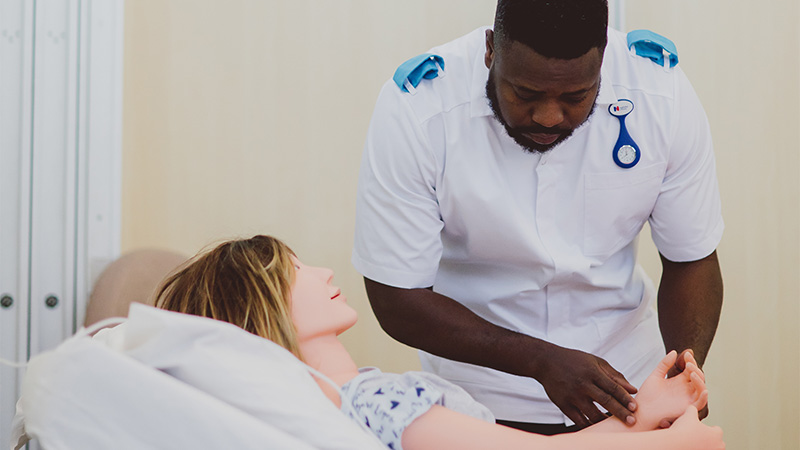
Access to outstanding facilities including our state-of-the-art simulation suite means you can develop your clinical expertise in a safe environment. You'll also collaborate with students from nursing and paramedic courses and medical students for Oxford University.
Our team of highly qualified practitioners will support and guide you throughout.

Study modules
Teaching for this course takes place
Face to Face and you can expect around 7 hours of contact time per week.
In addition to this, you should also anticipate a workload of 1,200 hours per year. Teaching usually takes place Monday to Friday, between 9.00am and 6.00pm.
Contact hours involve activities such as lectures, seminars, practicals, assessments, and academic advising sessions. These hours differ by year of study and typically increase significantly during placements or other types of work-based learning.
Please note: As our courses are reviewed regularly as part of our quality assurance framework, the modules you can choose from may vary from those shown here. The structure of the course may also mean some modules are not available to you.
Careers
After completing the course, you'll be able to register as a children’s nurse with the NMC and work in a range of settings. There are many career possibilities, especially with the rapid growth in digital healthcare and research. On graduation and registration with the NMC, most of our students gain employment in the NHS. You can go straight into hospital positions in acute, critical or emergency care. Alternatively, you could choose to make a difference in the community or support at a research facility?
As you progress in your career, you will have a wider range of options open to you, whether that is in advanced practice management or education. Some students choose to study for a PhD in order to pursue a career in academia or clinical research.
Whichever route you take, we have a strong track record of successful graduate employment - many of our students are headhunted because of the vast range of experience given on the course.
Entry requirements
Wherever possible we make our conditional offers using the UCAS Tariff. The combination of A-level grades listed here would be just one way of achieving the UCAS Tariff points for this course.
Standard offer
UCAS Tariff Points: 112
A Level: BBC
IB Points: 27
BTEC: DMM
Contextual offer
UCAS Tariff Points: 88
A Level: CCD
IB Points: 24
BTEC: MMM
Specific entry requirements
A Level: Including one A Level or a comparable Level 3 qualification in a science subject (e.g. Physical Education, Biology, Chemistry, Maths, Physics, Psychology).
GCSE: Grade 4 (C) in English, Maths and Science. For English and Maths, Level 2 Functional Skills are accepted as alternatives to GCSEs.
Relevant experience (e.g. in a hospital) or a suitable indication of your interest in, and understanding of, the relevant healthcare profession.
Caring for vulnerable children and their families is very fulfilling but it is important to recognise that it can be emotionally challenging too. We find that students enjoy their course and are more successful if they have carefully considered these factors and reflected on their personal readiness to embark upon a children's nursing career prior to starting the course. We are happy to talk through any individual concerns or queries you may have.
Securing a place is subject to both a satisfactory DBS and an Occupational Health clearance. If neither clearance has been completed prior to enrolment or a DBS issue has been declared on application, then enrolment may not be possible.
If enrolment has been agreed, then continuation on the programme will be contingent on satisfactory clearances.
Please also see the University's general entry requirements.
Screening
All applicants will be screened for fitness to practise and a Disclosure and Barring Service (DBS) check will be made.
Selection process
For this course, the University operates a gathered field approach to admission. This means that applications are assessed in groups, ensuring a fair and comprehensive selection process when the level of interest exceeds the number of places available.
As part of this process, following your interview, you may be placed on a waiting list until most interviews have been completed. If you are placed on the waiting list, you can expect to receive your decision before the end of March. We appreciate your patience and will keep you informed throughout the process.
All Oxford Brookes University Health and Social Care Programmes conduct Value Based Recruitment (VBR). We recognise that values and attitudes have the greatest impact on the quality of people's care and their experiences.
VBR is a way of helping our Programme recruitment teams to assess the values, motives and attitudes of those who wish to work with people in health and social care settings. When we refer to values we mean, for example, the values included in the NHS constitution.
VBR focuses on 'how' and 'why' an applicant makes choices in how they act and seeks to explore reasons for their behaviour. Further details about the VBR framework.
All shortlisted applicants will be invited for an interview.
English language requirements
An IELTS score of 6.5 in all areas is required for ALL applicants whose first language is not English.
Please also see the University's standard English language requirements.
English requirements for visas
If you need a student visa to enter the UK you will need to meet the UK Visas and Immigration minimum language requirements as well as the University's requirements. Find out more about English language requirements.
Credit transfer
Many of our courses consider applications for entry part-way through the course for students who have credit from previous learning or relevant professional experience.
Find out more about transferring to Brookes. If you'd like to talk through your options, please contact our Admissions team.
Terms and conditions of enrolment
When you accept our offer, you agree to the Terms and Conditions of Enrolment. You should therefore read those conditions before accepting the offer.
International qualifications and equivalences
How to apply
Application process
Accommodation for this course
If you're applying for this course, please note that there are specific accommodation arrangements for some students. Find out more about accommodation options for this course.Tuition fees
Questions about fees?
Contact Student Finance on:
Tuition fees
Please note, tuition fees for Home students may increase in subsequent years both for new and continuing students in line with an inflationary amount determined by government. Oxford Brookes University intends to maintain its fees for new and returning Home students at the maximum permitted level.
For further information please see our tuition fees FAQs.
Tuition fees for International students may increase in subsequent years both for new and continuing students.
The following factors will be taken into account by the University when it is setting the annual fees: inflationary measures such as the retail price indices, projected increases in University costs, changes in the level of funding received from Government sources, admissions statistics and access considerations including the availability of student support.
How and when to pay
Tuition fee instalments for the semester are due by the Monday of week 1 of each semester. Students are not liable for full fees for that semester if they leave before week 4. If the leaving date is after week 4, full fees for the semester are payable.
- For information on payment methods please see our Make a Payment page.
- For information about refunds please visit our Refund policy page
Additional costs
Please be aware that some courses will involve some additional costs that are not covered by your fees. Specific additional costs for this course are detailed below.
Compulsory costs
| Additional costs | Amount (£) |
|---|---|
| For clinical practice you will need some specialist equipment, this could include a stethoscope and a watch. | £60-250 |
If you are a student from the UK, you will typically be eligible for reimbursement of reasonable transport and / or accommodation costs that you incur on your clinical placements whilst studying the course. This is via the NHS Learning Support Fund. There is also support for international students. Details on expenses and financial support are available on the Placement Education Unit webpage. |
£30-1500 per year |
You will be provided with one allocation uniform. You will need to buy suitable shoes that are both professional and functional in line with the dress code. |
About £30-60 |
For placements in a non clinical enviroment you will need suitable clothing to wear instead of your uniform |
From £60-250 |
If digital identity checking is not possible for your DBS application, you may need to take your documents to the Post Office for verification. |
£16 |
Optional costs
| Additional costs | Amount (£) |
|---|---|
| Disclosure Barring Service (DBS) top-up check (to keep up to date) | £13 |
Your living expenses will depend on a variety of things, including your accommodation choices and your lifestyle, and can include things like food, course materials, social activities, and household goods and other expenses. |
£271-328 per week |
| If you choose to participate in any additional, optional trips, you are responsible for any associated costs. | £10-150 |
It’s your responsibility to cover print / binding costs where coursework submission is required. Please note that a lot of the coursework is now submitted online. |
From £30 |
| You may choose to purchase books to support your studies. Many books on our reading lists are available via the Library, or can be purchased secondhand. | £20-60 per book |
Accommodation fees in Brookes Letting (most do not include bills) |
£107-301 per week |
Accommodation fees in university halls (bills included, excluding laundry costs) |
£139-248 per week |
Graduation costs include tickets, gowning and photography. Gowns are not compulsory but typically students do hire robes, starting at £41. |
Typically £0-200 |
Fines are payable on items returned late although we will give you 5 days to return an item before fines are payable. Find out more about how to borrow and return items. |
£1 per book |
|
Students are responsible for their own travel to and from university for classes with single bus fares in the UK currently capped at £3. Oxford Brookes has committed to offering heavily discounted bus travel for students for at least three years from July 2026 with further information on our Travel webpages. |
From £3 |
Funding your studies
Financial support and scholarships
Featured funding opportunities available for this course.
All financial support and scholarships
Information from Discover Uni
Full-time study
Programme changes:
On rare occasions we may need to make changes to our course programmes after they have been
published on the website. For more information, please visit our
changes to programmes page.