

Economics, Politics and International Relations

BA (Hons)

UCAS code: LL21

Start dates: January 2026 / September 2026 / January 2027

Full time: 3 years, or 4 if a work placement is chosen

Part time: up to 8 years

Location: Headington

School(s): Oxford Brookes Business School

Find a course

Expand

Overview

From fully fledged battles to economic sanctions… what’s changed? Over the last hundred years, the world of politics and international relations has evolved rapidly. In the past, war has been a first response to conflict, but now economic sanctions are front and centre when it comes to political tactics that are being used to respond to conflict and influence political behaviour.

Political and economic events are closely linked so it’s important that we look at them side by side. Our BA Economics, Politics and International Relations is designed to do exactly that. You’ll look beyond the headlines and explore the forces shaping today’s world.

Understanding how to link theory and practice is key. We’ll explore the economic factors shaping the relationships between national governments and examine the issues that are central to the lives of people around the world.

The way you learn will be as diverse as the subjects you study. One day you might be discussing competing theoretical frameworks, the next you’ll be problem-solving and practising making policy recommendations.
Order a Prospectus Ask a question Attend an open day or webinar

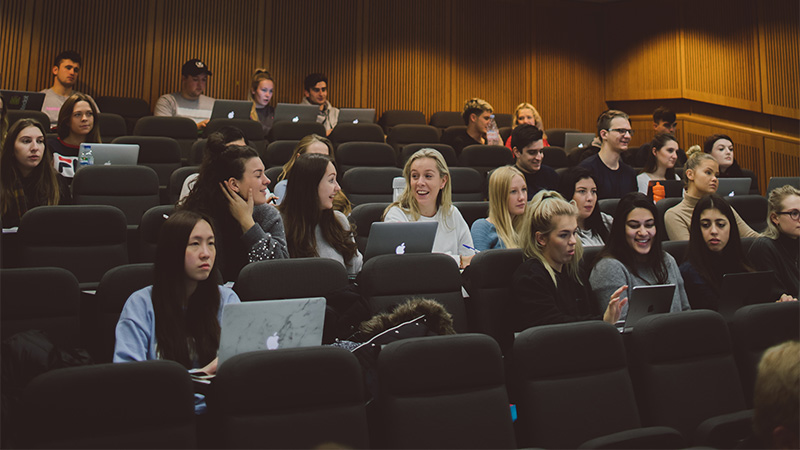
Students in a lecture theatre

Why Oxford Brookes University?

  • Learn from leaders
    Our world-class research on everything from environmental and natural resource economics to the role of imperialism on modern British policy feeds into what you learn in the classroom.
  • Study abroad
    Spend time in a different country to experience a different culture and broaden your perspective. Some universities make you choose between studying abroad or a placement. Here you can do both.
  • Boost your employability
    Join student-led societies focused on this area, listen to guest speakers and study abroad to make your CV shine.
  • Customise the course
    Shape your study with optional modules that allow you to explore a range of topics from international trade to ethics, power and world politics.
  • Placement opportunity
    We’ll help you find a placement that aligns with your ambitions. Past students have worked at The Walt Disney Company, Office National Statistics, IBM, John Lewis and more.
  • Study abroad

    You may be able to go on a European or international study exchange while you are at Brookes. Most exchanges take place in the second year. Although we will help as much as we can with your plans, ultimately you are responsible for organising and funding this study abroad.

Course details

Course structure

Your first year focuses on giving you a strong foundation in economics, politics, and international relations. Developing tools and skills for the rest of your degree will be a key part of your study too.

Throughout the course, you’ll have opportunities to decide what direction to take. You will have the flexibility to focus more on economics or on politics and international relations, as you progress. You also develop data handling skills.

After your second year, you’ll have the opportunity to go on placement. This experience gives you the chance to work for a prestigious company and add experience to your CV. Past students have worked at big names including The Walt Disney Company, IBM, John Lewis, and many more.

In your final year, you’ll choose more optional modules to continue to hone your expertise. You may choose to do an optional dissertation. Students have previously explored a range of areas via their dissertation, from the effect of corruption on Russian industry to climate change and consumption.
Group study

Learning and teaching

On this course your learning experience will be exciting and challenging. You will develop confidence and the necessary skills to take on the demands of graduate jobs in leading international organisations.

Our teaching methods include:

  • lectures
  • seminars
  • workshops
  • group projects
  • presentations
  • role plays
  • analysis of numerical data
  • discussions of topical material
  • guest speakers.

You’ll also learn through e-learning activities such as:

  • self-study quizzes
  • diagnostic assessments
  • computer-based simulations
  • online discussion groups.

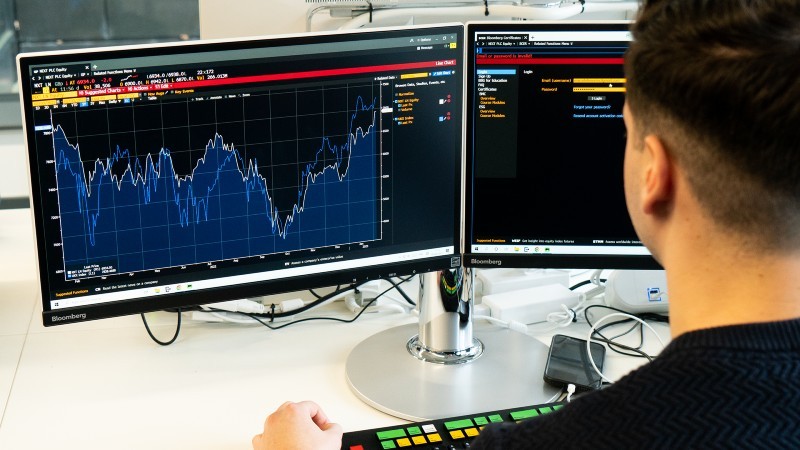
We are delighted to have launched our new Bloomberg Trading Suite.

Students on our Accounting, Finance and Economics courses can gain certification and experience of trading on the financial markets by making mock transactions using real-world financial market data. Read our in-depth news story to find out more.

Bloomberg Trading Suite News Article

Assessment

The majority of modules use a combination of both examinations and coursework for assessment. However some modules are assessed solely by coursework or by examination.

You will benefit from ongoing in-depth, specific feedback on your work.

Start this course in January or September

You can start this course in January if a September start doesn't suit you or is not currently offered for this course.

If you opt to start in January, in each of your 3 years, you will study your first semester between January and May and your second semester between September and December. There will be no teaching during June, July and August. 

Study modules

Teaching for this course takes place Face to Face and you can expect around nine hours of contact time per week. In addition to this, you should also anticipate a workload of 1,200 hours per year. Teaching usually takes place Monday to Friday, between 9.00am and 6.00pm.

Contact hours involve activities such as lectures, seminars, practicals, assessments, and academic advising sessions. These hours differ by year of study and typically increase significantly during placements or other types of work-based learning.

Year 1

Compulsory modules

  • Microeconomics I

    This module on microeconomic analysis will introduce you to economic models and analytical methods of reasoning. Through diagrammatic and mathematical models, you'll explore consumer and producer behaviour. You will learn to recognise relationships between economic variables and present these relationships diagrammatically, as well as interpret market data and apply it to real-world scenarios.

    By the end of the module, you will have a comprehensive understanding of microeconomic principles and be able to apply these principles to real-world situations, as well as evaluate economic policies using the analytical tools and models that you have learned. In addition to developing your academic literacy and research literacy skills, you'll grow skills in self-management, communication, problem-solving and critical thinking.

  • Macroeconomics I

    In this module, you will learn about the fundamentals of macroeconomics. You will cover key areas such as consumption, investment, savings, taxation, and the foreign sector. You will gain an understanding of how these variables relate to each other and how they impact the economy. Throughout the module, you will use real-world situations to illustrate the relevance of macroeconomics to your life as a student. You will develop the skills necessary to analyse and evaluate government policies on economic issues, identify the strengths and weaknesses of market economies, and prepare an argument and analysis of a particular macroeconomic event or change.

    By the end of this module, you should have a solid understanding of macroeconomic theory and its real-world applications. You will be able to analyse and evaluate economic policies and their impact on the economy, and identify the strengths and weaknesses of market economies as a mechanism of resource allocation. 
     

  • Quantitative Methods for Economics & Finance

    This module provides an introduction to essential quantitative techniques that are relevant to students
    of economics, finance and business. Students will be made familiar with appropriate statistical
    software that can be used for applied economics analysis. Using Excel as the primary calculative
    software tool enhances the scope of the module because it allows students to learn transferable

    employability skills, engage with real-world data and learn how to interpret their obtained results. On
    completion of the module, students will have competence in the application of mathematical
    techniques relevant to problems in economics, finance and business, an understanding of the
    essential mathematics of finance and an understanding of the basic techniques of optimisation in the
    context of economics, finance and business.

  • Political Socialisation and Ideology

    Why do we vote the way we do? What affects our actions, and our political decisions? In this module, we’ll investigate politics through human behaviour. You’ll explore political culture, and how we participate in a democratic society. We’ll also look at how humans are socialised to hold various political views. You’ll gain a key insight into how ideas and ideologies affect our behaviour individually and as a group. 

  • Politics in Comparative Perspective

    In this module, you’ll investigate politics, and the struggle for power, across the nations. You’ll gain a clear introduction to how and why political systems differ in our world today. You’ll examine case studies from a wide range of states, and gain a strong insight into how different regimes function – from the democratic to the totalitarian.

  • From Empire to States: the Origins on International Relations

    In this module, you’ll dive into International Relations and its key theories. You’ll explore how International Relations emerges from specific cultural and historic concerns. You’ll gain core analytical skills, as you interpret historical events such as the First World War, decolonisation and the ‘War on Terror’, and use them to explore pressing debates in International Relations.

    You’ll learn how International Relations has been shaped as a Western discipline, and how to challenge this by learning about aspects of international relations that have been erased or forgotten, such as colonialism and imperialism. You’ll learn to see International Relations as a rich array of competing stories about our world and what’s possible within it. 
     

  • Global Challenges in International Relations

    In this module, you’ll explore the leading issues of current world politics.

    You’ll investigate the key figures, structures and processes in world politics - like states, political economies and multinational societies.

    You’ll also analyse concepts such as:

    • anarchy
    • order
    • sovereignty
    • conflict and cooperation among states, and non-state figures.

    You’ll also investigate the chronic issues of world politics, including:

    • gender
    • migration
    • human rights
    • humanitarian intervention
    • energy resources and the environment
    • development, inequality and poverty.

     We’ll explore how different nations manage these issues and what this tells us about international governance.
     

Year 2

Compulsory modules

  • Microeconomics II

    This intermediate module enriches the understanding of microeconomic theory built in previous modules. It covers individual consumer preferences, market demand analysis, production costs, pricing behaviour of firms, and asymmetric information. You'll apply economic theory to real-world scenarios, including issues of price and income subsidies, taxation, insurance, and asset markets. The module utilises a graphical approach to help you develop a basic understanding of general equilibrium theory. You'll learn to distinguish between issues of equity and efficiency in product markets, gaining a deeper understanding of economic policies' societal impact.

    Through this module, you'll also develop self-management, learning, communication, and problem-solving skills essential to success in academic and professional settings. 

  • Macroeconomics II

    In this module, you will delve deeper into macroeconomic theory and policy by examining national economies and international linkages. You will analyse long and short-run macroeconomic models, fiscal and monetary policies, exchange rate policies, government debt, and currency unions. Through theoretical analysis and examination of recent economic events, you will develop a critical understanding of macroeconomic hypotheses and competing approaches. You will also enhance your problem-solving, critical thinking, and data analysis skills to apply theoretical understanding and empirical knowledge to macroeconomic policy debates.

    By completing this module, you will gain critical self-awareness by assessing the impact of macroeconomic shocks and economic policies in determining key economic variables. The carefully curated learning framework will enhance problem-solving and critical thinking skills, as well as the ability to work independently and as part of a team.

  • Exploring and Enhancing Employability

    This module will help you develop the knowledge, skills and attitudes you’ll need for making your career decisions and managing your future career development. You’ll also cover

    • transitions into graduate employment
    • self-employment 
    • further study 
    • professional training courses 

    in the UK or overseas. 

    You’ll be supported to take an informed and critical view of the world of work and think about your future role and responsibilities, not only to yourself but also to others. You’ll also learn about the University Careers Service and OBBS WAVES team. You’ll have the opportunity to go into placements, internships, volunteering and other extracurricular activities offered by the University.
     

  • Researching Politics and International Relations

    In this module, you’ll develop the practical research skills you need to design and carry out your first piece of social sciences research. You’ll start with the ‘big questions’ of ‘What exists?’ and ‘How can we know about what exists?’ From here, you’ll move on to consider the different research methods and their implications. You’ll take part in hands-on workshops and practical sessions, preparing you to conduct your research for your final-year dissertation.
     

  • Global Political Economy

    In this module, you’ll get to know the global economy. You’ll investigate how economics and politics shape world affairs in both trivial and profound ways. 

    In part 1, you’ll gain a strong knowledge of the history of the world economy. You’ll develop key analytical skills, as you explore competing explanations of how it functions. You’ll gain the tools you need to understand recent economic changes.

    In part 2, you’ll dig into key debates on how the global economy functions today, including: 

    • finance
    • global production
    • trade and international development
    • the relationship between the global economy and the environment. 
       
  • UK Politics

    How much did world leaders rely on history to make decisions? In this module, you’ll look at governing strategy from the 20th century to the present day. You’ll choose either the British or Soviet states, and analyse how their leaders managed crises and issues. You’ll also explore the relationship between politics and economics, and apply key approaches to the problems of governing.  

Optional modules

  • Choose 2 Optional modules from those below:

  • US Politics

    In this module, you can investigate the politics of the USA, subject to student numbers and staff availability. 

    You’ll focus on governmental and political institutions. You’ll also explore explosive issues in American politics, including religion, race and capital punishment.


  • European Politics

    In this module you'll look at and analyse governmental and political institutions in Europe. You'll cover policy-making, the participatory process and contemporary issues in European politics, with a focus on comparative study as well as the process of regionalisation. You'll examine:

    • The evolution of democracy and citizenship in Europe
    • Parties, party systems and elections in Europe 
    • The EU and theories of European integration
    • Regional nationalism and sub-state governance in Europe
    • The unique challenges facing post-communist Europe
    • The rise of populist nationalism in Europe
    • The politics of migration in Europe
    • The European welfare state
    • The impact of global challenges on European politics.
  • Nations and Nationalism

    In this module, you’ll explore the effect of nationalism, ethnicity and regime change on a country. You’ll get to grips with the different approaches we use to explore them. You’ll gain fantastic analytical skills as you apply these approaches to real world cases, and investigate the implications of their different perspectives. 

    You’ll also look at how globalisation impacts the politics and identity of a country. You’ll analyse the ways in which globalisation can be a force for good (spreading democracy) and bad (divisive, leading to nationalist resistance)
     

  • International Labour Markets

    This module examines the diversity of national policy approaches to labour market and social issues. You’ll undertake a comparative economic analysis of the behaviour of employers and employees operating in the global marketplace. Using a common framework of the economic theory of labour markets, you’ll also critically evaluate how governments, economic, social and other institutions alter outcomes in labour markets. 
    By completing this module, you’ll be able to present a range of international labour market data, defend appropriate policy proposals and solutions to labour market issues, and recognise the implications for analysis of various social and cultural phenomena.
     

  • Applied Econometrics

    This module provides an introduction to the interpretation and analysis of economic data through the application of appropriate statistical and econometric methodologies. You will gain practice in applying theory and develop your skills of statistical and econometric analysis through the completion of problem sets. Practising quantitative techniques in seminars is essential in helping you to identify your learning needs and to encourage you to become critically self-aware of your relative strengths and weaknesses in relation to the acquisition of quantitative skills, a fundamental attribute of graduates in economics and finance.

    On completion of the module you will have an understanding of hypothesis testing and statistical inference; the ability to conduct essential statistical analyses of data; and an understanding of regression analyses.

  • History of Economic Thought

    This module provides an introduction to the historical development of economic ideas. In so doing it is designed to illuminate both the influence of such ideas within a variety of social and political contexts and against the background of debates in economic policy. It aims to demonstrate the variety of approaches which can be taken to the study of economic phenomena and the traditions to which they give rise.

    Upon successful completion of this module, you will be able to appreciate the relationship between developments in economic thought and within general society, critically evaluate the ideas of economic thinkers and appreciate the diversity of paradigms which have influenced the development of economic doctrine over time.
     

  • International Trade

    You’ll be introduced to international trade and economic integration. And you’ll use partial equilibrium tools of economic analyses to analyse trade policy options and assess the welfare implications of these policies. Throughout this module, you’ll also explore the institutional arrangements of various trading blocks through reviewing multilateral and global institutions. 

    Upon successful completion of this module, you’ll  be able to understand the economic rationale of international trade, and the stages of economic integration, including their relevance to international negotiations. You’ll also gain problem-solving and IT skills.
     

  • Uncivil Society: Constituting Global Order

    How do we govern the world, when it’s no longer dominated by states and national governments? How do different types of migration shape the movement of people across the world? In this module, you’ll get to grips with a key part of international relations - borders and solidarities (groups with a common identity or interest). You’ll explore the various forms of borders and solidarities, including:

    • migrations across national boundaries 
    • regional organisations
    • trade agreements.

    You’ll link them to key forces and events, such as: 

    • NGOs
    • corporations
    • colonisation
    • refugee movements
    • the migrant ‘crisis’.

    You’ll gain valuable practical and professional knowledge, as you explore major issues today, and how global governance or migration shape our lives. 
     

Year 3 (optional placement year)

Optional modules

  • Optional Work Placement Year

    On this placement you will be able to access a 40-52 week work-based learning / placement opportunity to help develop your employability and enterprise skills. You will gain first-hand knowledge and experience of making applications to and working in a placement role. You will set your own work-based targets and reflect upon your progress in the role you have on your placement. Halfway through your placement you will make a presentation to your line manager and placement tutor which summarises your gained knowledge on your placement and the tasks you have/ will complete in your placement role.

Final Year

Compulsory modules

  • Perspectives on Global Challenges

    This module is your advanced introduction to pluralism and competing paradigms in economics, finance and international business. You will investigate contemporary topics by using theoretical and empirical tools in economics and finance where you’ll employ orthodox and non orthodox approaches. 

    Through the module you’ll develop a deep understanding of key global trends and outcomes that are relevant to the world of international business. Also you will progress your analytical investigation skills in the sphere of global economics.
     

  • The Environment, Sustainability and Social Justice

    How can we respond to and solve global injustice and the ecological crisis without a world government? How can we resolve issues in international politics which are beyond the limit of individual countries? A global unified approach is critical for success. 

    In this module, you’ll gain knowledge of the theory and practice of global development, justice and sustainability. And build your analytical skills.  You'll take a combined approach of looking at global development and the ecological crisis. You'll examine competing and contrasting perspectives that feature across these global issues. Helping you gain understanding in their global justice implications. Also you'll look at international policy responses and global governance initiatives. 
     

Optional modules

  • Choose 5 Optional Modules from those below:

  • Environmental Economics

    On this module, you build your understanding of modelling techniques and analytical tools of environmental economics. You will be able to critically analyse a range of environmental issues which impact environmental externalities on economic agents and the range of policy responses available to policymakers.

  • Economic Growth

    This module uses economic theory to analyse the structure and forces behind economic growth and development. You will learn standard theorie of economic growth and use those theories to analyse the process of economic growth across countries. You will familiarize with a set of important issues that are central to macroeconomics; develop some dynamic economics knowledge useful in macroeconomics as well as in a number of other sub-disciplines. By the end of the module you will gain  tools to analyse the economy with a long-run perspective that is normally overlooked in the other macroeconomic modules.
     

  • Behavioural Economics

    Build your understanding of the concept called ‘homo economicus’ where individuals are considered to be perfectly rational and concerned only about maximising their own welfare. Your understanding of strategic behaviour in encounters with other individuals, modelled as games will broaden. You’ll examine concepts such as:

    • bounded rationality
    • cognitive bias
    • market design
    • equilibrium selection
    • and policies in detail.

    By the end of the module you’ll have a critical understanding of the new stream of thinking that has developed within economics in the last few decades. You’ll have knowledge of what allows people to make mistakes in decision-making and be altruistic – i.e. care about others’ utility as well as their own.
     

  • Economics, Politics and International Relations Dissertation

    For this dissertation, you will engage in research and employ methodologies that require a thorough understanding of the process of research as well as using published research material. You'll deeply study a topic, selected with appropriate supervision and guidance from any suitable area of Economics in combination either with Politics or International Relations.

    In keeping with the interdisciplinary character of the module, it is expected that you choose from a plurality of methodological approaches of both a quantitative and qualitative character.
     

  • Conflict and Peacebuilding

    From terrorism to mass protests, how do we make sense of violence and resistance? In this module, you’ll explore the tensions between local and global communities in building peace. You’ll investigate how identity markers such as gender, race, nationality and ethnicity relate to violence and resistance. You can choose to focus on violence, resistance and identity politics, or violent conflict and peacebuilding.

  • Advanced Applied Econometrics

    Further and broaden your knowledge of econometrics. You’ll progress and develop your econometric skills that are needed to be able to successfully investigate economic and financial relationships by using appropriate econometric methodologies. You’ll study examples based on both economic and financial data that illustrate the application of the methodologies you’ll learn to use.

  • Economics, Politics and International Relations Dissertation

    For this dissertation, you will engage in research and employ methodologies that require a thorough understanding of the process of research as well as using published research material. You'll deeply study a topic, selected with appropriate supervision and guidance from any suitable area of Economics in combination either with Politics or International Relations.

    In keeping with the interdisciplinary character of the module, it is expected that you choose from a plurality of methodological approaches of both a quantitative and qualitative character.
  • Human Rights and Global Politics

  • Global Development


  • Terrorism and Counter Terrorism

    How does violence occur in different societies? How do people’s ideas of violence affect their cultures? In this module, you’ll look at how states manage violence such as terrorism. You’ll also consider how social norms and military values of violence shape our lives. You can choose to specialise in terrorism or counter-terrorism, or critical militarism studies. 

Please note: As our courses are reviewed regularly as part of our quality assurance framework, the modules you can choose from may vary from those shown here. The structure of the course may also mean some modules are not available to you.

Careers

You’ll be ready to work in prestigious companies around the world with roles in management, journalism, financial crime advisory, to working for organisations like the World Bank, the International Monetary Fund, NGOs, the third sector and much more. You could also decide to progress your studies to postgraduate level. How you use your degree is up to you.

Throughout your degree, we’ll help you prepare for your future. We have a module completely focused on employability in your second year where you’ll develop your CV, learn interview skills and explore assessment centres in order to prepare you for the graduate market.

You’ll be the perfect match for roles in: 
  • the diplomatic service
  • management
  • teaching
  • publishing
  • journalism
  • local government
  • law
  • trade unions.

Student profiles

Our Staff

Andy Kilmister

Andy teaches on a range of modules and research within the Business School and also act as an academic adviser. I am module leader for the Economics dissertation modules.

Read more about Andy

Dr Yoko Nagase

My primary teaching areas are microeconomics, Environmental and natural resource economics, public finance, and mathematical economics. I have also taught multi-disciplinary modules/courses such as Environmental Studies Senior Seminar (co-taught with a team of scholars in natural sciences) and a reading course for first-year students.

Read more about Yoko

Entry requirements

Wherever possible we make our conditional offers using the UCAS Tariff. The combination of A-level grades listed here would be just one way of achieving the UCAS Tariff points for this course.

Standard offer

UCAS Tariff Points: 112

A Level: BBC

IB Points: 27

BTEC: DMM

Contextual offer

UCAS Tariff Points: 88

A Level: CCD

IB Points: 24

BTEC: MMM

Further offer details

Applications are also welcomed for consideration from applicants with European qualifications, international qualifications or recognised foundation courses. For advice on eligibility please contact Admissions: admissions@brookes.ac.uk

If you don’t achieve the required tariff points you can apply to join a foundation course, like Foundation in Business or an international foundation course to help to reach the required level for entry onto this degree.

International qualifications and equivalences

Tuition fees

Please see the fees note
Home (UK) full time
£9,535

Home (UK) part time
£1,190 per single module

Home (UK) sandwich (placement)
£1,700

International full time
£17,100

International sandwich (placement)
£1,700

Home (UK) full time
£9,790

Home (UK) part time
£1,220 per single module

Home (UK) sandwich (placement)
£1,905

International full time
£19,700

International sandwich (placement)
£1,905

Questions about fees?

Contact Student Finance on:

Tuition fees

2025 / 26
Home (UK) full time
£9,535

Home (UK) part time
£1,190 per single module

Home (UK) sandwich (placement)
£1,700

International full time
£17,100

International sandwich (placement)
£1,700

2026 / 27
Home (UK) full time
£9,790

Home (UK) part time
£1,220 per single module

Home (UK) sandwich (placement)
£1,905

International full time
£19,700

International sandwich (placement)
£1,905

Questions about fees?

Contact Student Finance on:

+44 (0)1865 534400

financefees@brookes.ac.uk

Please note, tuition fees for Home students may increase in subsequent years both for new and continuing students in line with an inflationary amount determined by government. Oxford Brookes University intends to maintain its fees for new and returning Home students at the maximum permitted level.

For further information please see our tuition fees FAQs.

Tuition fees for International students may increase in subsequent years both for new and continuing students.

The following factors will be taken into account by the University when it is setting the annual fees: inflationary measures such as the retail price indices, projected increases in University costs, changes in the level of funding received from Government sources, admissions statistics and access considerations including the availability of student support. 

How and when to pay

Tuition fee instalments for the semester are due by the Monday of week 1 of each semester. Students are not liable for full fees for that semester if they leave before week 4. If the leaving date is after week 4, full fees for the semester are payable.

  • For information on payment methods please see our Make a Payment page.
  • For information about refunds please visit our Refund policy page

Additional costs

Please be aware that some courses will involve some additional costs that are not covered by your fees. Specific additional costs for this course are detailed below.

Information from Discover Uni

Full-time study

Part-time study

Programme changes:
On rare occasions we may need to make changes to our course programmes after they have been published on the website. For more information, please visit our changes to programmes page.