
Politics

BA (Hons) or BSc (Hons)

Start dates: September 2026 / September 2027

Full time: 3 years

Part time: up to 6 years

Location: Headington

School(s): School of Social Sciences

Find a course

Expand

Overview

Expose the link between people and political power. Our politics degree helps you make sense of an ever-changing world, understand the facts and use them to form coherent, compelling arguments about what’s going on in our times.

You’ll grapple with some of the most pressing issues of the modern era, such as:

  • nationalism and populism
  • regional politics, e.g. Russia, South Africa, and Europe
  • conflict and peacebuilding
  • gender equality and racial justice.

Also, you’ll be joining a community where those around you are socially, politically, and environmentally conscious and active.

As this is a joint honours degree, you can study it alongside another discipline of your choice and explore how they overlap. You may combine politics with:

  • Communication, Media and Culture
  • Criminology
  • History
  • Philosophy
  • Sociology.

Order a Prospectus Ask a question Attend an open day or webinar

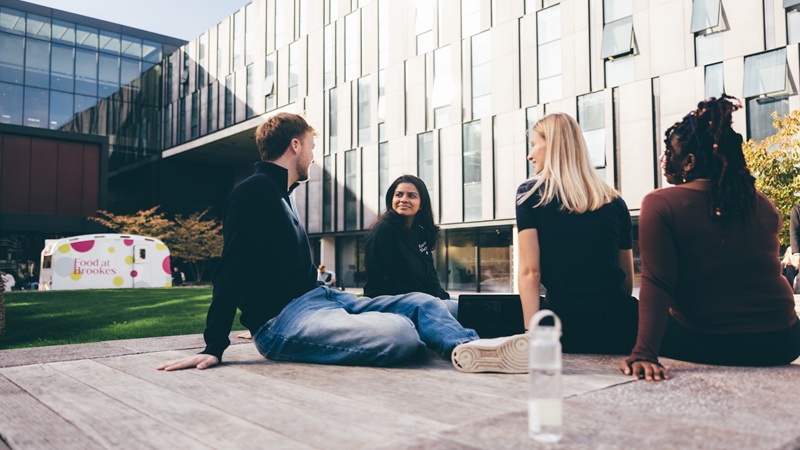
Student group outside on campus all talking to each other

Why Oxford Brookes University?

  • The heart of politics

    From colonialism to refugee action, Oxford is at the epicentre of modern political debate.

  • Constant support

    Our classes are small, meaning you’ll receive the attention and guidance you need.

  • Familiar faces

    Develop good working relationships with your tutors – many of whom are active researchers.

  • Relevant topics

    The course deals with contemporary political and social issues, like rising nationalism and tensions in Eastern Europe.

  • Stimulating activity

    We don’t just assess you with coursework and essays – you’ll get involved with NGO briefings, peace negotiation simulations and reflective diaries.

  • Additional language modules

    Our university-wide language programme is available to full-time undergraduate and postgraduate students on many of our courses, and can be taken as a credit on some courses.

Course details

Course structure

In year 1, you’ll discover the essentials of modern political issues. By exploring a broad range of political systems and ideologies, you’ll develop skills essential for success in your future career.

During year 2, you’ll debate the great issues of contemporary politics. You’ll sharpen your analytical and debating techniques, mould critical perspectives and turn facts and opinions into a clear, persuasive argument. The optional placement lets you get experience in the working world, boosting your job prospects.

In  year 3, you have the opportunity to complete a dissertation on an aspect of politics, your other subject or a combination of both. This is a fascinating opportunity to see how your two disciplines inform each other. Optional modules let you explore specialist political to

Student working on his laptop on campus

Learning and teaching

Our teaching staff are active researchers and their research directly informs your learning.

Our teaching methods include:

  • role play exercises
  • group work
  • video presentations
  • podcasts
  • placement learning
  • individual tutorials
  • lectures and seminars. 

You can attend our Centre for Global Politics, Economy and Society seminars, where speakers from other universities discuss their research.

We host our ‘Politics at Work’ seminar series for those interested in a career in international development / humanitarian aid. 

Assessment

We assess you with coursework and examinations. Coursework includes:

  • essays
  • group projects
  • field trips
  • role play
  • individual and group seminar presentations.

We assess some modules through an examination, and others solely through your work during the semester.

Study modules

Teaching for this course takes place face to face, and you should also anticipate a workload of 1,200 hours per year. Teaching usually takes place Monday to Friday, between 9.00am and 6.00pm.

Contact hours involve activities such as lectures, seminars, practicals, assessments, and academic advising sessions. These hours differ by year of study and typically increase significantly during placements or other types of work-based learning.

Year 1

Compulsory modules

  • Political Socialisation and Ideology

    Why do we vote the way we do? What affects our actions, and our political decisions? In this module, we’ll investigate politics through human behaviour. You’ll explore political culture, and how we participate in a democratic society. We’ll also look at how humans are socialised to hold various political views. You’ll gain a key insight into how ideas and ideologies affect our behaviour individually and as a group. 

  • Politics in Comparative Perspective

    In this module, you’ll investigate politics, and the struggle for power, across the nations. You’ll gain a clear introduction to how and why political systems differ in our world today. You’ll examine case studies from a wide range of states, and gain a strong insight into how different regimes function – from the democratic to the totalitarian.

  • Building Academic Skills and Engagement

    In this module, you will be supported in developing the academic, digital, and transferable skills required for success at university and beyond. It introduces key principles of independent learning, research, academic writing, and communication within the social sciences.

    You will learn how to read critically, write effectively, manage your time, and engage with evidence and argument. You will also be introduced to university support services to build confidence, independence, and a sense of academic belonging.

Optional modules

  • From Empires to States: the Origins of International Relations

    In this module, you’ll dive into International Relations, and its key theories. You’ll explore how International Relations emerges from specific cultural and historic concerns. You’ll gain core analytical skills, as you interpret historical events and use them to explore pressing debates on International Relations.

    You’ll learn how International Relations has been shaped as a Western discipline, and how to challenge this by learning about aspects of international relations that have been erased or forgotten. You’ll learn to see International Relations as a rich array of competing stories about our world and what’s possible within it.

  • Foundations of Social Theory

    What is social theory? Who are the major social theorists, and what do they have to say about things like power, beliefs and values, capitalism, feminism and more? In this module, you’ll explore key concepts and theories in classical and contemporary sociology. You’ll also immerse yourself in current debates, developments and approaches to social theory and you’ll encounter theories like Marxism, postcolonialism, functionalism and more.

  • Challenging the Headlines

    In this module, you will closely analyse International Relations and Politics through the lens of the media, and learn to link your consumption of media to broader global political issues. Through this study, you will develop your understanding of Politics whilst also building on your core skills that will assist you throughout your studies, such as confidence, self-analysis and planning for the future. The first in a series of three modules running throughout the programme, Challenging the Headllines will support you in developing vital and transferable skills as you approach graduation, enabling you to suit a range of future workplaces.

Year 2

Compulsory modules

  • Theorising Power & Society

    In this module, you’ll dive into key ideas within social and political theory. You’ll explore the key debates on themes such as: 

    • the State
    • gender
    • freedom
    • equality
    • power.


    By exploring texts, including Hobbes’ Leviathan and Rousseau's The Social Contract, as well as evaluating topics such as capitalism, progress and “the end of history”, you will develop your interpretation and analysis skills.


  • Researching Oxford and Beyond

    In this module, you will be introduced to a variety of research methods which will equip you with the understanding and skills needed to analyse research outcomes. You will study the methods that social scientists use to gather and analyse data and evidence, and compare the pros and cons of each method. You will also learn how to design your own achievable research project, an invaluable skill for the rest of your study.

Optional modules

  • UK Politics

    Examine the complex institutions that make up the British political system and how these have changed over time, including the evolution of political parties and how policy is made by the executive and implemented by the civil service.

    You’ll look at political and economic factors side-by-side in how the British state is constituted and how decisions are made. You’ll also cover topics like;

    • the changing nature of the British political system
    • conceptual approaches to British politics
    • the post-war consensus and its end electoral politics declinism
    • Britain’s foreign relations and its relationship with Europe

    Equip yourself with the knowledge and critical analytical skills to understand contemporary British politics.

  • Nations and Nationalism

    In this module, you’ll explore the effect of nationalism. You’ll get to understand the different concepts, debates and controversies in the study of nationalism. You’ll gain fantastic analytical skills, as you apply these approaches to real world cases, and explore the implications of their different perspectives.

    You’ll also look at how globalisation impacts the politics and identity of a country. You’ll analyse whether globalisation is a force for good, or if it is divisive, leading to nationalist resistance

  • Work-based Learning

    In this module, you’ll have the chance to carry out a work placement closely linked to your Politics course. You’ll be supported by your module leader to find a placement that meets your needs, and which will support your learning. With a carefully chosen placement, you’ll build on the skills and knowledge you’ve already gained in Year 1, and you’ll also strengthen vital skills for the workplace, like time management, communication and team-working. 

    Students have found placements in organisations like:

    • Asylum Welcome, working with asylum seekers in Oxford
    • Viva, an international children’s charity
    • Depaul, working with homeless people and immigrants in Paris.

    During and after your placement, you’ll:

    • create a placement portfolio, recording what you’ve done and achieved
    • craft a CV showing your experience
    • give a presentation on your placement.
  • Russia and Eastern Europe after Lenin

    In this module, you will compare and analyse the politics of Russia and Eastern Europe during the 20th Century. You will consider the key features of communist states in the region, with revolution being a major theme. You will understand the cause of revolution in these states, the nature of the Soviet system and it's satellites, and why communism failed here.
  • Professional Development in Practice

    The world's most pressing challenges don't fit neatly into one subject or discipline. This module puts you at the heart of tackling them.

    Working alongside academics, fellow students and external partners, you'll engage in projects that develop critical, creative and transferable skills needed to address real-world issues. You'll learn to analyse problems, consider multiple perspectives and apply your knowledge beyond your subject area.

    Through collaboration and reflection, you'll deepen your understanding of yourself, your subject and the wider contexts in which you will live and work.

    The second in a series of three modules running throughout the programme, Professional Development in Practice builds on your first year and prepares you for life beyond graduation.
  • US Politics

    In this module you will analyse the governmental and political institutions in the United States, alongside studying policymaking, the participatory process, and arising contemporary issues in American Politics.
  • Independent Study Module

    In this module, you will be offered the opportunity to undertake independent study and research with supervision. You can submit a proposal for independent study, and provided that supervision is available, an agreed programme of work and assessment schedule will be constructed. In undertaking an independent study module, you will learn how to propose and compose well-structured plans for independent study, make effective use of resources for research, and demonstrate high analysis skills.

Year 3

Optional modules

  • Freedom, Justice and Liberation

    In this module, you’ll explore understandings of freedom, justice and liberation in contemporary social and political thought. We’ll focus on a range of theoretical approaches, including:

    • decolonial theory 
    • feminist and queer theory 
    • post-structuralism 
    • crip theory
    • the black radical tradition


    These will be put in dialogue with classical theoretical discussions on freedom, justice and liberation. We will discuss questions like: 

    • Is it possible, and desirable, to make claims for justice and liberation based on group identity? 
    • Can past wrongs be addressed through reparations? 
    • Can justice be delivered via the criminal justice system? 


    As such, the module provides students with the theoretical tools to understand and navigate discussions on the meanings of justice, freedom and liberation in contemporary society, and to develop their own positions in relation to them.
     

  • State and Society in Contemporary Russia

    In this module, you’ll develop key critical skills as you explore the democratic challenges facing Russia. Contemporary Russia has undergone enormous social, political and economic transformation since the collapse of the Soviet Union in the early 1990s.You’ll gain a strong grounding in the key issues of this diverse, multi-ethnic state. You’ll look at core themes, such as:

    • regime dynamics and trajectory
    • the role of informal relations
    • corruption and governance problems
    • war and militarism
    • and identity politics.
  • South African Politics: From Apartheid to Democracy

    You'll start by analysing the legacy of South Africa’s history. Then you'll look at some of the key issues in the political economy of post-apartheid South Africa with the knowledge you've built. You'll assess the links between the legacies of apartheid and the nature of some of the problems encountered in South Africa today.


  • Independent Study

    This module gives you the chance to research a topic in Politics that fascinates you. With support from a supervisor, you’ll choose, plan and carry out your independent research. You’ll gain in-depth knowledge of your subject. You’ll also build great project management and research skills, which will help you in your future career.

  • Politics and International Relations in Public and Professional Life

    In this module, you will be provided the opportunity to draw on meaningful, practical experiences to develop your academic skills and self efficacy through the study of International Relations and Politics. You will discover the important role of International Relations and Politics in public and professional life, and apply the approaches and theories you have learned in your studies in order to explore the world of work. This module will support you in developing vital and transferrable skills as you approach graduation, enabling you to suit a range of future workplaces. The third in a series of three modules running throughout the programme, Politics and IR in Public and Professional Life provides a capstone experience that helps you consolidate your learning, showcase your achievements and prepare for the opportunities and challenges beyond graduation.
  • Law, Empires and Revolutions

    In this module, you’ll get to grips with capitalism today. You’ll explore what colonialism and the modern world can teach us about its laws and events. You’ll gain a fascinating, alternative history of international relations, as you explore the modern sovereign states system. You’ll also gain the key skills you need to study the relationship between history, international relations and law.

    Each week, you’ll take a crucial world event and analyse it. You’ll look at:
    • Arab spring
    • struggles for human rights
    • extraterritorial obligations
    • cross-border protests
    • migrants and refugees
    You’ll contrast these events with the following historical events which also involved high tension and legal debate:
    • colonial trading companies
    • slave revolutions
    • capitulations
    • the Treaties of Westphalia
    • the Ottoman empire.
  • Interdisciplinary Dissertation in Politics OR Dissertation in Joint Subject

    This module provides you with the opportunity for independent research under supervision. You will choose a dissertation topic with the advice of academic staff from both of your subjects, then design and conduct a piece of small scale research over two semesters, which is finally written up as a dissertation of 8,000 words.
  • Social Science Extended Project

    In this module, you will develop and utilise your research skills as you further investigate topics you will have encountered in other elements of your study through an extended project. You will work on either a community project or research dissertation, and you can choose to focus on just one of your subjects, or create an interdisciplinary project.

Please note: As our courses are reviewed regularly as part of our quality assurance framework, the modules you can choose from may vary from those shown here. The structure of the course may also mean some modules are not available to you.

Careers

The skills you pick up on this course will come in useful in a variety of settings. This includes government, law, journalism, trade unions, publishing, management, and social work. Or you may look to work with MPs or within political parties.

Our graduates can be found working with:

  • The Civil Service Fast Track Programme
  • Oxford University Press
  • Hestia (charity supporting those who experience domestic abuse)
  • The Cherie Blair Foundation for Women.

Our Life After Uni events let you network and have discussions with industry professionals. At our past events, there have been speakers from:

You can also pursue postgraduate study, where you can research an aspect of politics you’re fascinated with on a deeper level. We have masters’ degrees in International Relations and International Security. The former is also available as a distance learning course.

Student profiles

Joint honours options

You can study this course as part of a joint honours degree. This course can be joined with:

Entry requirements

Wherever possible we make our conditional offers using the UCAS Tariff. The combination of A-level grades listed here would be just one way of achieving the UCAS Tariff points for this course.

Standard offer

UCAS Tariff Points: 112 or 120 (dependent on joint honours subjects)

A Level: BBC or BBB (dependent on joint honours subjects) or equivalent

IB Points: 30 or 31 (dependent on joint honours subjects)

BTEC: DMM or DDM (dependent on joint honours subjects)

Contextual offer

UCAS Tariff Points:

A Level:

IB Points:

BTEC:

Further offer details

For joint honours, normally the offer will lie between the offers quoted for each subject.

Applications are also welcomed for consideration from applicants with European qualifications, international qualifications or recognised foundation courses. For advice on eligibility please contact Admissions: admissions@brookes.ac.uk

International qualifications and equivalences

Tuition fees

Please see the fees note
Home (UK) full time
£9,790

Home (UK) part time
£1,220 per single module

International full time
£17,250

Home (UK) full time
£10,050

Home (UK) part time
£1,255 per single module

International full time
£18,500

Questions about fees?

Contact Student Finance on:

Tuition fees

2026 / 27
Home (UK) full time
£9,790

Home (UK) part time
£1,220 per single module

International full time
£17,250

2027 / 28
Home (UK) full time
£10,050

Home (UK) part time
£1,255 per single module

International full time
£18,500

Questions about fees?

Contact Student Finance on:

+44 (0)1865 534400

financefees@brookes.ac.uk

Please note, tuition fees for Home students may increase in subsequent years both for new and continuing students in line with an inflationary amount determined by government. Oxford Brookes University intends to maintain its fees for new and returning Home students at the maximum permitted level.

For further information please see our tuition fees FAQs.

Tuition fees for International students may increase in subsequent years both for new and continuing students.

The following factors will be taken into account by the University when it is setting the annual fees: inflationary measures such as the retail price indices, projected increases in University costs, changes in the level of funding received from Government sources, admissions statistics and access considerations including the availability of student support. 

How and when to pay

Tuition fee instalments for the semester are due by the Monday of week 1 of each semester. Students are not liable for full fees for that semester if they leave before week 4. If the leaving date is after week 4, full fees for the semester are payable.

  • For information on payment methods please see our Make a Payment page.
  • For information about refunds please visit our Refund policy page

Additional costs

Please be aware that some courses will involve some additional costs that are not covered by your fees. Specific additional costs for this course are detailed below.

Information from Discover Uni

Full-time study

Part-time study

Programme changes:
On rare occasions we may need to make changes to our course programmes after they have been published on the website. For more information, please visit our changes to programmes page.