

International Relations

BA (Hons) or BSc (Hons)

Start dates: September 2025 / September 2026

Full time: 3 years

Part time: up to 6 years

Location: Headington

School(s): School of Social Sciences

Find a course

Expand

Overview

Make sense of a world that’s constantly in flux. Our International Relations degree will help you develop informed opinions on what’s going on in the world.

You’ll gain an in-depth knowledge of the most pressing political issues of our time, including:

  • nationalism and populism
  • world poverty and global trade justice
  • security, terrorism and peacebuilding
  • climate change, global development and migration
  • gender equality and racial justice.

You’ll also be surrounded by people who’re socially, politically, and environmentally aware and active.

This is a joint honours course. It lets you explore two of your passions and examine how they inform one another. You can combine International Relations with:

  • Anthropology
  • Communication, Media and Culture
  • Criminology
  • Geography
  • History
  • Philosophy
  • Sociology.

Order a Prospectus Ask a question Attend an open day or webinar

Student

Why Oxford Brookes University?

  • Present-day debate

    Oxford is at the centre of current political discourse, with activism on topics like colonialism and refugees.

  • Focus on you

    You’ll be joining a close-knit community, and always get the attention and support you need.

  • Familiar faces

    Develop good working relationships with your tutors – many of whom are active researchers.

  • Modern topics

    From the climate emergency to rising nationalism, the course deals with contemporary political and social issues.

  • Creative assessments

    It’s not just coursework and essays – assessments take the form of NGO briefings, peace negotiation simulations and reflective diaries.

  • Additional language modules

    Our university-wide language programme is available to full-time undergraduate and postgraduate students on many of our courses, and can be taken as a credit on some courses.

Course details

Course structure

Year 1 covers the key themes of modern international relations. You’ll get to explore a broad range of ideologies and political systems, gaining skills to help you succeed in securing a career after graduation.

In Year 2, you’ll explore the great issues of international relations. You’ll learn to cultivate your debating and analytical skills, and organise facts and opinions into logical, persuasive arguments. The optional work placement can give you experience in the working world and enhance your job prospects.

In Year 3, you have the opportunity to complete a dissertation on an aspect of politics, your other subject or a combination of both. This is a fascinating opportunity to see how your two disciplines inform each other. Optional modules include Ethics, Power and World Politics, and Violence, Militarism and Terrorism.
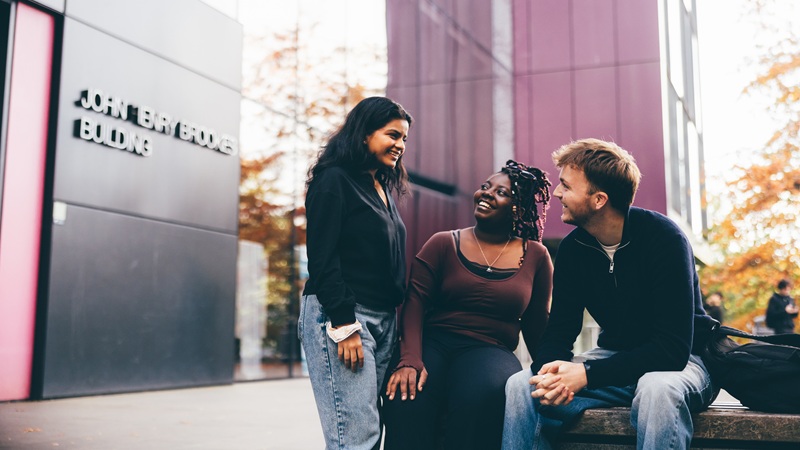
Students studying

Learning and teaching

We offer you a stimulating learning atmosphere within our Department of Social Sciences. You will develop a wide range of disciplinary and professional skills.

Our teaching methods include:

  • lectures
  • seminars
  • group work
  • individual and group presentations.

You can attend our weekly research seminars which include guest speakers who give presentations on their research interests. Our “Politics at Work” seminar series is perfect if you’re interested in international development or humanitarian aid.

We also encourage you to take part in our department’s online newsletter.

Assessment

We will assess you with coursework and examination. Coursework includes:

  • essays
  • group projects
  • individual seminar presentations
  • research projects.

Some modules include examinations at the end of the semester while other modules are assessed during the semester.

Study modules

Teaching for this course takes place face to face, and you should also anticipate a workload of 1,200 hours per year. Teaching usually takes place Monday to Friday, between 9.00am and 6.00pm.

Contact hours involve activities such as lectures, seminars, practicals, assessments, and academic advising sessions. These hours differ by year of study and typically increase significantly during placements or other types of work-based learning.

Year 1

Compulsory modules

  • From Empires to States: the Origins of International Relations

    In this module, you’ll dive into International Relations, and its key theories. You’ll explore how International Relations emerges from specific cultural and historic concerns. You’ll gain core analytical skills, as you interpret historical events and use them to explore pressing debates on International Relations.

    You’ll learn how International Relations has been shaped as a Western discipline, and how to challenge this by learning about aspects of international relations that have been erased or forgotten. You’ll learn to see International Relations as a rich array of competing stories about our world and what’s possible within it. 


  • Global Challenges in International Relations

    In this module, you’ll explore the leading issues of current world politics.

    You’ll investigate the key figures, structures and processes in world politics - like states, political economies and multinational societies.

    You’ll also analyse concepts such as:

    • anarchy
    • order
    • sovereignty
    • conflict and cooperation among states, and non-state figures.

    You’ll also investigate the chronic issues of world politics, including:

    • gender
    • migration
    • human rights
    • humanitarian intervention
    • energy resources and the environment
    • development, inequality and poverty.

    We’ll explore how different nations manage these issues and what this tells us about international governance.

  • Critical Skills in Politics and International Relations

    In this module, you’ll explore the art and science of Politics and International Relations. You’ll develop the critical research and study skills you need to succeed in your degree, as you explore how these two disciplines work. You’ll get to grips the scope of International Relations and Politics, and consider:

    • the issues they explore
    • the questions they seek to answer
    • their academic, educational and social value.

Optional modules

  • Foundations of Social Theory

    In this module, you’ll explore the key themes of social theory. You’ll investigate the works of  influential sociological theorists, including Karl Marx, Emile Durkheim and Max Weber. And you'll investigate how their work has shaped sociology and its different traditions.

    You'll immerse yourself in current debates, developments and approaches to social theory. And you'll explore how these affect our social relations today.

  • Politics in Comparative Perspective

    In this module, you’ll investigate politics, and the struggle for power, across the nations. You’ll gain a clear introduction to how and why political systems differ in our world today. You’ll examine case studies from a wide range of states, and gain a strong insight into how different regimes function – from the democratic to the totalitarian.

Year 2

Compulsory modules

  • Great Debates in International Relations: Inclusion and Exclusion

    Why should we study International Relations? In this module, you’ll get to grips with International Relations (IR). You’ll examine the ‘great debates’ in IR - like who is IR for? What is it meant to do? And how do we know when it is successful? Is IR theory a way of looking at diverse societies across the world? Or has it changed? And how have events like 9/11, decolonisation and the dawn of the Nuclear Age challenged our understanding of IR?

    You’ll examine why IR theory is a key to understanding international relations. You’ll ask whether International Relations is just about explaining facts. And you’ll explore whether our subjective moods and feelings influence IR. You’ll gain valuable critical skills, as you consider the relationship between theory and practice.

  • Researching Politics and International Relations

    In this module, you’ll develop the practical research skills you need to design and carry out your first piece of social sciences research. You’ll start with the ‘big questions’ of ‘What exists?’ and ‘How can we know about what exists?’ From here, you’ll move on to consider the different research methods and their implications. You’ll take part in hands-on workshops and practical sessions, preparing you to conduct your research for your final-year dissertation.

Optional modules

  • Uncivil Society: Constituting Global Order

    How do we govern the world, when it’s no longer dominated by states and national governments? How do different types of migration shape the movement of people across the world? In this module, you’ll get to grips with a key part of international relations - borders and solidarities (groups with a common identity or interest). You’ll explore the various forms of borders and solidarities, including:

    • migrations across national boundaries
    • regional organisations
    • trade agreements.

    And link them to key forces and events, such as: 

    • NGOs
    • corporations
    • colonisation
    • refugee movements
    • the migrant ‘crisis’.

    You’ll gain valuable practical and professional knowledge, as you explore leading issues today, and how global governance or migration shapes our lives. 

  • Contemporary Security Studies

    What is security? How can we achieve it? And who should provide it? In this module, you’ll dive into key debates on security, and its definitions. You’ll join policy makers, academics and civil servants as you discuss fundamental issues of security. You’ll explore the different ways we look at security, and the things it protects, for example:

    • The nation-state
    • The environment
    • The economy
    • A ‘way of life’.

    You’ll also look at the implications of security on peace and current global conflicts, as well as everyday violence and exclusion. 

  • Independent Study

    This module gives you the chance to research a topic that fascinates you. With support from a supervisor, you’ll choose, plan and carry out your independent research, gaining in-depth knowledge of your subject. Student projects have included subjects like:

    • Is democracy failing in Eastern Europe?
    • Did Putin solve Russia’s governance problems?
    • Authoritarianism and political stability in North Korea

    You’ll build great project management and research skills, which will help you in your future career.

  • The Global Political Economy

    In this module, you’ll get to know the global economy. You’ll investigate how economics and politics shape world affairs in both trivial and profound ways. 

    In part 1, you’ll gain a strong knowledge of the history of the world economy. You’ll develop key analytical skills, as you explore competing explanations of how it functions. You’ll gain the tools you need to understand the economy’s recent changes.

    In part 2, you’ll dig into key debates on how the global economy functions today, including: 

    • Finance
    • Global production
    • Trade and international development
    • The relationship between the global economy and the environment.
  • Work-based Learning

    In this module, you’ll have the chance to carry out a work placement closely linked to your International Relations course. You’ll be supported by your module leader to find a placement that meets your needs, and which will support your learning. With a carefully chosen placement, you’ll build on the skills and knowledge you’ve already gained in Year 1, and you’ll also strengthen vital skills for the workplace, like time management, communication and team-working. 

    Students have found placements in organisations like:

    • Asylum Welcome, working with asylum seekers in Oxford
    • Viva, an international children’s charity
    • Depaul, working with homeless people and immigrants in Paris.

    During and after your placement, you’ll:

    • create a placement portfolio, recording what you’ve done and achieved
    • craft a CV showing your experience
    • give a presentation on your placement.
  • European Politics

    In this module you'll look at and analyse governmental and political institutions in Europe. You'll cover policy-making, the participatory process and contemporary issues in European politics, with a focus on comparative study as well as the process of regionalisation. You'll examine:

    • The evolution of democracy and citizenship in Europe
    • Parties, party systems and elections in Europe 
    • The EU and theories of European integration
    • Regional nationalism and sub-state governance in Europe
    • The unique challenges facing post-communist Europe
    • The rise of populist nationalism in Europe
    • The politics of migration in Europe
    • The European welfare state
    • The impact of global challenges on European politics.

Optional Year Abroad

Optional modules

  • Year Abroad

    This module offers the opportunity to study abroad, experience a new culture, and apply your skills in different contexts to enhance your employability. It will help you develop self-management, cross-cultural communication, and interpersonal skills.

    You’ll receive support to secure a place at a partner institution abroad, where you can choose modules related to your degree or explore new areas that complement your studies.

    Studying at an international university will help you enhance your interpersonal skills through cross-cultural communication with students and tutors, allowing you to build lasting relationships. You'll also improve your study skills by focusing on your chosen areas of interest, gaining valuable international experience that will strengthen your CV.

    This year abroad module lasts for one academic year and is taken after the conclusion of your second year of study, once you’ve completed all your level 5 studies. Your year abroad is not credit-bearing.
     

Final Year

Compulsory modules

  • Double Dissertation in International Relations, or Interdisciplinary Dissertation in International Relations, or Dissertation in Combined Subject

    This module gives you the chance to do independent research on a topic that fascinates you. You’ll have the support of expert tutors in our International Relations team, who will help you choose your dissertation topic. Whether you’re exploring the international effects of climate change denial, or Trump’s effect on Brexit, you’ll use the skills and expertise you’ve developed during your International Relations degree, and gain fantastic research skills for your future career. 

Optional modules

  • Human Rights and Global Politics

    What should world leaders do? How much power should countries give each other? And how should states and individuals behave towards each other? In this module, you’ll get to understand the key questions in world politics. You’ll explore:
    • how we determine rights and duties
    • how we both enable and restrict dominance
    • how issues of race, gender and class interact
    • in relation to world politics.
    You’ll choose one of three topics that on international ethics and power - human rights, migration and immigration, or racism and colonialism."
  • The Environment, Sustainability and Social Justice

    Chronic and seemingly intractable challenges such as global injustice and the global ecological crisis cannot be dealt with by individual countries or through bilateral relations. A global approach is needed. But how can such global issues be responded to without a world government? 

    Studying this module you'll examine competing and contrasting perspectives in understanding global sustainability. This issue has generated significant academic debate for decades, which has in turn informed a range of international policy responses and global governance initiatives such as the UN Earth Summits. You will be encouraged to take a broad, interdisciplinary and historically grounded analysis of the theory and practice of global justice.
  • Independent Study

    This module gives you the chance to research a topic that fascinates you. With support from a supervisor, you’ll choose, plan and carry out your independent research, gaining in-depth knowledge of your subject. Student projects have included subjects like:

    • Is Europe’s relationship with Turkey failing?
    • How does globalisation impact the environment - in the US and China?
    • Is democracy failing in Eastern Europe?

    You’ll also build great project management and research skills, which will help you in your future career.

  • Terrorism and Counter-Terrorism

    You'll compare and contrast the shifting and different ways in which states respond to terrorism, and you'll critically engage with the idea of counter terrorism; what it is, and its relation to conceptions of the state, security and political violence. 

    You'll then examine particular moments of counter terrorism practice, going on to consider the similarities and differences in various countries' responses to terrorism. You'll conclude this module by considering how these various responses impact upon both human rights regimes and norms and citizenship rights, behaviours and practices.
  • Conflict and Peacebuilding

    In this module you’ll explore practices of conflict management and peacebuilding in societies which experience violent conflict. You’ll cover three key areas;

    • Conceptualise peace and the causes and dynamics of contemporary conflict
    • Investigate models of peacemaking
    • Understand how building a sustainable peace can be achieved by societies emerging from war.

    You’ll compare a variety of case studies to draw conclusions about these challenges and processes, alongside analysing current cases of violent conflict, critically evaluating peacebuilding processes and asking questions about the quality of peace that often emerges.

Please note: As our courses are reviewed regularly as part of our quality assurance framework, the modules you can choose from may vary from those shown here. The structure of the course may also mean some modules are not available to you.

Careers

The course will help you develop skills useful for a career in a variety of professions and settings, including journalism, government, trade unions, law, teaching, publishing, advertising, and governmental and non-governmental organisations.

You can find our graduates working with:

  • The Civil Service Fast Track Programme
  • Oxford University Press
  • Hestia (charity supporting those who experience domestic abuse)
  • The Cherie Blair Foundation for Women.

You can also network and get involved in discussions with industry professionals at our Life After Uni events. Previously, these have included guest speakers from:

Or you can pursue your interest in international relations or your other discipline with postgraduate study. Our masters’ courses include International Relations and International Security, and the former is available as a distance learning course.

Student profiles

Joint honours options

You can study this course as part of a joint honours degree. This course can be joined with:

Entry requirements

Wherever possible we make our conditional offers using the UCAS Tariff. The combination of A-level grades listed here would be just one way of achieving the UCAS Tariff points for this course.

Standard offer

UCAS Tariff Points: 112 or 120 (dependent on joint honours subjects)

A Level: BBC or BBB (dependent on joint honours subjects) or equivalent

IB Points: 30 or 31 (dependent on joint honours subjects)

BTEC: DMM or DDM (dependent on joint honours subjects)

Contextual offer

UCAS Tariff Points:

A Level:

IB Points:

BTEC:

Further offer details

For joint honours, normally the offer will lie between the offers quoted for each subject.

Applications are also welcomed for consideration from applicants with European qualifications, international qualifications or recognised foundation courses. For advice on eligibility please contact Admissions: admissions@brookes.ac.uk

International qualifications and equivalences

Tuition fees

Please see the fees note
Home (UK) full time
£9,535

Home (UK) part time
£1,190 per single module

International full time
£16,750

Home (UK) full time
£9,790

Home (UK) part time
£1,220 per single module

International full time
£17,250

Questions about fees?

Contact Student Finance on:

Tuition fees

2025 / 26
Home (UK) full time
£9,535

Home (UK) part time
£1,190 per single module

International full time
£16,750

2026 / 27
Home (UK) full time
£9,790

Home (UK) part time
£1,220 per single module

International full time
£17,250

Questions about fees?

Contact Student Finance on:

+44 (0)1865 534400

financefees@brookes.ac.uk

Please note, tuition fees for Home students may increase in subsequent years both for new and continuing students in line with an inflationary amount determined by government. Oxford Brookes University intends to maintain its fees for new and returning Home students at the maximum permitted level.

For further information please see our tuition fees FAQs.

Tuition fees for International students may increase in subsequent years both for new and continuing students.

The following factors will be taken into account by the University when it is setting the annual fees: inflationary measures such as the retail price indices, projected increases in University costs, changes in the level of funding received from Government sources, admissions statistics and access considerations including the availability of student support. 

How and when to pay

Tuition fee instalments for the semester are due by the Monday of week 1 of each semester. Students are not liable for full fees for that semester if they leave before week 4. If the leaving date is after week 4, full fees for the semester are payable.

  • For information on payment methods please see our Make a Payment page.
  • For information about refunds please visit our Refund policy page

Additional costs

Please be aware that some courses will involve some additional costs that are not covered by your fees. Specific additional costs for this course are detailed below.

Information from Discover Uni

Full-time study

Part-time study

Full-time study

Part-time study

Programme changes:
On rare occasions we may need to make changes to our course programmes after they have been published on the website. For more information, please visit our changes to programmes page.