

Resolving grievances at work policy
1.1 Oxford Brookes University (OBU) aims to provide an employee experience where people feel valued and supported. OBU recognises the importance of the relationships we build in contributing to our common purpose of making the world a better and fairer place.
1.2 Fair and reasonable handling of disagreements is an important element in building these relationships, and must be supported by an approach that focuses on collaboration and mutual respect, with shared and inclusive responsibility for resolution. Creating this approach supports OBU’s ambitions to create a healthy workplace through social relationships as part of the Well-being at Work Strategy.
2.1 The purpose of this policy is to provide a framework that encourages and supports employees and managers to resolve issues informally, and at an early stage. The framework, (Fig.1), ensures all employees can expect their concerns to be fairly and effectively handled, and where appropriate formally investigated.
2.2 The informal options provide greater scope for dialogue and understanding to resolve issues and repair relationships, rather than focusing on only a formal procedure, which can divide and further erode working relationships. It also provides support and guidance for all parties whilst navigating a resolution, mitigating the impact on well-being.
2.3 Formal grievance procedures are included, ensuring full and fair procedures are followed where the informal route has been exhausted or is not deemed appropriate in the circumstances of the issue(s) raised.
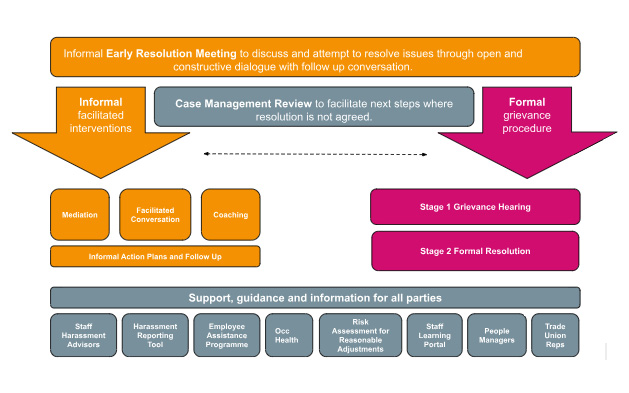
Description text for Fig.1
- 1. Informal Early Resolution Meeting to discuss and attempt to resolve issues through open and constructive dialogue with follow up conversation.
- 2.Informal facilitated interventions
- 2.1 Mediation, Facilitated Conversation and Coaching
- 2.2 Informal Action Plans and Follow Up
- 3. Formal grievance procedure
- 3.1 Stage 1 Grievance Hearing
- 3.2 Stage 2 Formal Resolution
- 4. Case Management Review to facilitate next steps where resolution is not agreed.
- 5. Support, guidance and information for all parties
- Staff Harassment Advisors
- Harassment Reporting Tool
- Employee Assistance Programme
- Occupational Health
- Risk Assessment for Reasonable Adjustments
- Staff Learning Portal
- People Managers
- Trade Union Reps
3.1 Issue(s) or Issue(s) at work refers to the specific complaint(s) the employee is seeking resolution for under this policy.
3.2 Grievance refers to the formal raising of an issue(s) in line with the formal procedures in the framework, which are outlined in full in Appendix 2. Whilst not a statutory legal framework, these procedures are in line with the Acas Code of Practice on Disciplinary and Grievance Procedures.
3.3 Collective grievance is when a group of employees formally raise the same issue(s) at the same time.
3.4 Bullying, harassment, and / or discrimination are defined in OBU’s Anti-harassment and Discrimination Policy, and where relevant to the issue(s) being raised, should be read alongside with this policy.
3.5 Grievant refers to the employee who is raising a formal grievance.
3.6 Respondent(s) refers to any employee against whom a formal grievance has been raised.
3.7 Line manager refers to the manager with whom an issue(s) is raised. This may not necessarily be the employee’s direct line manager (see section 5.8).
3.8 Resolution manager refers to the manager who is appointed to hear a formal grievance, carry out any required investigation, and determine the outcome.
3.9 Appeal manager refers to the manager who is appointed to hear and consider any appeal made against an outcome of a formal grievance.
3.10 Malicious intent refers to an issue(s) raised with deliberate intent to harm someone or their reputation, often by fabricating information or exaggeration.
3.11 Vexatious intent refers to an issue(s) pursued without merit, primarily to annoy, harass, or cause distress.
3.12 Spurious refers to an issue(s) that is lacking any substantial evidence, or based on false information.
4.1 If an issue(s) arises from a different OBU policy or procedure, it will be handled according to that policy, including any appeal process, and will not be addressed under this policy. This includes, but may not be limited to: disciplinary, probation, capability, managing absence, redundancy, flexible working requests, job evaluation, academic progression/promotions schemes, including Associate Lecturer transfers to fractional contracts, and the expiry of fixed term contracts. This list is not exhaustive and there may be other legitimate reasons where this policy will not apply, such as matters that are outside the authority of OBU (e.g., rules of pension schemes, income tax and national insurance).
4.2 Where an issue(s) is related to harassment, bullying, discrimination or victimisation, this policy should be read and applied alongside OBU’s Anti-Harassment and Discrimination Policy, on the harassment webpage.
4.3 Where any part of an issue(s) is related to freedom of speech, this policy and its procedures should be read and applied alongside OBU's Code of Practice on Freedom of Speech.
4.4 Employees are excluded from using this policy to raise substantively the same issue(s) again, where the formal procedures have been exhausted, unless recommendations made as part of the outcome of a formal grievance have not been implemented.
4.5 This policy will be used for the resolution of collective grievances raised by employees, notwithstanding the Disputes Procedures set out in Appendix B of the Local Recognition Agreement between OBU, the University and College Union (UCU), and UNISON for disputes raised by the trade union(s) on the behalf of employees.
4.6 OBU operates a separate Whistleblowing Policy for employees who have a reasonable belief that there are significant matters of public interest that are causing concerns.
4.7 Third party complaints are not covered by this policy, but the principles and procedures may be used in order to ensure best practice in handling any complaints received, if the University decides that it wishes to do so. Please refer to the information for staff webpage and the Student Complaints Procedure for complaints received from students.
4.8 This policy is designed to address issues related to the employee's employment with OBU, not issues within the trade union they may be a member of. If an employee has a complaint about how their trade union is handling matters, they must refer to the trade union's own internal policies and procedures to raise their concern.
4.9 There is no legal framework that requires issues raised by employees after they have left to be heard. However OBU recognises that former employees can raise important issues which may warrant investigation. Where a former employee raises an issue(s), the People Directorate will come to a decision on whether or not the issue(s) warrants investigation, normally through discussion with the individual.
4.10 If an employee raises an issue(s) under this policy prior to leaving, but the process has not been completed at their leaving date, the process will be concluded as required. The outcome of the process will be confirmed in writing by post or email as agreed.
4.11 This policy applies to all employees of OBU, with the exception of the Vice-Chancellor and the Registrar and Chief Operating Officer. Issues raised by these employees largely follow this policy, but will be submitted to the People Directorate who will inform the Chair of the Board of Governors. Meetings will be arranged in line with the formal grievance procedures in Appendix 2, but the grievance hearing will be conducted by an independent Governor who has not previously had any involvement in the matter. Any appeal will similarly be responded to by an independent Governor.
4.12 This policy does not form part of any contract of employment or other contract to provide services, and it may be amended at any time.
5.1 All parties are encouraged to view the raising of issues as an opportunity to improve working conditions and morale constructively. Adopting a constructive approach should facilitate satisfactory resolution, without unreasonable delay, and help to restore working relationships. A less constructive approach towards issues can alienate those involved and aggravate the situation. This often results in issues remaining unresolved, and the employee feeling that raising a formal grievance is their only recourse.
5.2 All employees are strongly encouraged to resolve issues through informal approaches where possible. They have the right to use the formal grievance route, and may choose to proceed with that if:
- they are unhappy with the outcome of informal attempts at resolution,
- they feel that the timeframe for resolution is unreasonable, or
- the issue is sufficiently serious to warrant a formal investigation.
5.3 It is not intended that an informal approach should entail a wide-scale investigation of issues. Rather it provides for safe, informal, and constructive dialogue as a means to resolving issues in the first instance.
5.4 All parties are asked to remember that informal interventions, however well facilitated, can be intimidating for some. The spirit of an informal intervention is one of not apportioning blame. Rather it is one of openness, compromise, and seeking to restore and improve relationships.
5.5 OBU promotes mediation or facilitated conversations as the preferred mechanisms for resolving issues at work. It is expected that all parties consider this at the earliest opportunity, and this can be discussed with a representative of the People Directorate through a case management review. It can also be advised on by OBU’s trained mediators by contacting the PD Operations Team.
5.6 Formal procedures can be paused at any stage to employ mediation or a facilitated conversation to bring about resolution. Formal procedures may resume if a mutually acceptable outcome isn't reached through the informal route.
5.7 Formal grievances (and any appeals) will be considered independently, impartially and objectively, by an appropriate manager with no prior involvement in the matter, who will hear the grievance (or appeal) and carry out any necessary investigations to establish the facts of the case and determine the outcome.
5.8 Issues should be raised with the line manager in the first instance. Where an employee feels they cannot raise an issue(s) with their line manager (or a formal grievance is against their line manager), the employee should raise it with the line manager's manager. Alternatively they can raise it with their link people manager by emailing pd-employment.relations.team@brookes.ac.uk, and seek advice from their respective trade union if they are a member.
5.9 Raising issues at work should be timely and recent. Delays in raising issues may limit options available for resolution, or full investigation to be carried out. Issues must be raised under this policy as soon as is reasonably practicable and within the following timeframes:
5.9.1 An isolated event (or a series of unlinked events) must be raised within 6 months of the occurrence.
5.9.2 A series of linked events must be raised within 6 months of the final occurrence in the series of linked events.
OBU reserves the right to reject a formal grievance if it is raised outside of these timeframes. A reasonable view will be applied if a matter outside the control of the person raising the issues prevented them raising it within six months.
5.10 The timeframes detailed in this policy and its appended procedures should be adhered to as far as reasonably possible. However unavoidable delays may arise due to sickness, work-related absence or annual leave.
5.11 Employees may be accompanied by a trade union representative or work colleague to meetings under the formal procedures in this policy. Respondents and witnesses also have that right. Where it is agreed with the relevant manager, or as a reasonable adjustment, that right may be extended to include informal meetings. The employee must inform the meeting chair of who will accompany them as soon as possible, and no later than two days before the meeting. If the companion of choice is not immediately available, the meeting should be rescheduled to a new date within five working days of the original date to allow them to participate. In the event that the companion is going to be consistently unavailable, OBU will request that an alternative companion is identified.
5.12 OBU will not discriminate on the grounds of sex, race / ethnicity, disability, age, sexual orientation, religion / belief (or lack of belief), pregnancy / maternity, marriage / civil partnership or gender reassignment when applying this policy and associated procedures. Reasonable adjustments will be made throughout the procedures to support employees who have a disability, literacy issues, difficulty in understanding or expressing themselves in English, or to assist the employee as required.
5.13 OBU fully supports and encourages employees to raise issues through this framework. Doing so will not prejudice current employment or future career prospects.
5.14 OBU recognise the possibility that spurious issues may be raised, or issues may be brought with malicious or vexatious intent. All issues raised must be treated seriously, in accordance with this policy, to ensure a fair procedure is followed. Where an investigation finds clear evidence of any party bringing spurious issues or acting with malicious or vexatious intent, disciplinary action may be taken in line with the Disciplinary Policy.
5.15 Where an issue is raised during a disciplinary, capability or absence management process, consideration should be given, by the People Directorate, to dealing with all matters concurrently, or temporarily suspending that process to deal with the issue under this policy.
5.16 Where an issue(s) being dealt with under this policy intersects with any other relevant OBU policies, the link people manager can support the manager to consider which elements of the presenting issues would be more appropriately progressed under a different policy.
5.17 Where multiple employees raise the same issue(s), this will normally be dealt with collectively. The right to be accompanied (section 5.11) is unchanged in this circumstance, and a spokesperson would be appointed by the group. All communications would pass through the spokesperson (who may or may not be a trade union representative). It will be for the spokesperson to communicate with the rest of the group on progress of the case. It is not necessary for all those involved to be present at meetings. To be named in a collective grievance, employees must agree to be named. Appropriate representative numbers must be agreed at each stage. In all other respects this policy and its procedures apply.
6.1 An employee wishing to raise an issue(s) informally should do so with their line manager, notwithstanding section 5.8. This does not have to be done in writing. Speaking about the matter may be entirely sufficient, depending on the circumstances. The procedures and informal routes for resolution as detailed in the framework, are fully explained in Appendix 1.
6.2 A case management review can be taken at any time during the informal or formal procedures by the People Directorate. This review gives an opportunity to ensure the appropriate steps are being taken to resolve issues effectively, and in a way that supports the wellbeing of all involved.
6.3 Employees may raise a formal grievance at any time by completing the formal grievance form in Appendix 4 (Brookes login required), and submitting it as per section 5.8 of this policy.
6.4 The formal procedures that follow are detailed in Appendix 2 and include the grievant's right to appeal the outcome of a formal grievance. Where the grievant chooses to exercise this right they should do so by completing the grievance appeal form in Appendix 5 (Brookes login required).
Employees / Grievants
7.1 Employees are encouraged where possible to raise issues in a timely manner, being mindful of section 5.9. Delays often make the task of resolving issues more challenging and lead to the erosion of working relationships.
7.2 Employees are expected to seek resolution through the preferred informal methods in the framework, where appropriate, and in line with section 5.8.
7.3 In raising a formal grievance the grievant must take responsibility for completing the grievance form in line with the guidance on the form. Where there are distinct and separate grievances against more than one person, each grievance must be submitted on a separate form but they will all be investigated by the same resolution manager at the same time.
7.4 The grievant must not include hearsay, instead detailing evidence relevant to their own grievance. They must avoid language which may be considered insulting, libellous or abusive, unless directly quoting something they have witnessed.
7.5 All employees are expected to make themselves available during normal working hours to enable the effective and efficient resolution of issues. They must cooperate and comply with the procedures detailed in Appendix 1 and Appendix 2.
Line managers
7.6 Line managers must always take issues raised seriously. It is possible sometimes that issues raised appear to be trivial, but they should bear in mind that the matter may not be trivial to the employee raising it.
7.7 Where resolution for the issue is sought under the informal interventions of the framework, the line manager will be responsible for setting up an early resolution meeting in line with the procedures detailed in Appendix 1.
7.8 Throughout the procedures, line managers (being mindful of section 5.8) will remain responsible for providing pastoral care, proactively supporting the wellbeing of their direct reports in line with the responsibilities of the line manager. They should refer to the support detailed in the framework, taking steps to ensure health, safety, wellbeing or operational risks are identified, and managed as appropriate, within the remit of their role. It is not an expectation of their role to represent the employee during the formal procedures.
7.9 On receipt of a formal grievance, the line manager will be responsible for contacting the People Directorate, who will identify a resolution manager, and cooperating with the handover of information to the resolution manager.
Resolution managers
7.10 The resolution manager appointed to hear a formal grievance must be impartial. They are therefore expected to disclose any potential conflict of interest when approached, or as it arises, to the people manager.
7.11 They should keep the grievant (and any respondents) informed on a regular basis with anticipated timescales, taking steps to ensure health, safety, well-being or operational risks are identified, documented and appropriately managed.
7.12 They are responsible for hearing the grievance(s), planning and carrying out any necessary investigation that is proportionate, balanced, and focused on establishing the facts of the case, through:
- Careful analysis and clarification of all evidence presented by the grievant
- Identification of relevant witnesses for interview.
- Preparing in advance of meetings: considering the objectives of the discussion, preparing relevant questions, and identifying any other evidence and/or documentation to be referred to.
- Documenting the investigation in a report which ensures: all points and evidence in the grievance are clearly laid out and addressed through the investigation, and the findings, outcome(s) reached, and recommended action(s) (with timeframes where relevant) are detailed.
7.13 Resolution managers have full discretion as to the scope and scale of investigation required, and to come to whatever conclusion they feel fair, proportionate and appropriate.
Appeal managers
7.14 The appeal manager appointed to hear a formal grievance appeal must not have been involved in the case previously and be impartial. They are therefore expected to disclose any potential conflict of interest when approached or as it arises to the people manager.
7.15 They should keep the grievant (and any respondents) regularly informed with anticipated timescales, taking steps to ensure health, safety, wellbeing or operational risks are identified, documented and appropriately managed.
7.16 They are responsible for understanding the grounds of the appeal and carrying out a balanced review that focuses on establishing whether or not the procedure and the findings and outcome(s) of the original grievance(s) were fair, through:
- Reviewing any new supporting documentation and/or evidence.
- Preparing in advance of meetings; considering the objectives of the discussion, preparing questions, and identifying evidence and/or documentation to be referred to.
- Clearly documenting all points in the appeal, ensuring all points and evidence are clearly laid out, considered and addressed, and the findings, outcome(s) reached, and recommended action(s) are detailed.
7.17 Appeal managers have full discretion to come to whatever conclusion they feel fair, proportionate and appropriate. Where there is any acknowledgment of failings in the original decision(s) made, or the process carried out, the appeal manager should consider the effect this has on the overall outcome(s). They should then seek to rectify this with clear recommendations, which can include informal interventions as detailed in the framework.
Supporting Roles
7.18 When responding to requests for information, witnesses must not include hearsay, instead detailing the facts relevant to their own experience of events. They must avoid language which may be considered insulting, libellous or abusive, unless directly quoting something they have witnessed, being mindful of section 5.14.
7.19 People managers (or People Directorate representatives) are responsible for appointing resolution managers and appeal managers and supporting the procedures by:
- Facilitating case management reviews.
- Facilitating informal interventions.
- Providing advice and guidance on policies, procedures and guidance that apply.
- Considering the relevant legislative and best practice context.
- Seeking equity in the application of this policy.
- Providing report and letter templates to support each stage of the formal procedures.
7.20 The role of the trade union representative or work colleague is to act in the best interests of the person(s) they are representing, providing guidance and support, and entering into all discussions in the spirit of this policy. During meetings, with the permission of the grievant, they are allowed to take notes, set out the grievant’s case, respond to any comments or points made, and confer with the grievant. They cannot answer questions put to the grievant, or prevent anyone at the meeting from explaining their position.
7.21 Staff Harassment Advisers are OBU employees who have volunteered their time to provide an information service to employees who feel they are experiencing (or have witnessed) unwanted behaviour. They also provide this to employees who have been accused of unwanted behaviour.
8.1 It is OBU’s aim to deal with issues at work sensitively and with respect for the privacy of all parties including grievants, respondents, and witnesses. Information on how data is collected, processed and shared during an investigation can be found in the Privacy Notice.
8.2 All parties must treat as confidential any information they receive or provide in connection with the issue(s), subject to seeking advice and guidance as per the framework.
8.3 Where a formal grievance is raised against another OBU employee, or group of employees, the relevant parties will normally be provided with a copy of the grievance(s), in order to provide any respondents with a fair opportunity to respond and participate in any investigation. The relevant parties will be limited only to those necessary and may include the grievant and any respondents’ chosen trade union representative or work colleague and the line manager of the grievant or any respondents.
8.4 Where witnesses provide evidence, the relevant parties will normally be provided with a copy. Witness statements provide vital evidence in investigations and should normally not be set aside due to the importance of fairness and transparency throughout the process. In exceptional cases where a witness is reluctant to provide evidence, the People Directorate may consider, in consultation with the individual, what safeguards could be put in place to support and enable evidence to be used.
8.5 Notes of all formal meetings will be made. For in-person meetings notes will be taken by a notetaker who must be from outside of the immediate School/Directorate and wholly uninvolved with the matters raised in the grievance. For online meetings notes will be made using Google’s transcription facility. This will be advised of at the start of the meeting, before it is switched on. Following the meeting, notes will normally be shared within one week, and agreed by all parties for accuracy, documenting any disagreements, but keeping the original text as a record.
8.6 Unauthorised voice or video recording of conversations and meetings is prohibited and not to be used within the process. Anyone in breach of data privacy rights of others may be subject to disciplinary action.
8.7 Records of informal interventions will be held locally and records of formal grievances will be held in the People Directorate. All records will be held securely for the minimum period in accordance with Data Protection Law and OBU’s Records Retention Schedule.
9.1 This policy should be read alongside the Appendices listed in section 12 and the Privacy Notice.
9.2 All employees should be familiar with the Conduct and Probity policies, procedures and guidance and their duties to comply with these in the course of their employment with OBU.
10.1 The framework details the support available for all parties involved in the application of this policy and its procedures.
10.2 OBU's Employee Assistance Programme and Multi Faith Chaplaincy may be able to provide emotional support, and Occupational Health can support in identifying appropriate reasonable adjustments where required.
10.3 Further information to support the health and wellbeing of all parties can be found on the Employee Health and Wellbeing webpages.
10.4 The Office for Students (OfS) operates a free speech complaints scheme. Under that scheme, the OfS can review complaints about free speech from non-student members, staff, applicants for academic posts and (actual or invited) visiting speakers. The scheme is free to use. Information about the complaints that the OfS can review is available on its website.
| Document name: | Resolving Grievances at Work |
|---|---|
| Document Type: | Policy |
| Version Number: | V 2.0 |
| Equality Impact Assessment: | May 2025 |
| Privacy Impact Assessment: | Privacy Notice |
| Approved by: | Joint Staff Committee |
| Date Approved: | 12 June 2025 |
| Effective from: | 24 June 2025 |
| Date for Review: | December 2024 |
| Supersedes (if applicable) | Resolving Issues at Work Policy and Grievance Policy |
| Next Review Due: | June 2027 |
| Author/Lead Contact | Policy Manager |
| Policy Owner | People Directorate |
| Document Location: | Working at Brookes - Employment Policies and Guidance |
| Related University Policies/Procedures/Guidance: | Whistleblowing (Public interest Disclosure) Policy, Anti Harassment and Discrimination Policy, Staff Harassment Advisors, Disciplinary Procedure, Conduct and Probity policies, Capability Procedure, Equality Diversity and Inclusion, Staff Learning Portal, MindTools, Health and Wellbeing Webpages, Harassment Webpages. |
| Keywords | Grievance, Issues at Work, Complaints, Harassment, Discrimination, Bullying, Victimisation |
| Version | Date | Revision description / Summary of changes | Author/Lead Contact |
|---|---|---|---|
| 2.0 | June 2025 | Scheduled review of the existing Resolving Issues at Work and Grievance Policies, bringing them together into a framework for more restorative practices that seek to resolve issues, both formally and informally in a supportive and reparative way. | Felicity Ball, Policy Manager, People Directorate |