

Biodiversity and Wildlife Conservation (with Foundation Year)

BSc (Hons)

UCAS code: C20F

Start dates: September 2026

Full time: 4 Years, or 5 if a work placement is chosen

Part time: Up to 11 years

Location: Headington

School(s): School of Biological and Medical Sciences

Find a course

Expand

Overview

Wildlife is in decline around the world due to human impact. If you’re eager to solve global conservation and animal issues, our Biodiversity and Wildlife Conservation (with Foundation Year) degree is for you.

You’ll begin with a foundation year to develop your academic skills and prepare for degree-level study. After passing this, you'll progress onto the Biodiversity and Wildlife Conservation degree, where you'll develop the skills to tackle the urgent global ecological crisis. Our teaching staff, with their real-world experience, will train you in the evolutionary origins, ecology, behaviour, and conservation of wildlife.

This degree gives you real-life employability skills. We’ll prepare you for conservation roles around the world, including in countries where trained conservationists are in short supply.

We’re proud of our nurturing environment with good connections between staff and students. You’ll benefit from research-active tutors and small group sizes.

The need is obvious, so join us at Oxford Brookes to learn the skills to make a difference.
Order a Prospectus Ask a question Attend an open day or webinar

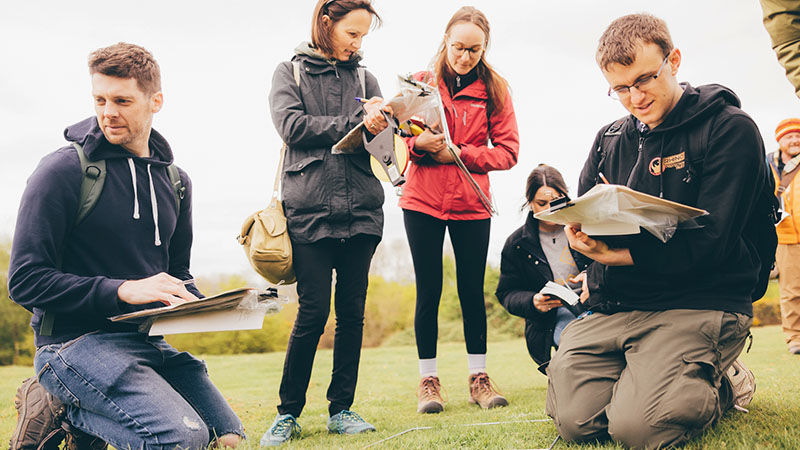
A group of students doing fieldwork

Why Oxford Brookes University?

  • Perfect Preparation
    Build essential study skills with an integrated foundation year. Gain academic confidence, improve critical thinking, and strengthen subject knowledge for your degree journey.
     
  • Access to outstanding environmental sites
    You’ll have access to a variety of natural and managed landscapes in and around the Oxford area; as well as the Oxford Natural History Museum.
  • Employment success
    We offer modules to help you identify interesting career paths and to develop your professional skills. These are supported with the opportunity to gain work experience through a placement year, a work experience module or research project.
  • Strong industry links
    We enjoy strong working relationships with organisations like WildlifeTrusts, RSPB, and animal rescue centres. These benefit our students through guest speakers and work experience opportunities.
  • Additional language modules

    Our university-wide language programme is available to full-time undergraduate and postgraduate students on many of our courses, and can be taken as a credit on some courses.

  • Study abroad

    You may be able to go on a European or international study exchange while you are at Brookes. Most exchanges take place in the second year. Although we will help as much as we can with your plans, ultimately you are responsible for organising and funding this study abroad.

  • Accreditation(s)

    Chartered Institute of Ecology and Environmental Management

    • CIEEM Accredited Degree Pathway

Course details

Course structure

In your foundation year, you’ll study our Life Sciences foundation and gain the necessary scientific and mathematical background required for you to step straight on to your honours degree.

In year 1 of your degree, you will study core topics including biodiversity, global issues in conservation, and communicating science. A one-week residential field course will sharpen your ability to identify species. 

In year 2, you will delve into animal behaviour through observation and experimentation. You'll study environmental change, focusing on the impact of human activity, threatened species, surveys and licensing. 

You have the option to take either a year long industry placement or a work experience module to advance your skills.

Your final year modules will deepen your understanding of key concepts and skills. You’ll cover wildlife conservation and environmental consultancy. The final year project will enable you to showcase your knowledge and expertise by exploring a topic of interest. This can be done with our research teams or with a conservation organisation. 

Student discussion

Learning and teaching

You will have the opportunity to develop a range of practical skills in such areas as field techniques, data handling, computing, report writing, oral presentations and teamwork within an environment that encourages openness and participation, where everyone feels respected, supported and valued and understands their own personal responsibility for equality and inclusive practice. 

The curriculum facilitates the development of culturally aware graduates, with ethical, sustainable and open approaches to thinking and practising conservation. Teaching methods include:

  • lectures
  • group projects
  • practical exercises.

Throughout your course you will develop transferable skills such as:

  • public speaking
  • using industry-standard specialised software
  • report writing.

Our teaching staff are experts in research work.

Assessment

Assessment methods are diverse and include:
  • set exercises
  • quizzes
  • essays
  • reviews
  • laboratory/field notebooks
  • scientific reports
  • mock grant proposals
  • videos
  • reflective portfolios
  • discussions
  • posters and oral presentations. 
The diversity of assessments is designed for inclusive learning enabling students to achieve their full potential by drawing on their strengths and prior experiences. 

Reflective learning is encouraged through use of self, peer and staff formative feedback on assignments, group work and project work, and reflective diaries all of which are designed to develop critical self-awareness and personal literacy.
 

Field Trips

The course involves field courses in Wales, Italy and locally around Oxford. These give our students the opportunity to gain practical skills.

Our students will  also have opportunities to study habitats and species management abroad by carrying out their research projects in Bali or Madagascar working alongside Oxford Brookes lecturers. More locally, there are opportunities to develop your understanding of captive breeding via zoo visits, for example some students have gained work experience at the Cotswold Wildlife Park.

We encourage our students will take part in organised scientific trips overseas with groups. Wildlife African Conservation Team and Operation Wallacea are both fantastic ways of gathering fieldwork data for honours research projects. We have links with other conservation organisations that our students will make use of. Through organisations such as the RSPB and Butterfly Conservation, students will be able to develop their research skills to address practical conservation issues in the UK.

Our many field work opportunities equip you with the skills you need to further a career in conservation.

Field trip costs: your course tuition fee covers the cost of the compulsory field courses in your course. The cost of any optional field trip (e.g. visit to Bali or Madagascar) is not included in your course tuition fee. 

Study modules

In your foundation year, you can expect around 14 hours of contact time per week. In addition to this, you should also anticipate a workload of 1,200 hours per year. When you begin your degree programme, you can expect around 12 hours of contact time per week and anticipate a workload of 1,200 hours per year. Teaching usually takes place Monday to Friday, between 9.00am and 6.00pm.

Contact hours involve activities such as lectures, seminars, practicals, assessments, and academic advising sessions. These hours differ by year of study and typically increase significantly during placements or other types of work-based learning.

Foundation Year

Compulsory modules

  • Foundation Academic Skills

    The module is designed as an introduction to the styles of learning and skills expected of students in higher education, and to the particular academic culture of Oxford Brookes University. You will develop a reflective approach to study, centred on learning new skills such as referencing, source evaluation, academic writing and communication skills. This will prepare you for your studies in other modules on the foundation year, as well as your undergraduate degree.
  • Foundation Biological Sciences

    Biology is one of the most exciting and challenging sciences you can choose to study. This module aims to provide you with a fundamental understanding of biology, while at the same time developing your study skills to a level required for success on your undergraduate degree. You will be encouraged to explore and gain confidence in a broad range of topics including environmental science, biomedical science, ecology, anatomy and physiology.
  • Foundation Chemistry

    This module is designed to improve your knowledge of the basic principles of chemistry that underpin a modern approach to the life sciences. It also aims to encourage you to ask fundamental questions of how science develops and to increase awareness of the experimental basis of scientific ideas. The overarching theme is the relationship between experiment, observations and the atomic model of matter. The module will also give you the opportunity to practise using simple mathematical ideas in more applied contexts.
  • Foundation Mathematics I

    This module is designed to give you the mathematical competence required to cope with degree level science modules. Throughout the module you will develop mathematical problem solving skills and the ability to present mathematical arguments clearly and succinctly.
  • Foundation Mathematics II

    This module will help you to build on your mathematics knowledge gained on module I and will continue to give you the mathematical competence required to cope with degree level science modules. Throughout the module you will continue to develop mathematical problem solving skills and progress your ability to present mathematical arguments clearly and succinctly.
  • Foundation Project

    This module offers you the opportunity to build on the skills developed in your other modules and to apply skills of collaborative learning and independent study. You will have the opportunity to further your understanding of an area of interest you have by designing and carrying out a project, which may be literature based or experimental.

Optional modules

  • Independent Study

    The independent study is a module that provides students with an opportunity to address a discipline area that is not formally offered as part of the taught programme or the student has a desire to expand on a topic area that was superficially covered. In this module we encourage students to create a product output that is potentially useful for the industry of interest. The type of product is chosen within consultation with the module leader and their chosen supervisor for the activity. There are no formal teaching components for this course but instead students are expected to conduct the work independently with some supervisory/stakeholder guidance. The module requires a learning contract which is agreed between the student and a supervising member of staff.

Year 1

Compulsory modules

  • Cell Biology and Genetics

    Cell biology is the study of how cells work and how they differentiate to form multicellular organisms. 

    This module is your introduction to cell function - you will study the different types of molecules within cells and build your knowledge about cellular organelles and their functions. You’ll explore the increasing levels of complexity and the diversity of cell types that have arisen through evolution.  

    On this module you’ll also look at genetics. What are genes and how do they work to bring about the traits that we observe in organisms? We will examine cell division in detail and look at how DNA is transcribed into RNA which translates into proteins that do most of the work in the cell.
     

  • Communicating Science

    For impact, scientific research findings need to be communicated to reach the relevant audience in a timely manner. The relevant audience can be

    • researchers
    • policy makers
    • public. 

    Science can be communicated by written reports to oral presentations. 

    On this module you’ll have Personal and Academic Support Scheme tutorials over your first year. You’ll receive the support and guidance to adjust to the academic demands of university. Also you will develop key skills like:

    • reading
    • critical thinking
    • literature searching
    • reporting 
    • presentation in various formats  
    • presenting to varied audiences.
       
  • Quantitative Skills for Life Science

    On this module you’ll be introduced to, build upon and practice the key quantitative skills for science. 

    Your key module areas will include:

    • hypothesis testing
    • designing scientific investigations
    • applying mathematical topics 
    • principles and application of statistical methods
    • using statistical software 
    • reporting in scientific research. 

    The timing of this module will help you to practise these skills incrementally on your other first year modules.
     

  • Biodiversity

    On this module you will explore the diversity of life. Looking at classification and the theory of evolution, that links all biology and the interactions between organisms and their environment. Then you’ll examine major structures and patterns in 

    • plants
    • animals 
    • fungi.

    Looking at how they vary within each kingdom and the interrelationships of some of the phyla. You will learn about how structure is related to function, within the ecological context and you will also look at the importance of each group. 

    By the end of this module you will have a deep knowledge of interactions between plants and animals; the interactions that are both antagonistic and mutualistic, and the wider environment. You’ll also develop your understanding of the functioning of ecosystems and the biosphere.

  • Global Issues in Conservation - A Sustainability Mindset

    This module will start you off on a life-time engagement with how we use science to understand the causes and potential solutions to urgent issues surrounding biodiversity and sustainability.

    You will build your confidence in navigating conflicting scientific ideas and societal solutions and constraints. Helping you to design research and formulate hypotheses as you move through your degree and beyond. You’ll take part in discussions about differing views, preparing you for a working life as changemakers in a more sustainable world. You’ll look at i themes, such as:

    • overfishing
    • palm oil production
    • climate change
    • plastics
    • trophy hunting
    • and meat eating.

    Each week a group will be chosen to present a paper on an agreed topic and other groups will be responsible for leading discussions, summarising and feeding back. This approach will give you ownership over your evidence-based views and interpretations.
     

  • Field Course: Identification and Methodology

    Develop your key field study skills during a week-long residential field course to an area with a rich natural history, habitat and landscape diversity. Your field-work will comprise of various group activities focussing on identification of terrestrial and aquatic flora and fauna - ecological sampling techniques for terrestrial and aquatic environments - quantitative description and analysis of group data, and designing field investigations. 

    This field course is early in the summer vacation, and is preceded by assessed preparatory exercises in Semester Two.
     

Year 2

Compulsory modules

  • Threatened Species

    Study the biological realms of our global plight to rescue our world’s critically endangered species from extinction. You’ll be introduced to the challenges of saving endangered species, most importantly, the role of the IUCN (International Union for Conservation of Nature), and captive populations. You'll investigate conservation genetics and how these specific environments are managed, while exploring in-situ versus ex-situ conservation.

    You’ll create a research project about a specific threatened species of your choice and consider how climate change increasingly impacts how populations use landscapes. You’ll draw links between biodiversity and key approaches to conservation landscapes.

    You’ll interact with species reintroduction programmes, managing island flora and fauna, and you'll explore the ethical and educational aspects surrounding ex-situ collections.

    You will gain an in-depth understanding of how biologists play an integral part in saving today’s endangered species.  
     

  • Animal Behaviour

    In this module you’ll delve into the fascinating science behind animal behaviour. Scientists have long studied the nuances of animal behaviour, investigating the underlying behavioural traits and their variation in animals, which is what you’ll be discovering too in this insightful module.

    You can expect to study a wide range of elements including physiological, morphological and evolutionary mechanisms. You’ll consider the importance of observation and experimentation on our understanding of behaviour, and adaptive behaviour of animals in the wild.

    You’ll turn your attention to the influences of resource type and quality on animal behaviour, the evolution of behavioural traits and the acquisition of new behaviours. Throughout your study you’ll have access to supportive literature and key primary research papers, which shall support your case studies on the importance of animal behaviour in conservation. 
     

  • Career Development

    In this module, you’ll learn essential training in professional career management skills, designed to assist you in actively planning and preparing for your future career. You’ll explore a career development cycle, starting with discovering your potential, considering opportunities within job roles, postgraduate study or training.

    On completion of this module you’ll feel confident about competing in the graduate job market, whether you are applying for work placements or graduate jobs. You can expect to get hands-on with practical involvement from the university’s Career Consultants and employers.

    After completion of this module you should have a clearer idea of where your career values lie, and a greater understanding of how you may realise your career aspirations.
     

  • Data Carpentry

    In this module, you’ll learn how to manage ‘big data’ and machine learning techniques for drawing meaningful Biological Science conclusions. You’ll get interactive and hands-on with the fundamentals of programming and analysis across biological, statistical and computer science elements. In addition, you’ll get up to speed on managing and communicating data from diverse biological disciplines using the R language for statistical computing. On completion of this module you’ll gain highly transferable skills from across a range of disciplines, making you an asset for both research and employment.  

  • Field Course: Surveys and Licensing

    In this module you’ll develop your competency in designing and executing field sampling techniques for UK flora and fauna, in line with protected species legislation. You’ll explore key habitat types and species while implementing best practice field assessment techniques and monitoring skills. Based on your competencies you will also be given the opportunity to apply for statutory body (Natural England) licences to survey protected species. On completion of this module you will have gained appropriate field experience for employment in field-based careers in ecology and conservation.

  • Environment change

    In this module, you’ll explore the current environmental issues in a rapidly changing world and the scientific approaches needed to fully understand and develop strategies to mitigate them. Discover some of the most pressing issues of today’s humankind as you draw on an interdisciplinary approach to understand pressures that exist across the environmental change landscape.

    You’ll critically assess current research, and formulate proposals for new areas of study. You'll consider some of the fundamental concepts and practices that underpin the quest to find solutions to our use of environmental resources. You’ll use this knowledge to devise hypothesis and experimental design elements to create more sustainable solutions to real-world issues.

    On completion of this module, you will have built strong foundational scientific skills and will be able to apply your knowledge to the consideration of new sustainable approaches to mitigate the risks of environmental change. 
     

Optional modules

  • Earth Systems

    In this module, you’ll gain an understanding of The Earth as a global system. You’ll consider it in terms of spheres: the geosphere, hydrosphere, atmosphere and biosphere, each interacting in different scales of time and space. You’ll gain core information needed to succeed in physical geography, as you understand how these spheres underpin the character and behaviour of the global system that we observe. You’ll explore each of these spheres in detail, gaining a whole picture of the global system. To do this you will engage with a range of disciplines, including:

    • geology
    • hydrology
    • micro- and macro-ecology
    • atmospheric chemistry
    • physics
    • computer modelling.
  • The Green Planet

    Without plants, life on Earth would look very different to what it is now. Plants provide us with energy and food, shelter, and the oxygen that we are breathing.

    In this module, you’ll explore how important plants are in tackling global issues like climate change, sustainability, preserving biodiversity, finding new medicines, understanding societal inequalities, and living a healthy life. You'll study the fundamental biology of plants: how they grow, reproduce, and interact with bacteria, viruses, animals, and abiotic stresses like heat or drought. You will learn to appreciate the diversity of flowers, and how pollination drove their evolution.

    You will discover how plants produce energy, oxygen, sugars and other components that are essential for life on Earth, as well as about cutting-edge research, gaining knowledge of pollen biology using a scanning electron microscope. In addition, you’ll be given the chance to create a science article all about your chosen plant genus. 
     

  • Geographical Information Systems

    This module gives you a grounding in the concepts, components and functions of Geographical Information Systems (GIS). You’ll develop knowledge and understanding of spatial data, including methods for data capture and spatial analysis within a GIS environment. You’ll acquire extensive practical experience using the industry standard GIS software, developing skills in creating and editing digital maps and incorporating third party sources of spatial data. You’ll be able to use this data for spatial analysis, modelling and decision support, and gain valuable skills for your future career.

  • Genetics

    Explore how genetics has revolutionised our understanding of genetic inheritance on many levels, from individuals to population and evolutionary connections from our ancestors to descendants. In this fascinating module, you’ll gain an insight into how certain genes are transferred from parents to offspring, in addition to exploring quantitative, population, ecological and evolutionary genetics. You’ll practice your abilities to analyse and interpret genetic data, enabling you to enhance your general numeracy and research competence skills, increasing your employability into science institutions as a result. 

Optional Placement Year

Optional modules

  • Professional Placement

    This Professional Placement module lets you gain first-hand experience of applying theoretical and practical science within a professional environment, for example within an industrial biotechnology company or a laboratory. You will gain insight into the work of a professional scientific employer and develop both practical laboratory skills and the ability to self-assess. We will suggest employers but experience tells us that successful students are usually those who are pro-active in searching out their own placements. Many placements do come with a salary, but sadly some employers do not feel they are obliged to offer a salary, and that the expenses they incur by hosting and training you are sufficient outlay for them. This issue of salary will have implications for you and for your funding status. We will give you advice on this during the application process, but you should make sure you understand your situation fully by talking with the Student Finance department.

Final Year

Compulsory modules

  • Research Project

    This is the culmination of your degree, and your chance to delve into the world of research to pioneer your own breakthrough. As part of this module you’ll have the opportunity to create an individual piece of research related to your degree subject, working alongside a supervisor from the Department of Biological Sciences at Oxford Brookes University. You’ll be encouraged to explore opportunities to develop your project outside of the University, under the guidance of your tutor. You’ll participate in formal sessions that are designed to help you consider possible project choices and provide you with the necessary knowledge to search for outside project opportunities. 

  • Professional Skills and Techniques

    You’ll focus on the development of your professional skills and personalise your career ambitions. You’ll select your study elements, which will allow you flexibility and draw upon your research expertise and links with external partners. Some of the wide range of topics you’ll cover will be relevant to your degree, such as advanced microscopy, protein biochemistry, species identification, geographic information systems, entrepreneurship or science communication.

    You’ll gain hands-on experience on how to competently perform techniques, and you’ll hear from professionals working in the sector, who will provide an insight into their career. You will learn how you can make a difference in the world and existing job market with the new knowledge and skills you’ll gain. Self-reflection is encouraged on this module, and you’ll get the chance to demonstrate your learning through a written report, talk, poster, leaflet, protocol, or oral viva.

  • Advanced Topics in Wildlife Conservation

    If you’ve ever been interested in the strategies behind conserving wildlife, this module is for you. You’ll study and identify key concepts which will support your ability to formulate solutions for protecting biodiversity at the local and landscape scale. You’ll focus your learning on core conservation issues, with consideration of controversies and alternative approaches to the practical issues involved in land management for successful conservation.  You’ll build on your foundational knowledge from previous modules. As your study progresses you will gain a practical and theoretical understanding of wildlife conservation and the environmental issues that threaten species. 

  • Interpreting Ecological and Environmental Complexity

    Interested in how ecosystems impact our environment? In this module, you’ll have the opportunity to participate in a one-week residential field course trip which will invite you to consider the connections between topical ecological and environmental systems. You’ll be encouraged to develop high level survey design, and put your data analysis and interpretation skills into action. The field course trip will run over the summer break, and shall be supplemented by scheduled activities in the following semester.  


  • Environmental Consultancy

    This is your opportunity to thrive in the field of environmental consultancy. You’ll gain real-life experience of environmental management, develop an expertise in professional practice, and explore legislation, regulation and geographical systems. You’ll work in small groups on an external client consultancy brief. Step by step, you shall walk the client through the process and write a proposal covering the work you intend to deliver. You’ll have the opportunity to produce a report and deliver an oral presentation for client consideration. Your study will be designed to support you through this process. 

  • Science and Humanity

    Science has had an impact on all aspects of our lives, and overall, you’ll learn how to set that influence in its social and historical context, in this module. You’ll address alternative views of the world, how they have been developed or replaced in the context of science, and have a clear look at the strengths and weaknesses of a scientific world view. You’ll explore ideas about the value of other life forms and consider environmental philosophy. You’ll take a refreshing perspective on modern contentious ideas and possibilities such as Genetic Modification, organic farming, fracking, stem cell research, manipulation of the human genome and designer babies. In addition, you’ll turn your focus to the political, economic, and moral context of the current environmental crisis. 
     

Optional modules

  • Work Experience

    This module will involve a supervised work-based learning experience. You will get the opportunity to spend a minimum of 60 hours in a working environment that is relevant to your career path. You’ll gain key skills in reflective practice and professional development, and will learn how to present your insights in a written essay and in a video. By the end of this module you will have obtained useful skills to enhance your future job applications and further your career. 

  • Independent Study in Life Sciences

    You'll have the opportunity to choose a topic that is relevant to your programme. Building upon your knowledge from your previous year of study, for those on the MBiol programme, you'll get the chance to immerse yourself in the production of a detailed project plan for your Masters year project/dissertation. For all other study programmes, you’ll pick a project in agreement with your supervisor, which will be submitted for approval by end of week 1 in the semester in which the study is to be undertaken. You’ll start planning your work six weeks before the start of the semester to give you ample time for submission. You’ll have access to Moodle where you’ll be able to view your module learning contract template and find all the information you need to successfully complete your independent study.

Please note: As our courses are reviewed regularly as part of our quality assurance framework, the modules you can choose from may vary from those shown here. The structure of the course may also mean some modules are not available to you.

Careers

This degree has a strong focus on the UK conservation job market, though many of our graduates end up working internationally too. Throughout the course, we emphasise career development alongside the development of your technical skills. 

Our graduates have gone into a variety of roles such as:

  • conservationist
  • ecologist
  • environmental consultant
  • field trial officer,
  • researcher,
  • Zoo keeper, 
  • teacher/lecturer.
Employers have included the Freshwater Habitat Trust, the Thames Valley Environmental Records Centre, Natural England, City Councils, the Environment Agency, various zoos, environmental consultancies and Wildlife Trusts.

Entry requirements

Wherever possible we make our conditional offers using the UCAS Tariff. The combination of A-level grades listed here would be just one way of achieving the UCAS Tariff points for this course.

Standard offer

UCAS Tariff Points: 48

A Level: DD

IB Points: 24

BTEC: PPP or MP

Contextual offer

UCAS Tariff Points:

A Level:

IB Points:

BTEC:

Further offer details

We aim to admit students who have the potential to make good scientists, and we believe that qualifications are not the only indicator of future potential. If your combination of qualifications doesn't match our typical offer, please contact the Admissions Office.

International qualifications and equivalences

Tuition fees

Please see the fees note
2026 / 27
Home (UK) full time
£9,790

Home (UK) part time
£1,220 per single module

Home (UK) sandwich (placement)
£1,905

International full time
£18,250

International sandwich (placement)
£1,905

Questions about fees?

Contact Student Finance on:

Tuition fees

2026 / 27
Home (UK) full time
£9,790

Home (UK) part time
£1,220 per single module

Home (UK) sandwich (placement)
£1,905

International full time
£18,250

International sandwich (placement)
£1,905

Questions about fees?

Contact Student Finance on:

+44 (0)1865 534400

financefees@brookes.ac.uk

Please note, tuition fees for Home students may increase in subsequent years both for new and continuing students in line with an inflationary amount determined by government. Oxford Brookes University intends to maintain its fees for new and returning Home students at the maximum permitted level.

For further information please see our tuition fees FAQs.

Tuition fees for International students may increase in subsequent years both for new and continuing students.

The following factors will be taken into account by the University when it is setting the annual fees: inflationary measures such as the retail price indices, projected increases in University costs, changes in the level of funding received from Government sources, admissions statistics and access considerations including the availability of student support. 

How and when to pay

Tuition fee instalments for the semester are due by the Monday of week 1 of each semester. Students are not liable for full fees for that semester if they leave before week 4. If the leaving date is after week 4, full fees for the semester are payable.

  • For information on payment methods please see our Make a Payment page.
  • For information about refunds please visit our Refund policy page

Additional costs

Please be aware that some courses will involve some additional costs that are not covered by your fees. Specific additional costs for this course are detailed below.

Information from Discover Uni

Full-time study

Part-time study

Programme changes:
On rare occasions we may need to make changes to our course programmes after they have been published on the website. For more information, please visit our changes to programmes page.