

Artificial intelligence and data analytics network
Digital Business
In the world of ongoing digital transformation, a digital business uses technology to create, deliver, and capture value. It leverages on data and technology to streamline operations, enhance customer experiences, and create value for all its stakeholders. Some of the ongoing projects at Oxford Brookes University in digital business domain are:
- TiPS Innovation adoption accelerator project, led by Tim Vorley, Tzameret Rubin and Francisco Trincado Munos, in collaboration with Lancaster University
- Digit Lab, led by Tim Vorley, Tzameret Rubin and Jeremy Zwiegelaar, in collaboration with University of Exeter and University of East Anglia
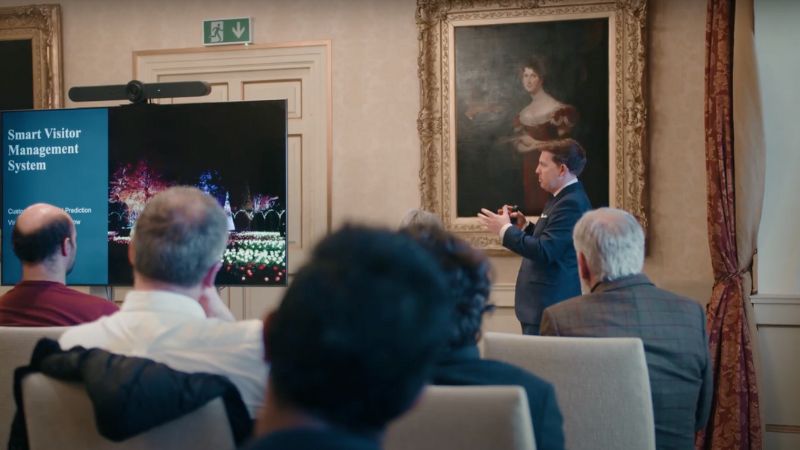
- Blenheim Palace visitors management system, led by Paul Jackson
- Input Output Research Hub (IORH) - Inclusive Open Finance Passport led by Tzameret Rubin in collaboration with University of Edinburgh

Humanities and Social Science
The integration of artificial intelligence in humanities, arts enhance the creative process, offering fresh perspectives and possibilities for both scholars and creators. Some of the work at Oxford Brookes University in humanities and social science domain includes:
- Interplay of AI and fine art, led by Paul Kilsby
- Challenging AI regulation, led by Kit Fotheringham

Health and Life Sciences
The fields of biology, biomechanics and nursing are also being transformed by AI by giving the tools to researchers to analyse intricate biological systems, optimise experimental designs, health related systems development and enhance predictive modelling for diverse applications. Specific projects that are underway at Oxford Brookes University in the domain of health and life sciences include:
- Creation of a digital system capable of prospective compliance monitoring and
auditing by extracting data directly from electronic patients record. - Shared databases and standardization in biomechanics led by Olga Barrera, Eleni Elia
- New material architectures designing tailored to fulfil specific functions, led by Olga Barrera, Fabio Cuzzolin
- Image processing and analysis to quantify architectural properties of multiphase materials such as: cells, tissues, porous media, battery electrodes, led by Olga Barrera

Engineering
In the rapidly evolving landscape of digital transformation, engineering harnesses the power of technology and data to solve complex problems, optimise designs, and create sustainable solutions. Leveraging artificial intelligence, engineers are advancing fields such as solid mechanics by enabling predictive modeling and failure analysis. At Oxford Brookes University, ongoing projects in the engineering domain explore these cutting-edge intersections of AI, sustainability, and digital innovation to deliver impactful solutions for the future. Some of the projects are:
- Fatigue and non-destructive evaluation (NDE), noise vibration and harshness, light weight vehicle structural analysis and analysis of adhesively bonded structures led by John Durodola
- Disassembly of complex multi-material parts and life cycle assessment to evaluate the environmental impacts and benefits, supporting sustainable practices across industries led by James Broughton and Marco Raugei
- A cloud-based infrastructure integrates computational power, data, and hybrid models to predict solar cell degradation and optimise load curves through smart control strategies and real-time interactions, led by Denise Morrey, Davide Sciortino, Paul Henshall and Shahaboddin Resalati

Computing
Computing leverages advancements in artificial intelligence, big data, and simulation to enhance efficiency, foster innovation, and address critical issues across various domains. Some of the projects that are underway at Oxford Brookes University in the domain of computing include:
- Autonomous vehicle perception and control systems, connected vehicle communications, smart city integration, ethical vehicles and transport strategy led by Andrew Bradley
- Epistemic AI is a new paradigm for a next-generation artificial intelligence providing worst-case guarantees on its predictions thanks to a proper modelling of real-world uncertainties. This project is led by Fabio Cuzzolin
- AI applications in health, theoretical applications of dynamic systems, reinforcement learning and developmental robotics led by Tjeerd Olde Scheper
- AI Assisted Integrated Circuit Verification technique to verify very large Systems-on-Chip (SoC) systems (20+ cores and over 2 billion transistors). This project is led by Abusaleh Jabir
- Foundational and practical problems of cloud computing and cybersecurity with research methodologies rooted in formal methods, software automation and a new method for testing AI applications. This project is led by Hong Zhu
- Defence and Security at Oxford Brookes University (DASOBU) is a leading centre of excellence for research, knowledge exchange and training in defence and security areas and comprises leading expertise in matters such as artificial intelligence, psychology and cyber security. The centre brings together government, industry and academia to analyse and tackle real world problems, including the cognitive domain and hybrid warfare threats such as cyber-attacks and circulation of disinformation in the public domain
- eHealth using artificial intelligence, with a strong focus on usability and data visualisation. There is particular interest in technology for people living with diabetes. This project is led by Rachel Harrison
Architecture and Built Environment
Main Research Projects
- YouthMove 15 - Youth-centric Mobility and Activity in the 15-minute City funded by EU Driving Urban Transitions Programme Co-Principal Investigator (XR Lead).
- Augmented Nature – Augmented Reality Prototype for Digital Greening Initiatives funded by EPSRC through Ecological Citizen(s) Network. Principal Investigator.
- ENACT 15mC – Envisioning Neighbourhoods and Co-Creating Thriving Communities in the Fifteen-minute City (01/12/2023 - 31/12/2026) funded by European Union (EU) Driving Urban Transitions (DUT) Partnership via UK Research and Innovation (UKRI). Co-Investigator (XR Lead).
- Framework for Co-creation of Inclusive Green Public Spaces using Augmented Reality. Oxford, UK. Funded by the British Council, supported by UCL in Collaboration with Anglia Ruskin University & Tu Dortmund. Principal Investigator.
PhDs
- Co-creating Equitable and Sustainable Urban Environments using Visualising Technologies (current).
- Developing a Digital Twin based platform to improve building operations and maintenance decision making by creating immersive 3D metaphors for real time IoT data using XR Techniques (current).
- AI enabled XR visualisation of Digital Twin to achieve Net Zero (current).
- What are the effects of Virtual Reality (VR) on clinical skills proficiency, specifically leadership and clinical decision-making, among final-year paramedic students in Oxfordshire? (current).